
Mindmap
CLA theories and theorists
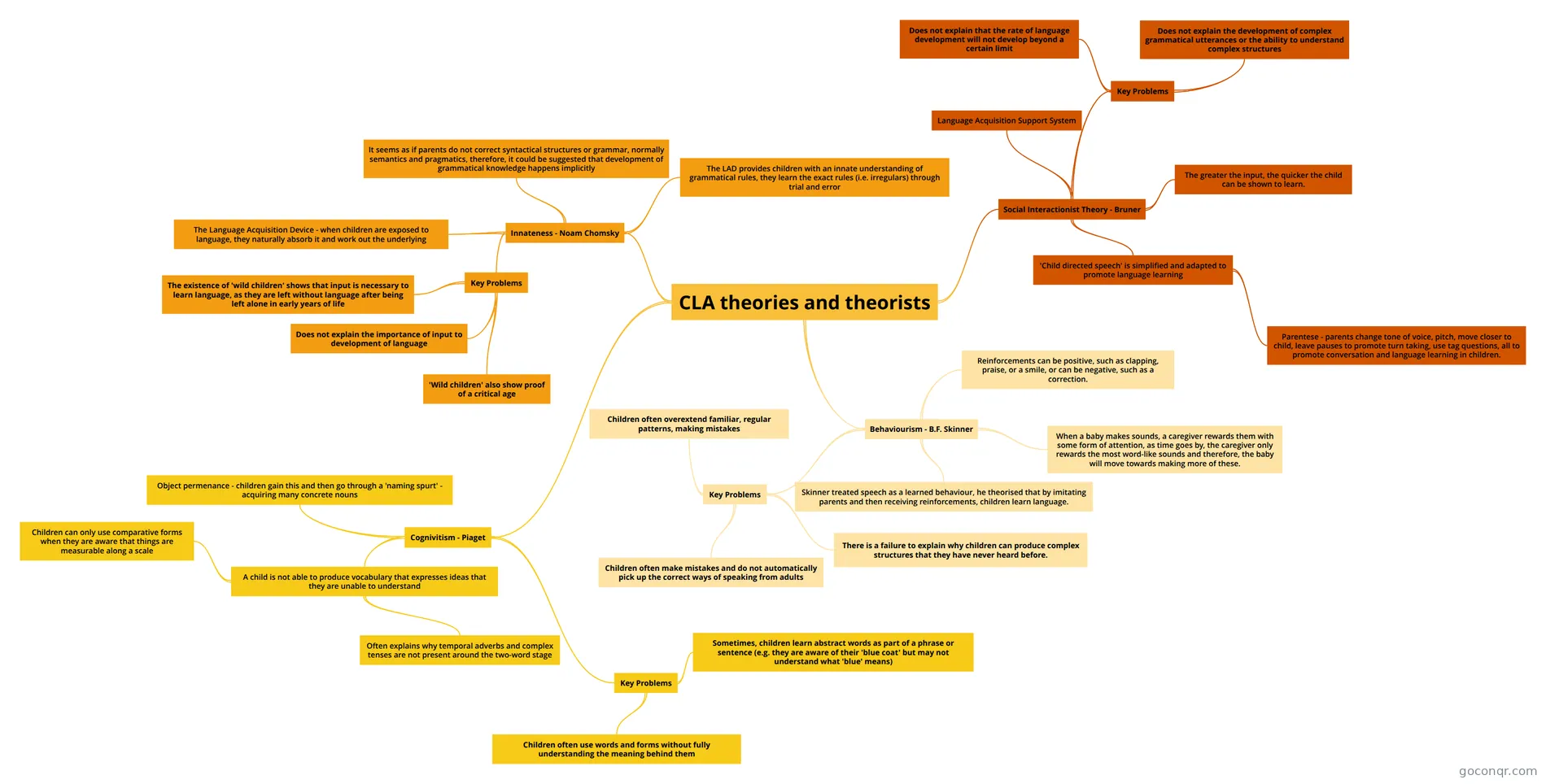
Mind map: CLA theories and theorists
Inhalt der Mindmap
CLA theories and theorists
Behaviourism - B.F. Skinner
- Skinner treated speech as a learned behaviour, he theorised that by imitating parents and then receiving reinforcements, children learn language.
- Reinforcements can be positive, such as clapping, praise, or a smile, or can be negative, such as a correction.
- When a baby makes sounds, a caregiver rewards them with some form of attention, as time goes by, the caregiver only rewards the most word-like sounds and therefore, the baby will move towards making more of these.
- Key Problems
- Children often make mistakes and do not automatically pick up the correct ways of speaking from adults
- Children often overextend familiar, regular patterns, making mistakes
- There is a failure to explain why children can produce complex structures that they have never heard before.
Innateness - Noam Chomsky
- The Language Acquisition Device - when children are exposed to language, they naturally absorb it and work out the underlying
- The LAD provides children with an innate understanding of grammatical rules, they learn the exact rules (i.e. irregulars) through trial and error
- It seems as if parents do not correct syntactical structures or grammar, normally semantics and pragmatics, therefore, it could be suggested that development of grammatical knowledge happens implicitly
- Key Problems
- Does not explain the importance of input to development of language
- The existence of 'wild children' shows that input is necessary to learn language, as they are left without language after being left alone in early years of life
- 'Wild children' also show proof of a critical age
Social Interactionist Theory - Bruner
- 'Child directed speech' is simplified and adapted to promote language learning
- Parentese - parents change tone of voice, pitch, move closer to child, leave pauses to promote turn taking, use tag questions, all to promote conversation and language learning in children.
- The greater the input, the quicker the child can be shown to learn.
- Language Acquisition Support System
- Key Problems
- Does not explain the development of complex grammatical utterances or the ability to understand complex structures
- Does not explain that the rate of language development will not develop beyond a certain limit
- 'Child directed speech' is simplified and adapted to promote language learning
Cognivitism - Piaget
- A child is not able to produce vocabulary that expresses ideas that they are unable to understand
- Often explains why temporal adverbs and complex tenses are not present around the two-word stage
- Children can only use comparative forms when they are aware that things are measurable along a scale
- Object permenance - children gain this and then go through a 'naming spurt' - acquiring many concrete nouns
- Key Problems
- Children often use words and forms without fully understanding the meaning behind them
- Sometimes, children learn abstract words as part of a phrase or sentence (e.g. they are aware of their 'blue coat' but may not understand what 'blue' means)
- A child is not able to produce vocabulary that expresses ideas that they are unable to understand
Informationen
- Beschreibung
- A level English Mindmap am CLA theories and theorists, erstellt von Florence Clarke am 20/06/2019.
- Erstellt von
- Florence Clarke
- Aufrufe
- 4
- Bewertung
Mehr zu Theories of First Language Acquisition