
Mindmap
Evolution
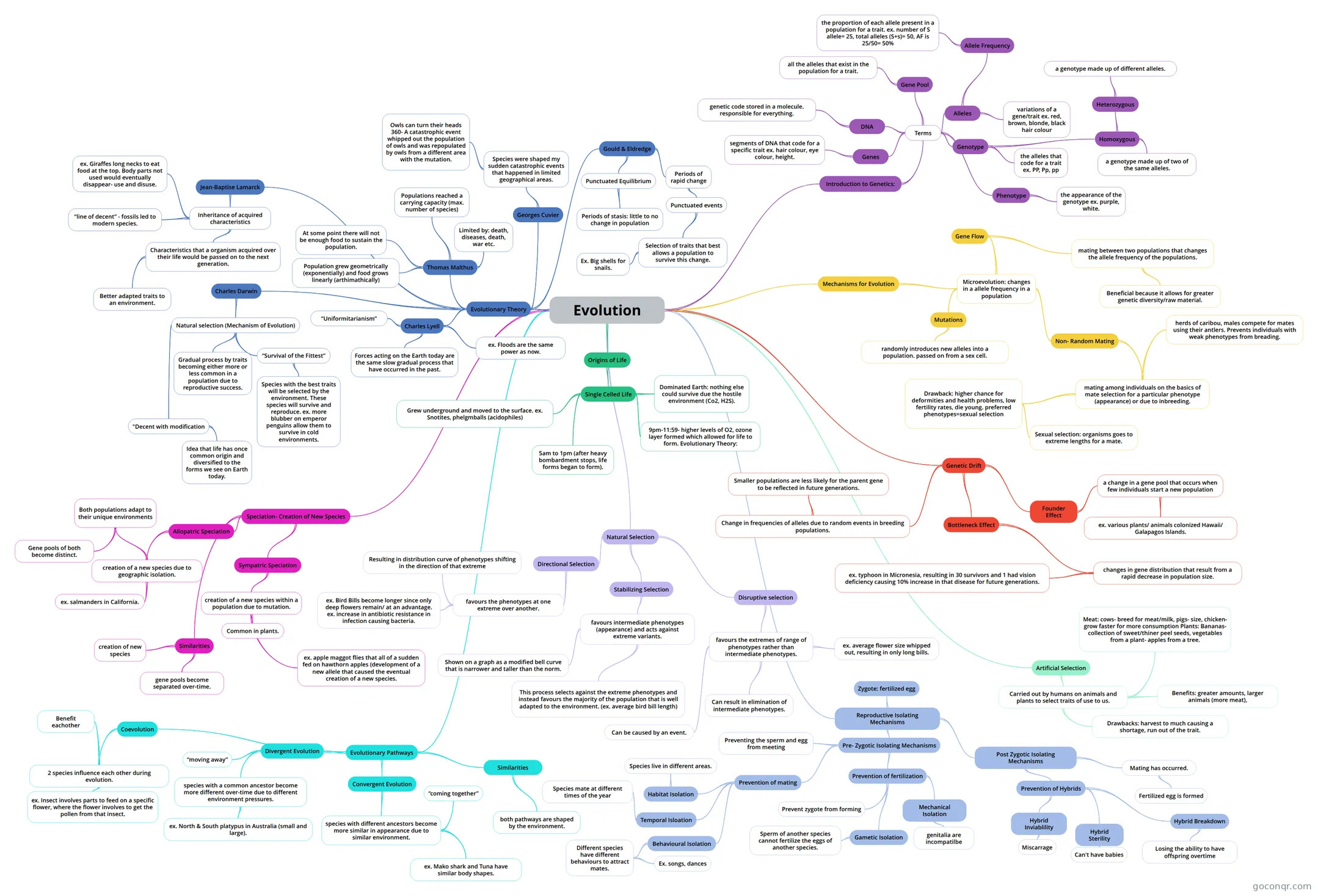
Mind map: Evolution
Inhalt der Mindmap
Evolution
Origins of Life
- Single Celled Life
- 5am to 1pm (after heavy bombardment stops, life forms began to form).
- Grew underground and moved to the surface. ex. Snotites, phelgmballs (acidophiles)
- Dominated Earth: nothing else could survive due the hostile environment (Co2, H2S).
- 9pm-11:59- higher levels of O2, ozone layer formed which allowed for life to form. Evolutionary Theory:
- Single Celled Life
Evolutionary Theory
- Charles Lyell
- Forces acting on the Earth today are the same slow gradual process that have occurred in the past.
- “Uniformitarianism”
- ex. Floods are the same power as now.
- Thomas Malthus
- Population grew geometrically (exponentially) and food grows linearly (arthimathically)
- At some point there will not be enough food to sustain the population.
- Populations reached a carrying capacity (max. number of species)
- Limited by: death, diseases, death, war etc.
- Charles Darwin
- Natural selection (Mechanism of Evolution)
- Gradual process by traits becoming either more or less common in a population due to reproductive success.
- “Survival of the Fittest”
- Species with the best traits will be selected by the environment. These species will survive and reproduce. ex. more blubber on emperor penguins allow them to survive in cold environments.
- "Decent with modification
- Idea that life has once common origin and diversified to the forms we see on Earth today.
- Natural selection (Mechanism of Evolution)
- Jean-Baptise Lamarck
- Inheritance of acquired characteristics
- Characteristics that a organism acquired over their life would be passed on to the next generation.
- Better adapted traits to an environment.
- “line of decent” - fossils led to modern species.
- ex. Giraffes long necks to eat food at the top. Body parts not used would eventually disappear- use and disuse.
- Characteristics that a organism acquired over their life would be passed on to the next generation.
- Inheritance of acquired characteristics
- Georges Cuvier
- Species were shaped my sudden catastrophic events that happened in limited geographical areas.
- Owls can turn their heads 360- A catastrophic event whipped out the population of owls and was repopulated by owls from a different area with the mutation.
- Species were shaped my sudden catastrophic events that happened in limited geographical areas.
- Gould & Eldredge
- Punctuated Equilibrium
- Periods of stasis: little to no change in population
- Periods of rapid change
- Punctuated events
- Selection of traits that best allows a population to survive this change.
- Ex. Big shells for snails.
- Selection of traits that best allows a population to survive this change.
- Punctuated events
- Punctuated Equilibrium
- Charles Lyell
Introduction to Genetics:
- Terms
- DNA
- genetic code stored in a molecule. responsible for everything.
- Genes
- segments of DNA that code for a specific trait ex. hair colour, eye colour, height.
- Alleles
- variations of a gene/trait ex. red, brown, blonde, black hair colour
- Allele Frequency
- the proportion of each allele present in a population for a trait. ex. number of S allele= 25, total alleles (S+s)= 50, AF is 25/50= 50%
- Genotype
- the alleles that code for a trait ex. PP, Pp, pp
- Homoxygous
- a genotype made up of two of the same alleles.
- Heterozygous
- a genotype made up of different alleles.
- Gene Pool
- all the alleles that exist in the population for a trait.
- Phenotype
- the appearance of the genotype ex. purple, white.
- DNA
- Terms
Mechanisms for Evolution
- Microevolution: changes in a allele frequency in a population
- Mutations
- randomly introduces new alleles into a population. passed on from a sex cell.
- Gene Flow
- mating between two populations that changes the allele frequency of the populations.
- Beneficial because it allows for greater genetic diversity/raw material.
- mating between two populations that changes the allele frequency of the populations.
- Non- Random Mating
- mating among individuals on the basics of mate selection for a particular phenotype (appearance) or due to inbreeding.
- herds of caribou, males compete for mates using their antlers. Prevents individuals with weak phenotypes from breading.
- Drawback: higher chance for deformities and health problems, low fertility rates, die young. preferred phenotypes=sexual selection
- Sexual selection: organisms goes to extreme lengths for a mate.
- mating among individuals on the basics of mate selection for a particular phenotype (appearance) or due to inbreeding.
- Mutations
- Microevolution: changes in a allele frequency in a population
Genetic Drift
- Change in frequencies of alleles due to random events in breeding populations.
- Smaller populations are less likely for the parent gene to be reflected in future generations.
- Founder Effect
- a change in a gene pool that occurs when few individuals start a new population
- ex. various plants/ animals colonized Hawaii/ Galapagos Islands.
- a change in a gene pool that occurs when few individuals start a new population
- Bottleneck Effect
- changes in gene distribution that result from a rapid decrease in population size.
- ex. typhoon in Micronesia, resulting in 30 survivors and 1 had vision deficiency causing 10% increase in that disease for future generations.
- changes in gene distribution that result from a rapid decrease in population size.
- Change in frequencies of alleles due to random events in breeding populations.
Natural Selection
- Stabilizing Selection
- favours intermediate phenotypes (appearance) and acts against extreme variants.
- This process selects against the extreme phenotypes and instead favours the majority of the population that is well adapted to the environment. (ex. average bird bill length)
- Shown on a graph as a modified bell curve that is narrower and taller than the norm.
- favours intermediate phenotypes (appearance) and acts against extreme variants.
- Directional Selection
- favours the phenotypes at one extreme over another.
- Resulting in distribution curve of phenotypes shifting in the direction of that extreme
- ex. Bird Bills become longer since only deep flowers remain/ at an advantage. ex. increase in antibiotic resistance in infection causing bacteria.
- favours the phenotypes at one extreme over another.
- Disruptive selection
- favours the extremes of range of phenotypes rather than intermediate phenotypes.
- Can result in elimination of intermediate phenotypes.
- Can be caused by an event.
- ex. average flower size whipped out, resulting in only long bills.
- favours the extremes of range of phenotypes rather than intermediate phenotypes.
- Stabilizing Selection
Artificial Selection
- Carried out by humans on animals and plants to select traits of use to us.
- Meat: cows- breed for meat/milk, pigs- size, chicken- grow faster for more consumption Plants: Bananas- collection of sweet/thiner peel seeds, vegetables from a plant- apples from a tree.
- Benefits: greater amounts, larger animals (more meat),
- Drawbacks: harvest to much causing a shortage, run out of the trait.
- Carried out by humans on animals and plants to select traits of use to us.
Speciation- Creation of New Species
- Sympatric Speciation
- creation of a new species within a population due to mutation.
- Common in plants.
- ex. apple maggot flies that all of a sudden fed on hawthorn apples (development of a new allele that caused the eventual creation of a new species.
- creation of a new species within a population due to mutation.
- Allopatric Speciation
- creation of a new species due to geographic isolation.
- Both populations adapt to their unique environments
- Gene pools of both become distinct.
- ex. salmanders in California.
- Both populations adapt to their unique environments
- creation of a new species due to geographic isolation.
- Similarities
- creation of new species
- gene pools become separated over-time.
- Sympatric Speciation
Evolutionary Pathways
- Convergent Evolution
- species with different ancestors become more similar in appearance due to similar environment.
- “coming together”
- ex. Mako shark and Tuna have similar body shapes.
- species with different ancestors become more similar in appearance due to similar environment.
- Divergent Evolution
- species with a common ancestor become more different over-time due to different environment pressures.
- ex. North & South platypus in Australia (small and large).
- “moving away”
- species with a common ancestor become more different over-time due to different environment pressures.
- Similarities
- both pathways are shaped by the environment.
- Coevolution
- 2 species influence each other during evolution.
- Benefit eachother
- ex. Insect involves parts to feed on a specific flower, where the flower involves to get the pollen from that insect.
- 2 species influence each other during evolution.
- Convergent Evolution
Reproductive Isolating Mechanisms
- Post Zygotic Isolating Mechanisms
- Mating has occurred.
- Fertilized egg is formed
- Prevention of Hybrids
- Hybrid Breakdown
- Losing the ability to have offspring overtime
- Hybrid Sterility
- Can't have babies
- Hybrid Inviablility
- Miscarrage
- Hybrid Breakdown
- Mating has occurred.
- Pre- Zygotic Isolating Mechanisms
- Preventing the sperm and egg from meeting
- Prevention of mating
- Behavioural Isolation
- Different species have different behaviours to attract mates.
- Ex. songs, dances
- Different species have different behaviours to attract mates.
- Temporal Isloation
- Species mate at different times of the year
- Habitat Isolation
- Species live in different areas.
- Behavioural Isolation
- Prevention of fertilization
- Prevent zygote from forming
- Mechanical Isolation
- genitalia are incompatilbe
- Gametic Isolation
- Sperm of another species cannot fertilize the eggs of another species.
- Zygote: fertilized egg
- Post Zygotic Isolating Mechanisms
Informationen
- Beschreibung
- Mindmap am Evolution, erstellt von nicolem am 11/02/2015.
- Erstellt von
- nicolem
- Aufrufe
- 1
- Bewertung