
Mindmap
Biological Membranes
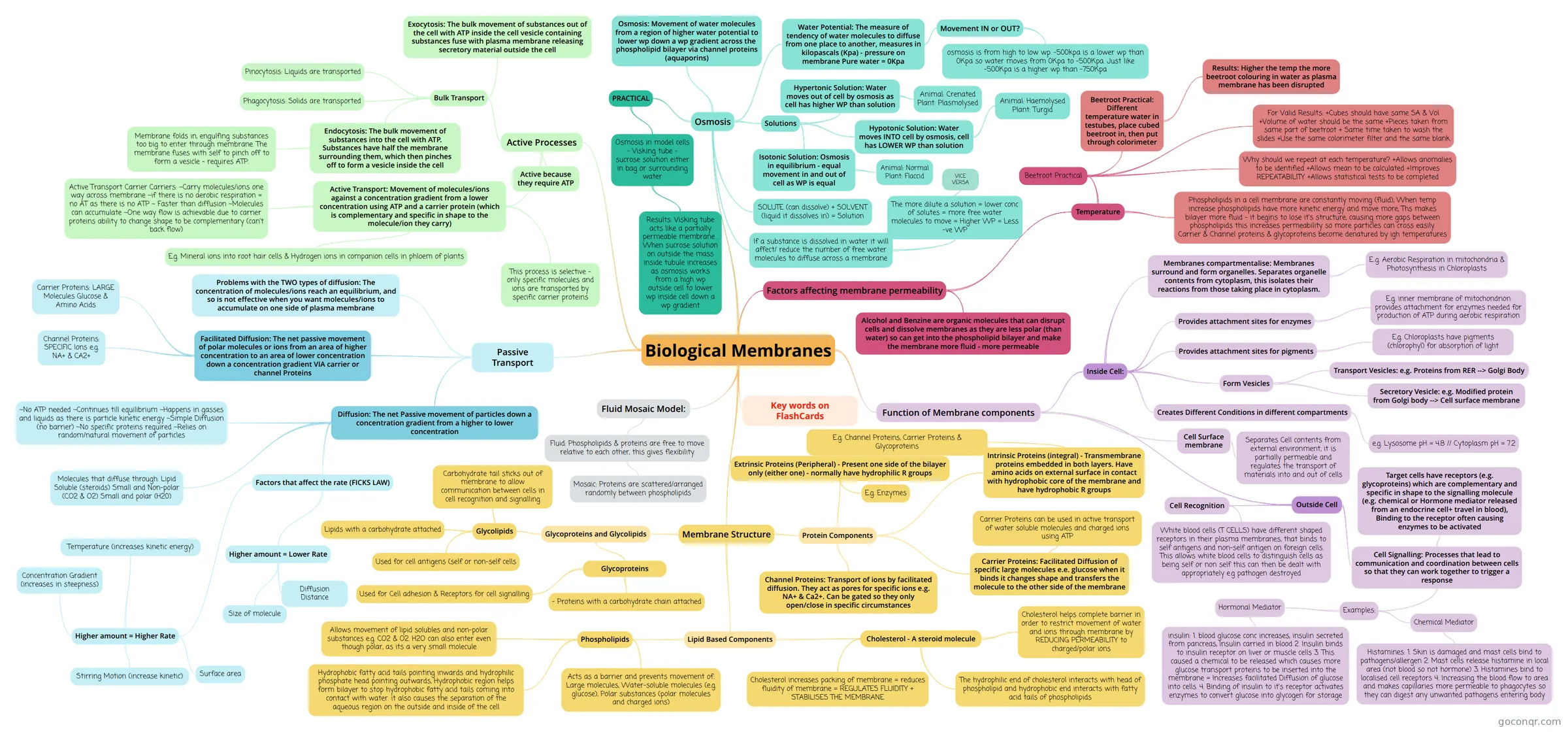
Mind map: Biological membranes
Inhalt der Mindmap
Biological Membranes
Fluid Mosaic Model:
- Fluid: Phospholipids & proteins are free to move relative to each other, this gives flexibility
- Mosaic: Proteins are scattered/arranged randomly between phospholipids
- Fluid: Phospholipids & proteins are free to move relative to each other, this gives flexibility
Membrane Structure
- Lipid Based Components
- Phospholipids
- Hydrophobic fatty acid tails pointing inwards and hydrophilic phosphate head pointing outwards, Hydrophobic region helps form bilayer to stop hydrophobic fatty acid tails coming into contact with water. it also causes the separation of the aqueous region on the outside and inside of the cell
- Allows movement of lipid solubles and non-polar substances e.g. CO2 & O2. H2O can also enter even though polar, as its a very small molecule
- Acts as a barrier and prevents movement of: Large molecules, Water-soluble molecules (e.g. glucose), Polar substances (polar molecules and charged ions)
- Cholesterol - A steroid molecule
- The hydrophilic end of cholesterol interacts with head of phospholipid and hydrophobic end interacts with fatty acid tails of phospholipids
- Cholesterol increases packing of membrane = reduces fluidity of membrane = REGULATES FLUIDITY + STABILISES THE MEMBRANE
- Cholesterol helps complete barrier in order to restrict movement of water and ions through membrane by REDUCING PERMEABILITY to charged/polar ions
- Phospholipids
- Protein Components
- Intrinsic Proteins (integral) - Transmembrane proteins embedded in both layers. Have amino acids on external surface in contact with hydrophobic core of the membrane and have hydrophobic R groups
- E.g. Channel Proteins, Carrier Proteins & Glycoproteins
- Extrinsic Proteins (Peripheral) - Present one side of the bilayer only (either one) - normally have hydrophilic R groups
- E.g. Enzymes
- Channel Proteins: Transport of ions by facilitated diffusion. They act as pores for specific ions e.g. NA+ & Ca2+. Can be gated so they only open/close in specific circumstances
- Carrier Proteins: Facilitated Diffusion of specific large molecules e.e. glucose when it binds it changes shape and transfers the molecule to the other side of the membrane
- Carrier Proteins can be used in active transport of water soluble molecules and charged ions using ATP
- Intrinsic Proteins (integral) - Transmembrane proteins embedded in both layers. Have amino acids on external surface in contact with hydrophobic core of the membrane and have hydrophobic R groups
- Glycoproteins and Glycolipids
- Glycoproteins
- - Proteins with a carbohydrate chain attached
- Used for Cell adhesion & Receptors for cell signalling
- Glycolipids
- Lipids with a carbohydrate attached
- Used for cell antigens (self or non-self cells
- Carbohydrate tail sticks out of membrane to allow communication between cells in cell recognition and signalling
- Glycoproteins
- Lipid Based Components
Function of Membrane components
- Cell Surface membrane
- Separates Cell contents from external environment, it is partially permeable and regulates the transport of materials into and out of cells
- Outside Cell
- Cell Signalling: Processes that lead to communication and coordination between cells so that they can work together to trigger a response
- Target cells have receptors (e.g. glycoproteins) which are complementary and specific in shape to the signalling molecule (e.g. chemical or Hormone mediator released from an endocrine cell+ travel in blood), Binding to the receptor often causing enzymes to be activated
- Examples:
- Chemical Mediator
- Histamines: 1. Skin is damaged and mast cells bind to pathogens/allergen 2. Mast cells release histamine in local area (not blood so not hormone) 3. Histamines bind to localised cell receptors 4. Increasing the blood flow to area and makes capillaries more permeable to phagocytes so they can digest any unwanted pathogens entering body
- Hormonal Mediator
- insulin: 1. blood glucose conc increases, insulin secreted from pancreas, Insulin carried in blood 2. Insulin binds to insulin receptor on liver or muscle cells 3. This caused a chemical to be released which causes more glucose transport proteins to be inserted into the membrane = Increases facilitated Diffusion of glucose into cells. 4. Binding of insulin to it's receptor activates enzymes to convert glucose into glycogen for storage
- Chemical Mediator
- Cell Recognition
- White blood cells (T CELLS) have different shaped receptors in their plasma membranes, that binds to self antigens and non-self antigen on foreign cells. This allows white blood cells to distinguish cells as being self or non self this can then be dealt with appropriately e.g pathogen destroyed
- Cell Signalling: Processes that lead to communication and coordination between cells so that they can work together to trigger a response
- Inside Cell:
- Membranes compartmentalise: Membranes surround and form organelles. Separates organelle contents from cytoplasm, this isolates their reactions from those taking place in cytoplasm.
- E..g. Aerobic Respiration in mitochondria & Photosynthesis in Chloroplasts
- Provides attachment sites for enzymes
- E.g. inner membrane of mitochondrion provides attachment for enzymes needed for production of ATP during aerobic respiration
- Provides attachment sites for pigments
- E.g. Chloroplasts have pigments (chlorophyl) for absorption of light
- Form Vesicles
- Transport Vesicles: e.g. Proteins from RER --> Golgi Body
- Secretory Vesicle: e.g. Modified protein from Golgi body --> Cell surface membrane
- Creates Different Conditions in different compartments
- e.g. Lysosome pH = 4.8 // Cytoplasm pH = 7.2
- Membranes compartmentalise: Membranes surround and form organelles. Separates organelle contents from cytoplasm, this isolates their reactions from those taking place in cytoplasm.
- Cell Surface membrane
Passive Transport
- Diffusion: The net Passive movement of particles down a concentration gradient from a higher to lower concentration
- ~No ATP needed ~Continues till equilibrium ~Happens in gasses and liquids as there is particle kinetic energy ~Simple Diffusion (no barrier) ~No specific proteins required ~Relies on random/natural movement of particles
- Molecules that diffuse through: Lipid Soluble (steroids) Small and Non-polar (CO2 & O2) Small and polar (H20)
- Factors that affect the rate (FICKS LAW)
- Higher amount = Higher Rate
- Temperature (increases kinetic energy)
- Concentration Gradient (increases in steepness)
- Stirring Motion (increase kinetic)
- Surface area
- Higher amount = Lower Rate
- Size of molecule
- Diffusion Distance
- Higher amount = Higher Rate
- Facilitated Diffusion: The net passive movement of polar molecules or ions from an area of higher concentration to an area of lower concentration down a concentration gradient VIA carrier or channel Proteins
- Carrier Proteins: LARGE Molecules Glucose & Amino Acids
- Channel Proteins: SPECIFIC Ions e.g. NA+ & CA2+
- Problems with the TWO types of diffusion: The concentration of molecules/ions reach an equilibrium, and so is not effective when you want molecules/ions to accumulate on one side of plasma membrane
- Diffusion: The net Passive movement of particles down a concentration gradient from a higher to lower concentration
Active Processes
- Active Transport: Movement of molecules/ions against a concentration gradient from a lower concentration using ATP and a carrier protein (which is complementary and specific in shape to the molecule/ion they carry)
- This process is selective - only specific molecules and ions are transported by specific carrier proteins
- Active Transport Carrier Carriers: ~Carry molecules/ions one way across membrane ~if there is no aerobic respiration = no AT as there is no ATP ~ Faster than diffusion ~Molecules can accumulate ~One way flow is achievable due to carrier proteins ability to change shape to be complementary (can't back flow)
- E.g. Mineral ions into root hair cells & Hydrogen ions in companion cells in phloem of plants
- Active because they require ATP
- Bulk Transport
- Endocytosis: The bulk movement of substances into the cell with ATP. Substances have half the membrane surrounding them, which then pinches off to form a vesicle inside the cell
- Membrane folds in, engulfing substances too big to enter through membrane. The membrane fuses with self to pinch off to form a vesicle - requires ATP.
- Phagocytosis: Solids are transported
- Pinocytosis: Liquids are transported
- Exocytosis: The bulk movement of substances out of the cell with ATP inside the cell vesicle containing substances fuse with plasma membrane releasing secretory material outside the cell
- Endocytosis: The bulk movement of substances into the cell with ATP. Substances have half the membrane surrounding them, which then pinches off to form a vesicle inside the cell
- Active Transport: Movement of molecules/ions against a concentration gradient from a lower concentration using ATP and a carrier protein (which is complementary and specific in shape to the molecule/ion they carry)
Osmosis
- Osmosis: Movement of water molecules from a region of higher water potential to lower wp down a wp gradient across the phospholipid bilayer via channel proteins (aquaporins)
- If a substance is dissolved in water it will affect/ reduce the number of free water molecules to diffuse across a membrane
- The more dilute a solution = lower conc of solutes = more free water molecules to move = Higher WP = Less -ve WP
- VICE VERSA
- The more dilute a solution = lower conc of solutes = more free water molecules to move = Higher WP = Less -ve WP
- SOLUTE (can dissolve) + SOLVENT (liquid it dissolves in) = Solution
- Water Potential: The measure of tendency of water molecules to diffuse from one place to another, measures in kilopascals (Kpa) - pressure on membrane Pure water = 0Kpa
- Movement IN or OUT?
- osmosis is from high to low wp. -500kpa is a lower wp than 0Kpa so water moves from 0Kpa to -500Kpa. Just like -500Kpa is a higher wp than -750Kpa
- Movement IN or OUT?
- PRACTICAL
- Osmosis in model cells - Visking tube - sucrose solution either in bag or surrounding water
- Results: Visking tube acts like a partially permeable membrane . When sucrose solution on outside the mass inside tubule increases as osmosis works from a high wp outside cell to lower wp inside cell down a wp gradient
- Osmosis in model cells - Visking tube - sucrose solution either in bag or surrounding water
- Solutions
- Isotonic Solution: Osmosis in equilibrium - equal movement in and out of cell as WP is equal
- Animal: Normal Plant: Flaccid
- Hypotonic Solution: Water moves INTO cell by osmosis, cell has LOWER WP than solution
- Animal: Haemolysed Plant: Turgid
- Hypertonic Solution: Water moves out of cell by osmosis as cell has higher WP than solution
- Animal: Crenated Plant: Plasmolysed
- Isotonic Solution: Osmosis in equilibrium - equal movement in and out of cell as WP is equal
Factors affecting membrane permeability
- Temperature
- Phospholipids in a cell membrane are constantly moving (fluid), When temp increase phospholipids have more kinetic energy and move more, Ths makes bilayer more fluid - it begins to lose it's structure, causing more gaps between phospholipids this increases permeability so more particles can cross easily. Carrier & Channel proteins & glycoproteins become denatured by igh temperatures
- Beetroot Practical
- Beetroot Practical: Different temperature water in testubes, place cubed beetroot in, then put through colorimeter
- Results: Higher the temp the more beetroot colouring in water as plasma membrane has been disrupted
- For Valid Results: +Cubes should have same SA & Vol +Volume of water should be the same +Pieces taken from same part of beetroot + Same time taken to wash the slides +Use the same colorimeter filter and the same blank
- Why should we repeat at each temperature? +Allows anomalies to be identified +Allows mean to be calculated +Improves REPEATABILITY +Allows statistical tests to be completed
- Beetroot Practical: Different temperature water in testubes, place cubed beetroot in, then put through colorimeter
- Alcohol and Benzine are organic molecules that can disrupt cells and dissolve membranes as they are less polar (than water) so can get into the phospholipid bilayer and make the membrane more fluid - more permeable
- Temperature
Key words on FlashCards
Informationen
- Beschreibung
- A level Biology (Module 2) Mindmap am Biological Membranes, erstellt von Amy Cornwell am 18/02/2020.
- Erstellt von
- Amy Cornwell
- Aufrufe
- 0
- Bewertung