
Mindmap
P-values, Generalisability, Study Limits
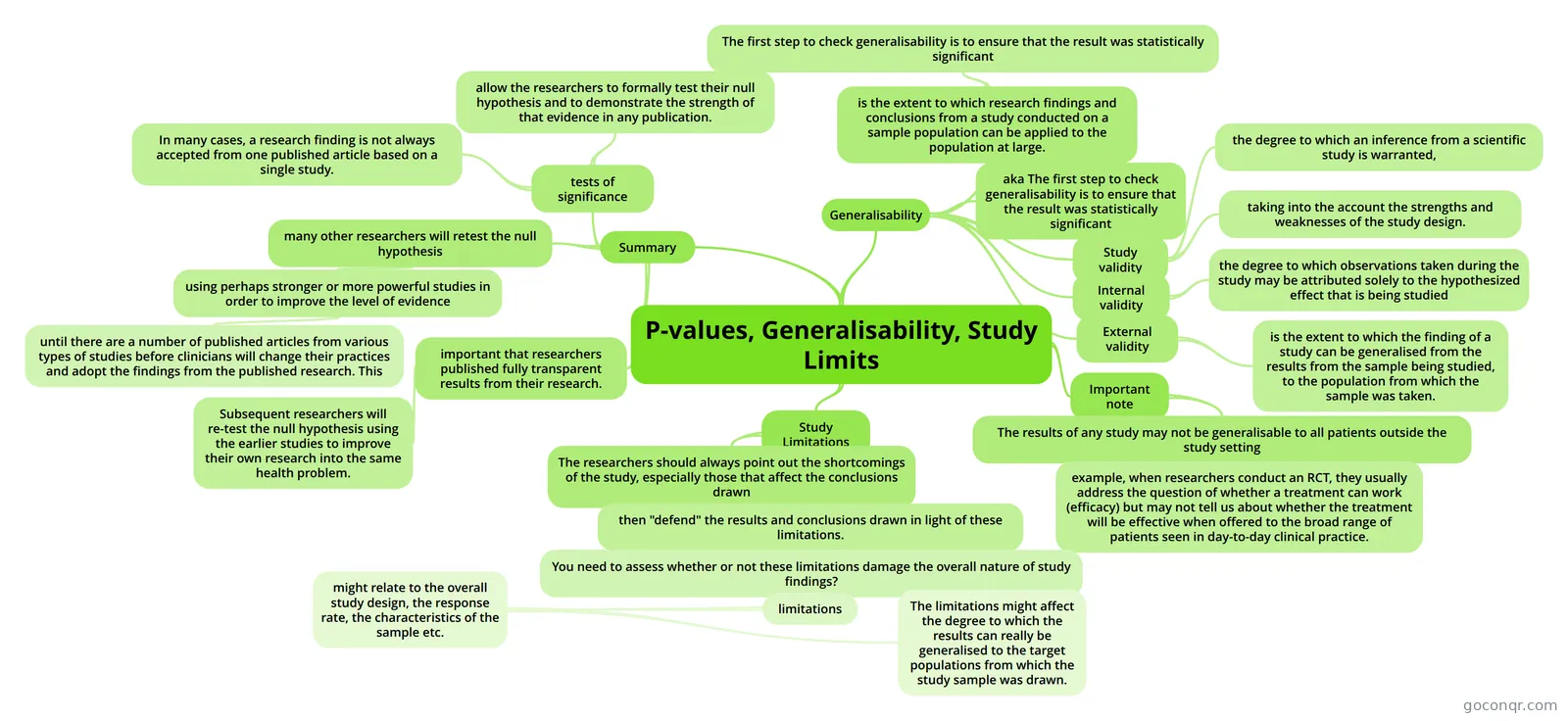
Mind map: p-values, generalisability and study limits
Inhalt der Mindmap
P-values, Generalisability, Study Limits
Summary
- tests of significance
- allow the researchers to formally test their null hypothesis and to demonstrate the strength of that evidence in any publication.
- In many cases, a research finding is not always accepted from one published article based on a single study.
- many other researchers will retest the null hypothesis
- using perhaps stronger or more powerful studies in order to improve the level of evidence
- until there are a number of published articles from various types of studies before clinicians will change their practices and adopt the findings from the published research. This
- using perhaps stronger or more powerful studies in order to improve the level of evidence
- important that researchers published fully transparent results from their research.
- Subsequent researchers will re-test the null hypothesis using the earlier studies to improve their own research into the same health problem.
- tests of significance
Generalisability
- is the extent to which research findings and conclusions from a study conducted on a sample population can be applied to the population at large.
- The first step to check generalisability is to ensure that the result was statistically significant
- aka The first step to check generalisability is to ensure that the result was statistically significant
- Study validity
- the degree to which an inference from a scientific study is warranted,
- taking into the account the strengths and weaknesses of the study design.
- Internal validity
- the degree to which observations taken during the study may be attributed solely to the hypothesized effect that is being studied
- External validity
- is the extent to which the finding of a study can be generalised from the results from the sample being studied, to the population from which the sample was taken.
- is the extent to which research findings and conclusions from a study conducted on a sample population can be applied to the population at large.
Important note
- The results of any study may not be generalisable to all patients outside the study setting
- example, when researchers conduct an RCT, they usually address the question of whether a treatment can work (efficacy) but may not tell us about whether the treatment will be effective when offered to the broad range of patients seen in day-to-day clinical practice.
- The results of any study may not be generalisable to all patients outside the study setting
Study Limitations
- The researchers should always point out the shortcomings of the study, especially those that affect the conclusions drawn
- then "defend" the results and conclusions drawn in light of these limitations.
- You need to assess whether or not these limitations damage the overall nature of study findings?
- limitations
- might relate to the overall study design, the response rate, the characteristics of the sample etc.
- The limitations might affect the degree to which the results can really be generalised to the target populations from which the study sample was drawn.
- might relate to the overall study design, the response rate, the characteristics of the sample etc.
- limitations
- You need to assess whether or not these limitations damage the overall nature of study findings?
- then "defend" the results and conclusions drawn in light of these limitations.
- The researchers should always point out the shortcomings of the study, especially those that affect the conclusions drawn
Informationen
- Beschreibung
- HBS108 (Topic 8.4 Statistical inference and hypothesis testing: Conf) Mindmap am P-values, Generalisability, Study Limits, erstellt von shirley.ha am 16/09/2013.
- Erstellt von
- shirley.ha
- Aufrufe
- 122
- Tags
- Bewertung