
Mindmap
10.4 Evidence for evolution
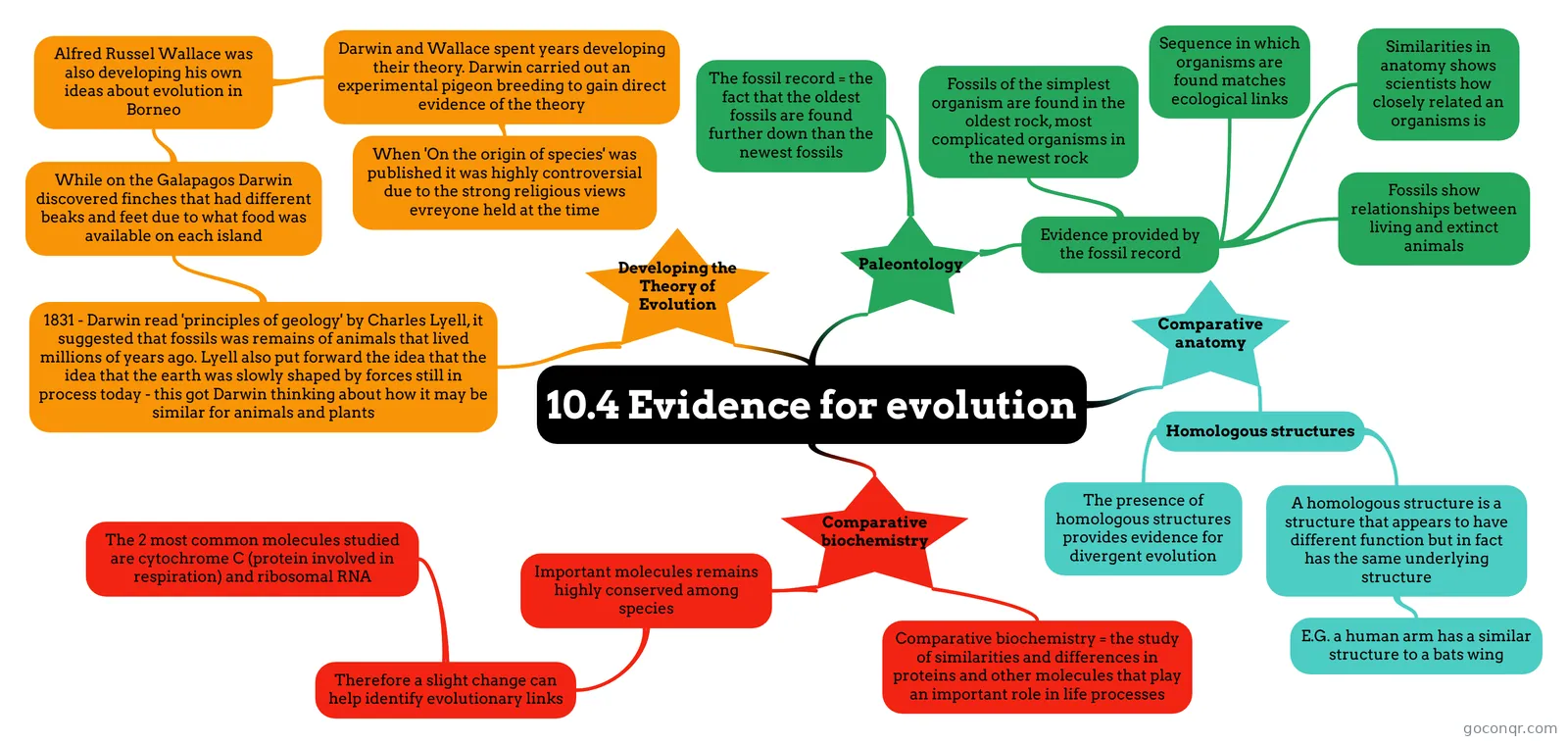
Mind map: Evidence for evolution
Inhalt der Mindmap
10.4 Evidence for evolution
Developing the Theory of Evolution
- 1831 - Darwin read 'principles of geology' by Charles Lyell, it suggested that fossils was remains of animals that lived millions of years ago. Lyell also put forward the idea that the idea that the earth was slowly shaped by forces still in process today - this got Darwin thinking about how it may be similar for animals and plants
- While on the Galapagos Darwin discovered finches that had different beaks and feet due to what food was available on each island
- Alfred Russel Wallace was also developing his own ideas about evolution in Borneo
- Darwin and Wallace spent years developing their theory. Darwin carried out an experimental pigeon breeding to gain direct evidence of the theory
- When 'On the origin of species' was published it was highly controversial due to the strong religious views evreyone held at the time
- Darwin and Wallace spent years developing their theory. Darwin carried out an experimental pigeon breeding to gain direct evidence of the theory
- Alfred Russel Wallace was also developing his own ideas about evolution in Borneo
- While on the Galapagos Darwin discovered finches that had different beaks and feet due to what food was available on each island
- 1831 - Darwin read 'principles of geology' by Charles Lyell, it suggested that fossils was remains of animals that lived millions of years ago. Lyell also put forward the idea that the idea that the earth was slowly shaped by forces still in process today - this got Darwin thinking about how it may be similar for animals and plants
Paleontology
- The fossil record = the fact that the oldest fossils are found further down than the newest fossils
- Evidence provided by the fossil record
- Fossils of the simplest organism are found in the oldest rock, most complicated organisms in the newest rock
- Sequence in which organisms are found matches ecological links
- Similarities in anatomy shows scientists how closely related an organisms is
- Fossils show relationships between living and extinct animals
Comparative anatomy
- Homologous structures
- A homologous structure is a structure that appears to have different function but in fact has the same underlying structure
- E.G. a human arm has a similar structure to a bats wing
- The presence of homologous structures provides evidence for divergent evolution
- A homologous structure is a structure that appears to have different function but in fact has the same underlying structure
- Homologous structures
Comparative biochemistry
- Comparative biochemistry = the study of similarities and differences in proteins and other molecules that play an important role in life processes
- Important molecules remains highly conserved among species
- Therefore a slight change can help identify evolutionary links
- The 2 most common molecules studied are cytochrome C (protein involved in respiration) and ribosomal RNA
- Therefore a slight change can help identify evolutionary links
Informationen
- Beschreibung
- Biology Mindmap am 10.4 Evidence for evolution, erstellt von Harry Lovegrove am 03/06/2020.
- Erstellt von
- Harry Lovegrove
- Aufrufe
- 1
- Verlauf
-
- Erstellt von Joe Hitchings · 31 Mai 2020
- Kopiert von Harry Lovegrove · 3 Jun 2020
- Bewertung
Mehr zu Evidence for Evolution