
Mindmap
BIO 150
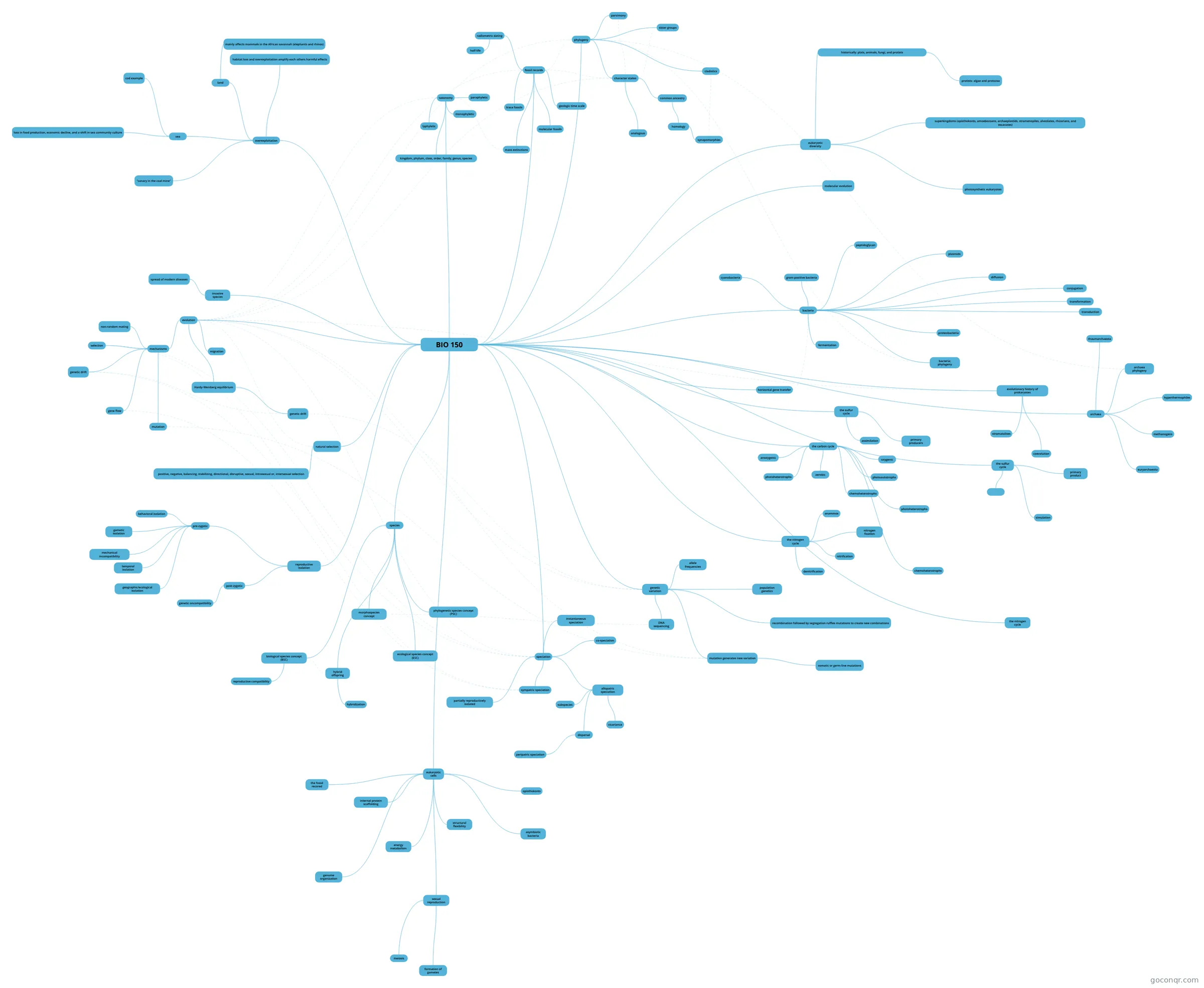
Mind map: Evolution and biodiversity
Inhalt der Mindmap
BIO 150
overexploitation
- sea
- cod example
- loss in food production, economic decline, and a shift in sea community culture
- land
- mainly affects mammals in the African savannah (elephants and rhinos)
- habitat loss and overexploitation amplify each others harmful effects
- "canary in the coal mine"
- an indicator of how bad overexploitation has got and that we need to stop
- sea
invasive species
- spread of modern diseases
eukaryotic diversity
- superkingdoms (opisthokonts, amoebozoans, archaeplastids, stramenopiles, alveolates, rhizarians, and excavates)
- historically: plats, animals, fungi, and protists
- protists: algae and protozoa
- photosynthetic eukaryotes
genetic variation
- 2 sources a factor in evolution
- population genetics
- mutation generates new variation
- source 2 mutation leads to evolution
- somatic or germ-line mutations
- can be classified by their effects on an organism neutral: little or no effects (most mutations are natural) deleterious: harmful advantageous: this rarely happens; they improve their carriers' chances of survival or reproduction (can increase the frequency in a population until eventually they are carried by every member of a species)
- recombination followed by segregation ruffles mutations to create new combinations
- source 1
- allele frequencies
- the number of x's present in the population divided by the total number of alleles the proportion, among all the alleles of a gene in a population, that consists of a specified allele
- DNA sequencing
- the gold standard for measuring genetic variation
evolution
- a change in the genetic makeup of a population over time POPULATIONS EVOLVE, NOT INDIVIDUALS
- Hardy-Weniberg equilibrium
- the situation in which evolution doesn't occur evolution is NOT occurring 5 conditions: 1. there is no difference in the survival and reproductive successs of individuals 2. the population is sufficiently large to prevent sampling errors 3. populations are not added to or subtracted from by migration 4. there is no mutation 5. individuals mate at random
- genetic drift
- a method of evolution
- migration
- mechanisms
- selection
- genetic drift
- gene flow
- non-random mating
- mutation
natural selection
- a "method" of evolution
- positive, negative, balancing, stabilizing, directional, disruptive, sexual, intrasexual or, intersexual selection
molecular evolution
species
- biological species concept (BSC)
- Ernst Mayr: "species are groups of actually or potentially interbreeding populations that are reproductively isolated from other such groups" does not apply to asexual reproduction or extinct organisms
- reproductive compatibility
- morphospecies concept
- members of the same species look alike rule of thumb concept can also be seen in DNA sequences
- hybrid offspring
- occurs when closely related species interbreed complicates the BSC
- hybridization
- ecological species concept (ESC)
- there is a one-to-one correspondence between a species and its niche
- phylogenetic species concept (PSC)
- emphasizes that members of a species all share a common ancestry and a common fate requires all members of a species be descended from a single common ancestor
- biological species concept (BSC)
reproductive isolation
- pre-zygotic
- act before the fertilization of an egg prevent fertilization from taking place
- behavioral isolation
- individuals mate only with other individuals based on specific courtship rituals
- gametic isolation
- incompatibilities between the gametes of two different species
- mechanical incompatibility
- body is configured in some way that they fit only with a certain sex and type of species
- temporal isolation
- isolated in time
- geographic/ecological isolation
- isolated in space
- post-zygotic
- come into play after fertilization result in the failure of the fertilized egg to develop into a fertile individual
- genetic oncompatibility
- pre-zygotic
speciation
- the development of reproductive isolation between populations fundamental evolutionary process of genetic divergence between genetically separated populations are subject to genetic drift or natural selection (or both)
- partially reproductively isolated
- not truly separate species, but the genetic differences between them are extensive enough that the hybrid offspring they produce have reduced fertility or viability compared to offspring produced by crosses between individuals within each population
- allopatric speciation
- populations are geographically separated from each other
- subspecies
- dispersal
- some individuals colonize a distance place
- peripatric speciation
- in a peripheral space
- vicariance
- a geographic barrier arises within a single population, separating it into two or more isolated populations
- co-speciation
- a process in which two groups of organisms speciate in response to each other and at the same time
- sympatric speciation
- same geographic location natural selection must act strongly to counteract the homogenizing effect of gene flow
- instantaneous speciation
phylogeny
- provide hypotheses of evolutionary relationships
- sister groups
- groups that are closer to each other than any other group
- character states
- helpful in determining gevolutinoary relationships
- common ancestry
- homology
- synapomorphies
- homology
- analogous
- cladistics
- building a phylogenetic tree on the basis of synapomorphies
- parsimony
- the simplest form of a phylogenetic tree, aka the one with the fewest number of character changes
taxonomy
- helps to show evolutionary relationships
- monophyletic
- paraphyletic
- lyphyletic
- kingdom, phylum, class, order, family, genus, species
fossil records
- can help provide evidence for phylogenetic hypotheses contain unique combinations of characters
- trace fossils
- molecular fossils
- geologic time scale
- radiometric dating
- half-life
- mass extinctions
- eliminated ecologically important tara, thereby providing evolutionary opportunities for the survivors
bacteria
- plasmids
- peptidoglycan
- cell wall that gives structural support
- diffusion
- explains why bacterial cells tend to be small
- conjugation
- transformation
- transduction
- fermentation
- bacteria; phylogeny
- proteobacteria
- gram-positive bacteria
- cyanobacteria
horizontal gene transfer
- major source of genetic diversity in bacteria genes pass from parent to offspring bacteria inherit most of their genes from parental cells
archaea
- archaea phylogeny
- hyperthermophiles
- methanogens
- euryarchaeota
- thaumarchaeota
the carbon cycle
- oxygenic
- aerobic
- anoxygenic
- photoautotrophs
- plants, algae, and cyanobacteria
- plants, algae, and cyanobacteria
- chemoheterotrophs
- animals, fungi, and many prokaryotes
- photoheterotrophs
- chemoheterotrophs
- animals, fungi, and many prokaryotes
- photoheterotrophs
the sulfur cycle
- primary product
- simulation
the nitrogen cycle
the sulfur cycle
- bacteria and archaeons dominate the Earth's sulfur cycle
- primary producers
- assimilation
the nitrogen cycle
- driven by bacteria and archaeons
- nitrogen fixation
- nitrification
- denitrification
- anammox
evolutionary history of prokaryotes
- stromatolites
- coevolution
eukaryotic cells
- internal protein scaffolding
- energy metabolism
- structural flexibility
- genome organization
- sexual reproduction
- meiosis
- formation of gametes
- asymbiotic bacteria
- opisthokonts
- the fossil recored
Informationen
- Beschreibung
- Biology Mindmap am BIO 150, erstellt von Haley Silvernail am 28/08/2020.
- Erstellt von
- Haley Silvernail
- Aufrufe
- 8
- Verlauf
-
- Erstellt von Haley Silvernail · 28 Aug 2020
- Kopiert von Haley Silvernail · 28 Aug 2020
- Bewertung