
Mindmap
Biology - Adaptions
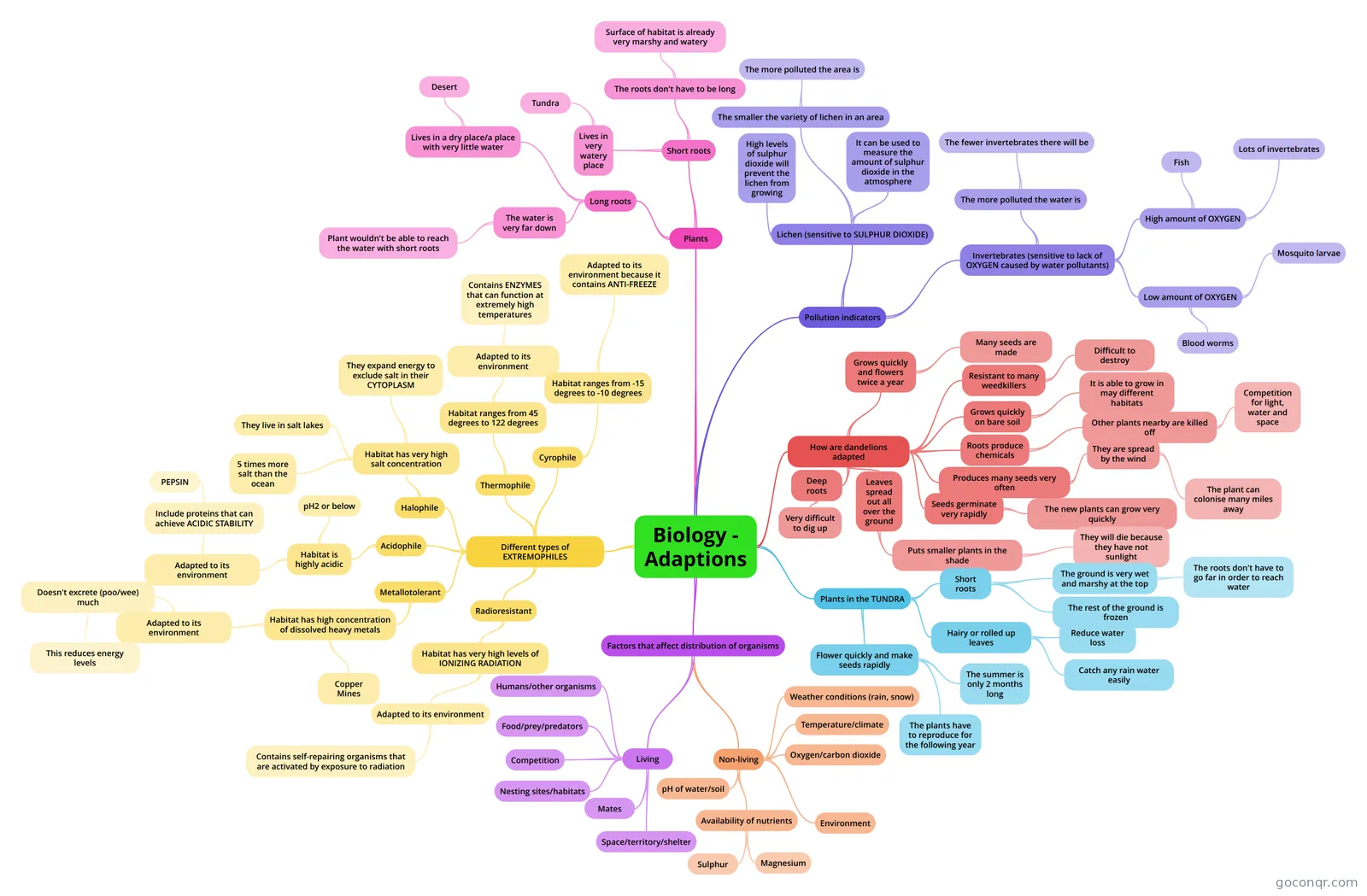
Mind map: Biology adaptations
Inhalt der Mindmap
Biology - Adaptions
How are dandelions adapted
- Grows quickly and flowers twice a year
- Many seeds are made
- Resistant to many weedkillers
- Difficult to destroy
- Grows quickly on bare soil
- It is able to grow in may different habitats
- Roots produce chemicals
- Other plants nearby are killed off
- Competition for light, water and space
- Other plants nearby are killed off
- Produces many seeds very often
- They are spread by the wind
- The plant can colonise many miles away
- They are spread by the wind
- Seeds germinate very rapidly
- The new plants can grow very quickly
- Leaves spread out all over the ground
- Puts smaller plants in the shade
- They will die because they have not sunlight
- Puts smaller plants in the shade
- Deep roots
- Very difficult to dig up
- Grows quickly and flowers twice a year
Plants in the TUNDRA
- Short roots
- The ground is very wet and marshy at the top
- The roots don't have to go far in order to reach water
- The rest of the ground is frozen
- The ground is very wet and marshy at the top
- Hairy or rolled up leaves
- Reduce water loss
- Catch any rain water easily
- Flower quickly and make seeds rapidly
- The summer is only 2 months long
- The plants have to reproduce for the following year
- Short roots
Different types of EXTREMOPHILES
- Thermophile
- Habitat ranges from 45 degrees to 122 degrees
- Adapted to its environment
- Contains ENZYMES that can function at extremely high temperatures
- Adapted to its environment
- Habitat ranges from 45 degrees to 122 degrees
- Cyrophile
- Habitat ranges from -15 degrees to -10 degrees
- Adapted to its environment because it contains ANTI-FREEZE
- Habitat ranges from -15 degrees to -10 degrees
- Halophile
- Habitat has very high salt concentration
- 5 times more salt than the ocean
- They live in salt lakes
- They expand energy to exclude salt in their CYTOPLASM
- Habitat has very high salt concentration
- Acidophile
- Habitat is highly acidic
- pH2 or below
- Adapted to its environment
- Include proteins that can achieve ACIDIC STABILITY
- PEPSIN
- Include proteins that can achieve ACIDIC STABILITY
- Habitat is highly acidic
- Metallotolerant
- Habitat has high concentration of dissolved heavy metals
- Copper Mines
- Adapted to its environment
- Doesn't excrete (poo/wee) much
- This reduces energy levels
- Doesn't excrete (poo/wee) much
- Habitat has high concentration of dissolved heavy metals
- Radioresistant
- Habitat has very high levels of IONIZING RADIATION
- Adapted to its environment
- Contains self-repairing organisms that are activated by exposure to radiation
- Adapted to its environment
- Habitat has very high levels of IONIZING RADIATION
- Thermophile
Factors that affect distribution of organisms
- Living
- Humans/other organisms
- Food/prey/predators
- Space/territory/shelter
- Nesting sites/habitats
- Competition
- Mates
- Non-living
- Weather conditions (rain, snow)
- Temperature/climate
- pH of water/soil
- Availability of nutrients
- Sulphur
- Magnesium
- Oxygen/carbon dioxide
- Environment
- Living
Pollution indicators
- Lichen (sensitive to SULPHUR DIOXIDE)
- High levels of sulphur dioxide will prevent the lichen from growing
- It can be used to measure the amount of sulphur dioxide in the atmosphere
- The smaller the variety of lichen in an area
- The more polluted the area is
- Invertebrates (sensitive to lack of OXYGEN caused by water pollutants)
- The more polluted the water is
- The fewer invertebrates there will be
- High amount of OXYGEN
- Lots of invertebrates
- Fish
- Low amount of OXYGEN
- Mosquito larvae
- Blood worms
- The more polluted the water is
- Lichen (sensitive to SULPHUR DIOXIDE)
Plants
- Long roots
- Lives in a dry place/a place with very little water
- Desert
- The water is very far down
- Plant wouldn't be able to reach the water with short roots
- Lives in a dry place/a place with very little water
- Short roots
- Lives in very watery place
- Tundra
- The roots don't have to be long
- Surface of habitat is already very marshy and watery
- Lives in very watery place
- Long roots
Informationen
- Beschreibung
- GCSE Biology Mindmap am Biology - Adaptions, erstellt von Anjali Moser am 04/05/2015.
- Erstellt von
- Anjali Moser
- Aufrufe
- 7
- Bewertung