
Mindmap
BMA-U3-AOS3
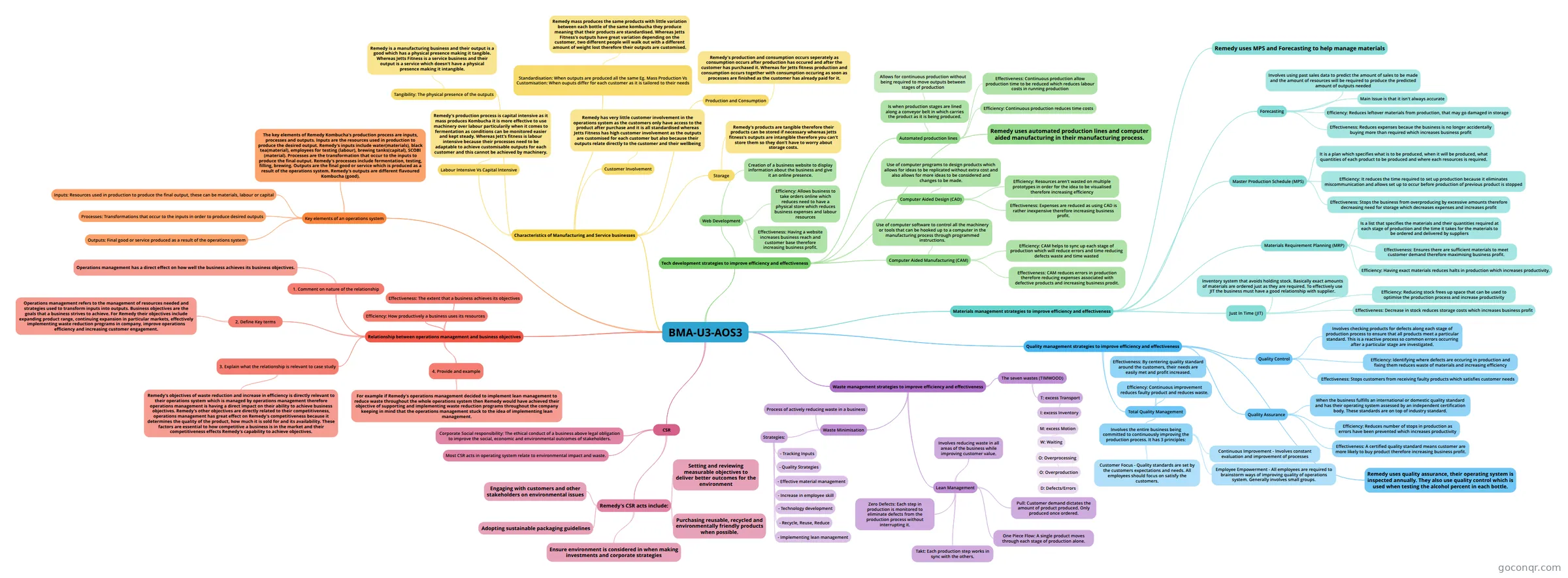
Mind map: BMA-U3-AOS3
Inhalt der Mindmap
BMA-U3-AOS3
- Using Remedy Kombucha case study for this Service business to compare was Jetts Fitness
Relationship between operations management and business objectives
- 1. Comment on nature of the relationship
- Operations management has a direct effect on how well the business achieves its business objectives.
- 2. Define Key terms
- Operations management refers to the management of resources needed and strategies used to transform inputs into outputs. Business objectives are the goals that a business strives to achieve. For Remedy their objectives include expanding product range, continuing expansion in particular markets, effectively implementing waste reduction programs in company, improve operations efficiency and increasing customer engagement.
- 3. Explain what the relationship is relevant to case study
- Remedy's objectives of waste reduction and increase in efficiency is directly relevant to their operations system which is managed by operations management therefore operations management is having a direct impact on their ability to achieve business objectives. Remedy's other objectives are directly related to their competitiveness, operations management has great effect on Remedy's competitiveness because it determines the quality of the product, how much it is sold for and its availability. These factors are essential to how competitive a business is in the market and their competitiveness effects Remedy's capability to achieve objectives.
- 4. Provide and example
- For example if Remedy's operations management decided to implement lean management to reduce waste throughout the whole operations system then Remedy would have achieved their objective of supporting and implementing waste reduction programs throughout the company keeping in mind that the operations management stuck to the idea of implementing lean management.
- Effectiveness: The extent that a business achieves its objectives
- Efficiency: How productively a business uses its resources
- 1. Comment on nature of the relationship
Key elements of an operations system
- Inputs: Resources used in production to produce the final output, these can be materials, labour or capital
- Processes: Transformations that occur to the inputs in order to produce desired outputs
- Outputs: Final good or service produced as a result of the operations system
- The key elements of Remedy Kombucha's production process are inputs, processes and outputs. Inputs are the resources used in production to produce the desired output. Remedy's inputs include water(materials), black tea(material), employees for testing (labour), brewing tanks(capital), SCOBI (material). Processes are the transformation that occur to the inputs to produce the final output. Remedy's processes include fermentation, testing, filling, brewing. Outputs are the final good or service which is produced as a result of the operations system. Remedy's outputs are different flavoured Kombucha (good).
Characteristics of Manufacturing and Service businesses
- Tangibility: The physical presence of the outputs
- Remedy is a manufacturing business and their output is a good which has a physical presence making it tangible. Whereas Jetts Fitness is a service business and their output is a service which doesn't have a physical presence making it intangible.
- Standardisation: When outputs are produced all the same Eg. Mass Production Vs Customisation: When ouputs differ for each customer as it is tailored to their needs
- Remedy mass produces the same products with little variation between each bottle of the same kombucha they produce meaning that their products are standardised. Whereas Jetts Fitness's outputs have great variation depending on the customer, two different people will walk out with a different amount of weight lost therefore their outputs are customised.
- Storage
- Remedy's products are tangible therefore their products can be stored if necessary whereas Jetts fitness's outputs are intangible therefore you can't store them so they don't have to worry about storage costs.
- Labour Intensive Vs Capital Intensive
- Remedy's production process is capital intensive as it mass produces Kombucha it is more effective to use machinery over labour particularily when it comes to fermentation as conditions can be monitored easier and kept steady. Whereas Jett's fitness is labour intensive because their processes need to be adaptable to achieve customisable outputs for each customer and this cannot be achieved by machinery.
- Customer Involvement
- Remedy has very little customer involvement in the operations system as the customers only have access to the product after purchase and it is all standardised whereas Jetts Fitness has high customer involvement as the outputs are customised for each customer but also because their outputs relate directly to the customer and their wellbeing
- Production and Consumption
- Remedy's production and consumption occurs seperately as consumption occurs after production has occured and after the customer has purchased it. Whereas for Jetts fitness production and consumption occurs together with consumption occuring as soon as processes are finished as the customer has already paid for it.
- Tangibility: The physical presence of the outputs
Tech development strategies to improve efficiency and effectiveness
- Web Development
- Creation of a business website to display information about the business and give it an online presence.
- Efficiency: Allows business to take orders online which reduces need to have a physical store which reduces business expenses and labour resources
- Effectiveness: Having a website increases business reach and customer base therefore increasing business profit.
- Computer Aided Design (CAD)
- Use of computer programs to design products which allows for ideas to be replicated without extra cost and also allows for more ideas to be considered and changes to be made.
- Efficiency: Resources aren't wasted on multiple prototypes in order for the idea to be visualised therefore increasing efficiency
- Effectiveness: Expenses are reduced as using CAD is rather inexpensive therefore increasing business profit.
- Computer Aided Manufacturing (CAM)
- Use of computer software to control all the machinery or tools that can be hooked up to a computer in the manufacturing process through programmed instructions.
- Efficiency: CAM helps to sync up each stage of production which will reduce errors and time reducing defects waste and time wasted
- Effectiveness: CAM reduces errors in production therefore reducing expenses associated with defective products and increasing business prodit.
- Automated production lines
- Is when production stages are lined along a conveyor belt in which carries the product as it is being produced.
- Allows for continuous production without being required to move outputs between stages of production
- Effectiveness: Continuous production allow production time to be reduced which reduces labour costs in running production
- Efficiency: Continuous production reduces time costs
- Is when production stages are lined along a conveyor belt in which carries the product as it is being produced.
- Remedy uses automated production lines and computer aided manufacturing in their manufacturing process.
- Web Development
Materials management strategies to improve efficiency and effectiveness
- Forecasting
- Involves using past sales data to predict the amount of sales to be made and the amount of resources will be required to produce the predicted amount of outputs needed
- Efficiency: Reduces leftover materials from production, that may go damaged in storage
- Effectiveness: Reduces expenses becaue the business is no longer accidentally buying more than required which increases business profit
- Main Issue is that it isn't always accurate
- Master Production Schedule (MPS)
- It is a plan which specifies what is to be produced, when it will be produced, what quantities of each product to be produced and where each resources is required.
- Efficiency: It reduces the time required to set up production because it eliminates miscommunication and allows set up to occur before production of previous product is stopped
- Effectiveness: Stops the business from overproducing by excessive amounts therefore decreasing need for storage which decreases expenses and increases profit
- Materials Requirement Planning (MRP)
- Is a list that specifies the materials and their quantities required at each stage of production and the time it takes for the materials to be ordered and delivered by suppliers
- Effectiveness: Ensures there are sufficient materials to meet customer demand therefore maximising business profit.
- Efficiency: Having exact materials reduces halts in production which increases productivity.
- Just In Time (JIT)
- Inventory system that avoids holding stock. Basically exact amounts of materials are ordered just as they are required. To effectively use JIT the business must have a good relationship with supplier.
- Efficiency: Reducing stock frees up space that can be used to optimise the production process and increase productivity
- Effectiveness: Decrease in stock reduces storage costs which increases business profit
- Remedy uses MPS and Forecasting to help manage materials
- Forecasting
Quality management strategies to improve efficiency and effectiveness
- Quality Control
- Involves checking products for defects along each stage of production process to ensure that all products meet a particular standard. This is a reactive process so common errors occurring after a particular stage are investigated.
- Efficiency: Identifying where defects are occuring in production and fixing them reduces waste of materials and increasing efficiency
- Effectiveness: Stops customers from receiving faulty products which satisfies customer needs
- Quality Assurance
- When the business fulfills an international or domestic quality standard and has their operating system assessed by an independent certification body. These standards are on top of industry standard.
- Efficiency: Reduces number of stops in production as errors have been prevented which increases productivity
- Effectiveness: A certified quality standard means customer are more likely to buy product therefore increasing business profit.
- Total Quality Management
- Involves the entire business being committed to continuously improving the production process. It has 3 principles:
- Continuous Improvement - Involves constant evaluation and improvement of processes
- Employee Empowerment - All employees are required to brainstorm ways of improving quality of operations system. Generally involves small groups.
- Customer Focus - Quality standards are set by the customers expectations and needs. All employees should focus on satisfy the customers.
- Effectiveness: By centering quality standard around the customers, their needs are easily met and profit increased.
- Efficiency: Continuous improvement reduces faulty product and reduces waste.
- Involves the entire business being committed to continuously improving the production process. It has 3 principles:
- Remedy uses quality assurance, their operating system is inspected annually. They also use quality control which is used when testing the alcohol percent in each bottle.
- Quality Control
Waste management strategies to improve efficiency and effectiveness
- Waste Minimisation
- Process of actively reducing waste in a business
- Strategies:
- - Tracking Inputs
- - Quality Strategies
- - Effective material management
- - Increase in employee skill
- - Technology development
- - Recycle, Reuse, Reduce
- - Implementing lean management
- Lean Management
- Pull: Customer demand dictates the amount of product produced. Only produced once ordered.
- One Piece Flow: A single product moves through each stage of production alone.
- Takt: Each production step works in sync with the others.
- Zero Defects: Each step in production is monitored to eliminate defects from the production process without interrupting it.
- Involves reducing waste in all areas of the business while improving customer value.
- The seven wastes (TIMWOOD)
- T: excess Transport
- I: excess Inventory
- M: excess Motion
- W: Waiting
- O: Overprocessing
- O: Overproduction
- D: Defects/Errors
- O: Overproduction
- O: Overprocessing
- W: Waiting
- M: excess Motion
- I: excess Inventory
- T: excess Transport
- Waste Minimisation
CSR
- Corporate Social responsibility: The ethical conduct of a business above legal obligation to improve the social, economic and environmental outcomes of stakeholders.
- Most CSR acts in operating system relate to environmental impact and waste.
- Remedy's CSR acts include:
- Setting and reviewing measurable objectives to deliver better outcomes for the environment
- Purchasing reusable, recycled and environmentally friendly products when possible.
- Ensure environment is considered in when making investments and corporate strategies
- Adopting sustainable packaging guidelines
- Engaging with customers and other stakeholders on environmental issues
Informationen
- Beschreibung
- Year 12 Business Mindmap am BMA-U3-AOS3, erstellt von Ashley Burston am 05/06/2021.
- Erstellt von
- Ashley Burston
- Aufrufe
- 2
- Bewertung
Mehr zu Operations Strategy and Objectives