
Mindmap
CULTURE
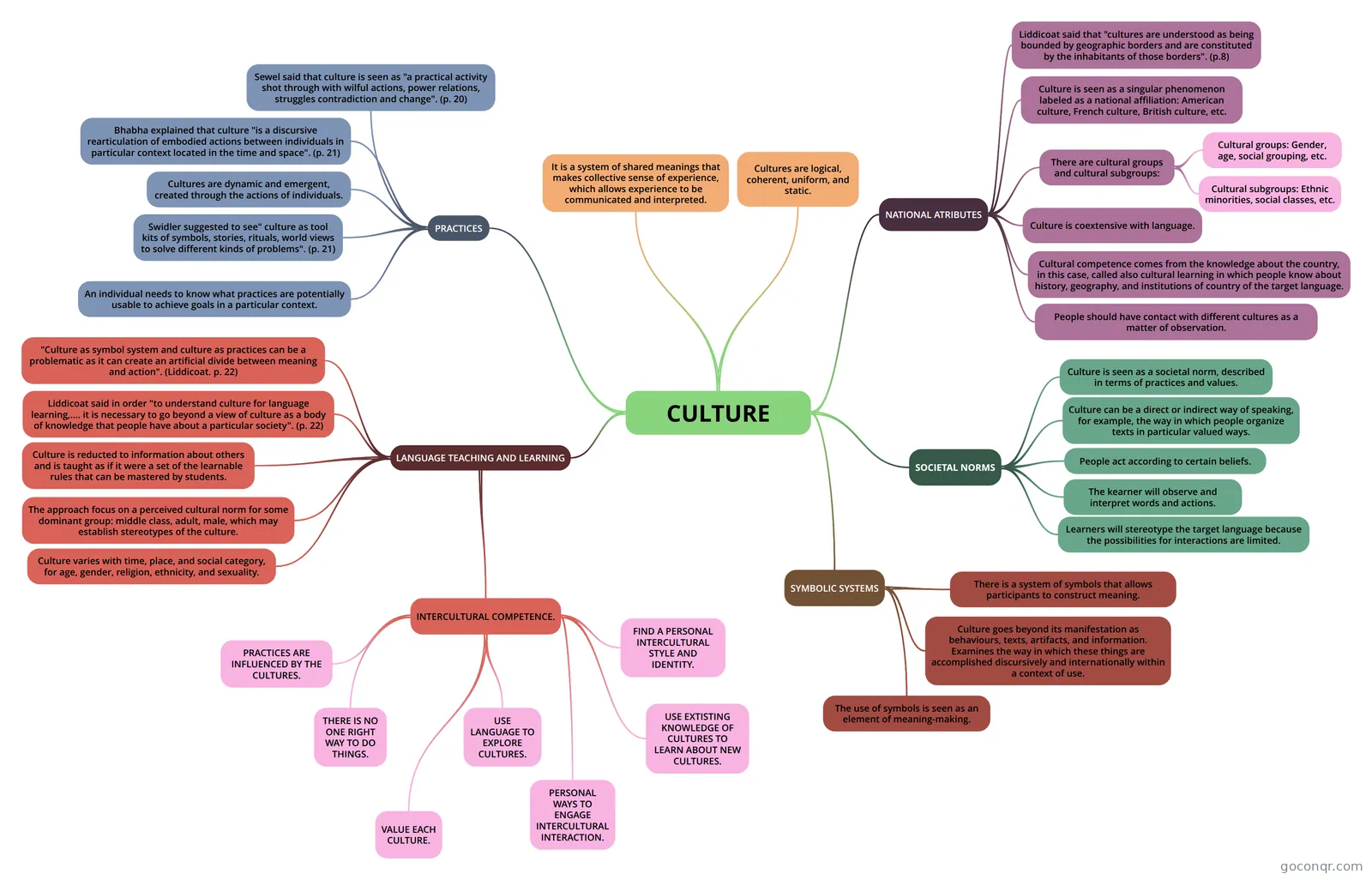
Mind map: Culture
Inhalt der Mindmap
CULTURE
It is a system of shared meanings that makes collective sense of experience, which allows experience to be communicated and interpreted.
Cultures are logical, coherent, uniform, and static.
NATIONAL ATRIBUTES
- Liddicoat said that "cultures are understood as being bounded by geographic borders and are constituted by the inhabitants of those borders". (p.8)
- Culture is seen as a singular phenomenon labeled as a national affiliation: American culture, French culture, British culture, etc.
- Culture is coextensive with language.
- Cultural competence comes from the knowledge about the country, in this case, called also cultural learning in which people know about history, geography, and institutions of country of the target language.
- People should have contact with different cultures as a matter of observation.
- There are cultural groups and cultural subgroups:
- Cultural groups: Gender, age, social grouping, etc.
- Cultural subgroups: Ethnic minorities, social classes, etc.
SOCIETAL NORMS
- Culture is seen as a societal norm, described in terms of practices and values.
- Culture can be a direct or indirect way of speaking, for example, the way in which people organize texts in particular valued ways.
- People act according to certain beliefs.
- The kearner will observe and interpret words and actions.
- Learners will stereotype the target language because the possibilities for interactions are limited.
SYMBOLIC SYSTEMS
- There is a system of symbols that allows participants to construct meaning.
- The use of symbols is seen as an element of meaning-making.
- Culture goes beyond its manifestation as behaviours, texts, artifacts, and information. Examines the way in which these things are accomplished discursively and internationally within a context of use.
PRACTICES
- Sewel said that culture is seen as "a practical activity shot through with wilful actions, power relations, struggles contradiction and change". (p. 20)
- Bhabha explained that culture "is a discursive rearticulation of embodied actions between individuals in particular context located in the time and space". (p. 21)
- Cultures are dynamic and emergent, created through the actions of individuals.
- Swidler suggested to see" culture as tool kits of symbols, stories, rituals, world views to solve different kinds of problems". (p. 21)
- An individual needs to know what practices are potentially usable to achieve goals in a particular context.
LANGUAGE TEACHING AND LEARNING
- "Culture as symbol system and culture as practices can be a problematic as it can create an artificial divide between meaning and action". (Liddicoat. p. 22)
- Liddicoat said in order "to understand culture for language learning,.... it is necessary to go beyond a view of culture as a body of knowledge that people have about a particular society". (p. 22)
- Culture is reducted to information about others and is taught as if it were a set of the learnable rules that can be mastered by students.
- The approach focus on a perceived cultural norm for some dominant group: middle class, adult, male, which may establish stereotypes of the culture.
- Culture varies with time, place, and social category, for age, gender, religion, ethnicity, and sexuality.
- INTERCULTURAL COMPETENCE.
- PRACTICES ARE INFLUENCED BY THE CULTURES.
- THERE IS NO ONE RIGHT WAY TO DO THINGS.
- VALUE EACH CULTURE.
- USE LANGUAGE TO EXPLORE CULTURES.
- PERSONAL WAYS TO ENGAGE INTERCULTURAL INTERACTION.
- USE EXTISTING KNOWLEDGE OF CULTURES TO LEARN ABOUT NEW CULTURES.
- FIND A PERSONAL INTERCULTURAL STYLE AND IDENTITY.
Informationen
- Beschreibung
- Mindmap am CULTURE, erstellt von Ana Maria Machado Botero am 28/07/2021.
- Erstellt von
- Ana Maria Machado Botero
- Aufrufe
- 1
- Bewertung
Mehr zu Culture and Cultural Awareness