
Mindmap
Week 4 WSP: Evolution - Transitions and Innovations
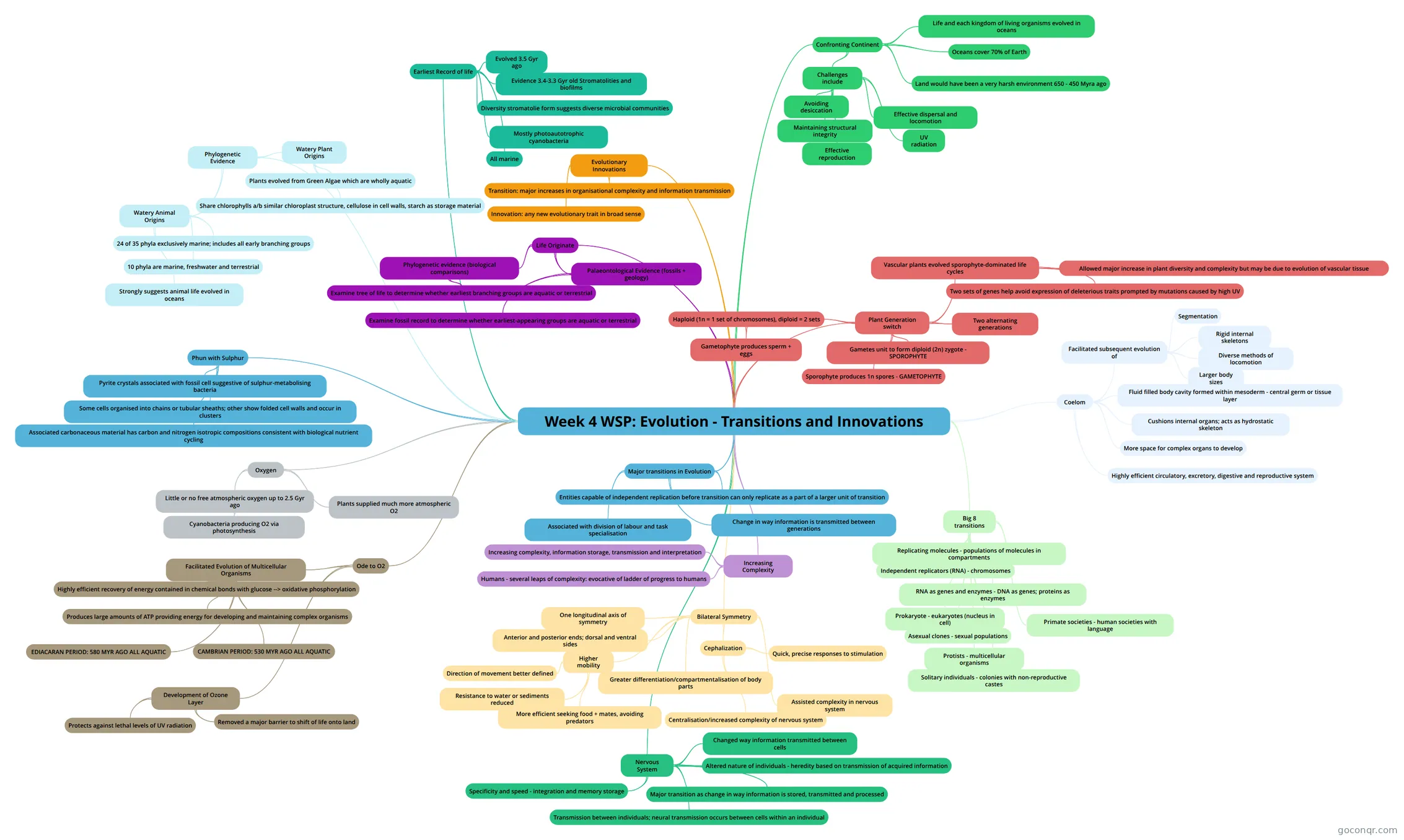
Mind map: Evolution transitions and innovations
Inhalt der Mindmap
Week 4 WSP: Evolution - Transitions and Innovations
Major transitions in Evolution
- Entities capable of independent replication before transition can only replicate as a part of a larger unit of transition
- Associated with division of labour and task specialisation
- Change in way information is transmitted between generations
Big 8 transitions
- Replicating molecules - populations of molecules in compartments
- Independent replicators (RNA) - chromosomes
- RNA as genes and enzymes - DNA as genes; proteins as enzymes
- Prokaryote - eukaryotes (nucleus in cell)
- Asexual clones - sexual populations
- Protists - multicellular organisms
- Solitary individuals - colonies with non-reproductive castes
- Primate societies - human societies with language
Increasing Complexity
- Increasing complexity, information storage, transmission and interpretation
- Humans - several leaps of complexity: evocative of ladder of progress to humans
Bilateral Symmetry
- One longitudinal axis of symmetry
- Anterior and posterior ends; dorsal and ventral sides
- Higher mobility
- Direction of movement better defined
- Resistance to water or sediments reduced
- More efficient seeking food + mates, avoiding predators
- Greater differentiation/compartmentalisation of body parts
- Cephalization
- Centralisation/increased complexity of nervous system
- Quick, precise responses to stimulation
- Assisted complexity in nervous system
Nervous System
- Changed way information transmitted between cells
- Altered nature of individuals - heredity based on transmission of acquired information
- Major transition as change in way information is stored, transmitted and processed
- Transmission between individuals; neural transmission occurs between cells within an individual
- Specificity and speed - integration and memory storage
Coelom
- Fluid filled body cavity formed within mesoderm - central germ or tissue layer
- Cushions internal organs; acts as hydrostatic skeleton
- More space for complex organs to develop
- Highly efficient circulatory, excretory, digestive and reproductive system
- Facilitated subsequent evolution of
- Segmentation
- Rigid internal skeletons
- Diverse methods of locomotion
- Larger body sizes
Plant Generation switch
- Two alternating generations
- Haploid (1n = 1 set of chromosomes), diploid = 2 sets
- Gametophyte produces sperm + eggs
- Gametes unit to form diploid (2n) zygote - SPOROPHYTE
- Sporophyte produces 1n spores - GAMETOPHYTE
- Vascular plants evolved sporophyte-dominated life cycles
- Two sets of genes help avoid expression of deleterious traits prompted by mutations caused by high UV
- Allowed major increase in plant diversity and complexity but may be due to evolution of vascular tissue
Evolutionary Innovations
- Transition: major increases in organisational complexity and information transmission
- Innovation: any new evolutionary trait in broad sense
Life Originate
- Phylogenetic evidence (biological comparisons)
- Examine tree of life to determine whether earliest branching groups are aquatic or terrestrial
- Palaeontological Evidence (fossils + geology)
- Examine fossil record to determine whether earliest-appearing groups are aquatic or terrestrial
- Phylogenetic evidence (biological comparisons)
Phylogenetic Evidence
- Watery Animal Origins
- 24 of 35 phyla exclusively marine; includes all early branching groups
- 10 phyla are marine, freshwater and terrestrial
- Strongly suggests animal life evolved in oceans
- Watery Plant Origins
- Plants evolved from Green Algae which are wholly aquatic
- Share chlorophylls a/b similar chloroplast structure, cellulose in cell walls, starch as storage material
- Watery Animal Origins
Earliest Record of life
- Evolved 3.5 Gyr ago
- Evidence 3.4-3.3 Gyr old Stromatolities and biofilms
- Diversity stromatolie form suggests diverse microbial communities
- Mostly photoautotrophic cyanobacteria
- All marine
Phun with Sulphur
- Pyrite crystals associated with fossil cell suggestive of sulphur-metabolising bacteria
- Some cells organised into chains or tubular sheaths; other show folded cell walls and occur in clusters
- Associated carbonaceous material has carbon and nitrogen isotropic compositions consistent with biological nutrient cycling
Oxygen
- Little or no free atmospheric oxygen up to 2.5 Gyr ago
- Cyanobacteria producing O2 via photosynthesis
- Plants supplied much more atmospheric O2
- Little or no free atmospheric oxygen up to 2.5 Gyr ago
Ode to O2
- Facilitated Evolution of Multicellular Organisms
- Highly efficient recovery of energy contained in chemical bonds with glucose --> oxidative phosphorylation
- Produces large amounts of ATP providing energy for developing and maintaining complex organisms
- EDIACARAN PERIOD: 580 MYR AGO ALL AQUATIC
- CAMBRIAN PERIOD: 530 MYR AGO ALL AQUATIC
- Development of Ozone Layer
- Protects against lethal levels of UV radiation
- Removed a major barrier to shift of life onto land
- Facilitated Evolution of Multicellular Organisms
Confronting Continent
- Life and each kingdom of living organisms evolved in oceans
- Oceans cover 70% of Earth
- Land would have been a very harsh environment 650 - 450 Myra ago
- Challenges include
- Avoiding desiccation
- Maintaining structural integrity
- Effective reproduction
- Effective dispersal and locomotion
- UV radiation
Informationen
- Beschreibung
- South Australian Certificate of Education (SACE) Biology Mindmap am Week 4 WSP: Evolution - Transitions and Innovations, erstellt von Paras Chrysostomou am 22/08/2015.
- Erstellt von
- Paras Chrysostomou
- Aufrufe
- 0
- Bewertung