
Mindmap
Acute Epigastric Pain
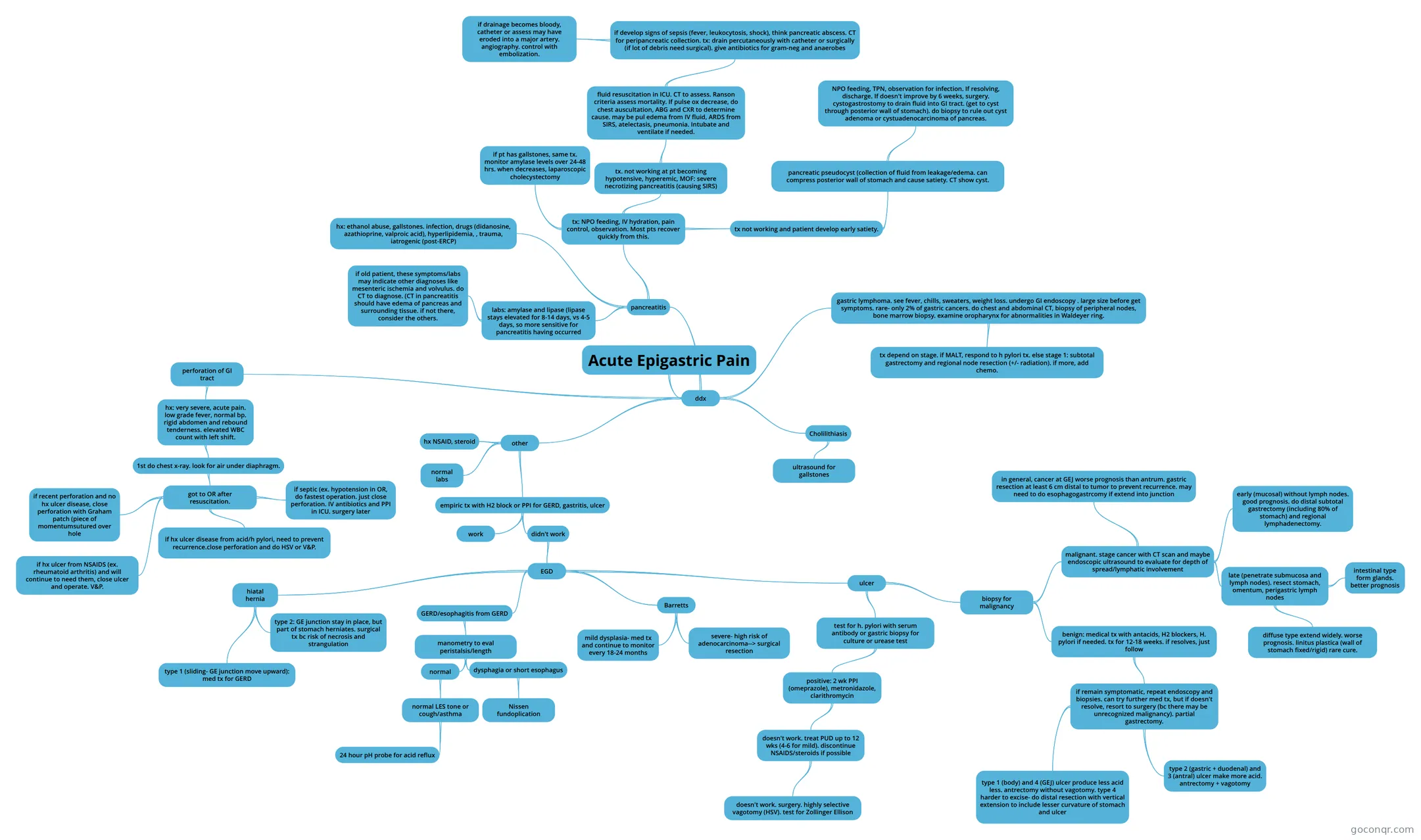
Mind map: Acute epigastric pain
Inhalt der Mindmap
Acute Epigastric Pain
ddx
- pancreatitis
- labs: amylase and lipase (lipase stays elevated for 8-14 days, vs 4-5 days, so more sensitive for pancreatitis having occurred
- if old patient, these symptoms/labs may indicate other diagnoses like mesenteric ischemia and volvulus. do CT to diagnose. (CT in pancreatitis should have edema of pancreas and surrounding tissue. if not there, consider the others.
- hx: ethanol abuse, gallstones. infection, drugs (didanosine, azathioprine, valproic acid), hyperlipidemia, , trauma, iatrogenic (post-ERCP)
- tx: NPO feeding, IV hydration, pain control, observation. Most pts recover quickly from this.
- if pt has gallstones, same tx. monitor amylase levels over 24-48 hrs. when decreases, laparoscopic cholecystectomy
- tx. not working at pt becoming hypotensive, hyperemic, MOF: severe necrotizing pancreatitis (causing SIRS)
- fluid resuscitation in ICU. CT to assess. Ranson criteria assess mortality. If pulse ox decrease, do chest auscultation, ABG and CXR to determine cause. may be pul edema from IV fluid, ARDS from SIRS, atelectasis, pneumonia. Intubate and ventilate if needed.
- if develop signs of sepsis (fever, leukocytosis, shock), think pancreatic abscess. CT for peripancreatic collection. tx: drain percutaneously with catheter or surgically (if lot of debris need surgical). give antibiotics for gram-neg and anaerobes
- if drainage becomes bloody, catheter or assess may have eroded into a major artery. angiography. control with embolization.
- if develop signs of sepsis (fever, leukocytosis, shock), think pancreatic abscess. CT for peripancreatic collection. tx: drain percutaneously with catheter or surgically (if lot of debris need surgical). give antibiotics for gram-neg and anaerobes
- fluid resuscitation in ICU. CT to assess. Ranson criteria assess mortality. If pulse ox decrease, do chest auscultation, ABG and CXR to determine cause. may be pul edema from IV fluid, ARDS from SIRS, atelectasis, pneumonia. Intubate and ventilate if needed.
- tx not working and patient develop early satiety.
- pancreatic pseudocyst (collection of fluid from leakage/edema. can compress posterior wall of stomach and cause satiety. CT show cyst.
- NPO feeding, TPN, observation for infection. If resolving, discharge. If doesn't improve by 6 weeks, surgery. cystogastrostomy to drain fluid into GI tract. (get to cyst through posterior wall of stomach). do biopsy to rule out cyst adenoma or cystuadenocarcinoma of pancreas.
- pancreatic pseudocyst (collection of fluid from leakage/edema. can compress posterior wall of stomach and cause satiety. CT show cyst.
- labs: amylase and lipase (lipase stays elevated for 8-14 days, vs 4-5 days, so more sensitive for pancreatitis having occurred
- other
- hx NSAID, steroid
- normal labs
- empiric tx with H2 block or PPI for GERD, gastritis, ulcer
- work
- didn't work
- EGD
- GERD/esophagitis from GERD
- manometry to eval peristalsis/length
- normal
- normal LES tone or cough/asthma
- 24 hour pH probe for acid reflux
- normal LES tone or cough/asthma
- dysphagia or short esophagus
- Nissen fundoplication
- normal
- manometry to eval peristalsis/length
- Barretts
- mild dysplasia- med tx and continue to monitor every 18-24 months
- severe- high risk of adenocarcinoma--> surgical resection
- hiatal hernia
- type 1 (sliding- GE junction move upward): med tx for GERD
- type 2: GE junction stay in place, but part of stomach herniates. surgical tx bc risk of necrosis and strangulation
- ulcer
- test for h. pylori with serum antibody or gastric biopsy for culture or urease test
- positive: 2 wk PPI (omeprazole), metronidazole, clarithromycin
- doesn't work. treat PUD up to 12 wks (4-6 for mild). discontinue NSAIDS/steroids if possible
- doesn't work. surgery. highly selective vagotomy (HSV). test for Zollinger Ellison
- doesn't work. treat PUD up to 12 wks (4-6 for mild). discontinue NSAIDS/steroids if possible
- positive: 2 wk PPI (omeprazole), metronidazole, clarithromycin
- biopsy for malignancy
- benign: medical tx with antacids, H2 blockers, H. pylori if needed. tx for 12-18 weeks. if resolves, just follow
- if remain symptomatic, repeat endoscopy and biopsies. can try further med tx, but if doesn't resolve, resort to surgery (bc there may be unrecognized malignancy). partial gastrectomy.
- type 1 (body) and 4 (GEJ) ulcer produce less acid less. antrectomy without vagotomy. type 4 harder to excise- do distal resection with vertical extension to include lesser curvature of stomach and ulcer
- type 2 (gastric + duodenal) and 3 (antral) ulcer make more acid. antrectomy + vagotomy
- if remain symptomatic, repeat endoscopy and biopsies. can try further med tx, but if doesn't resolve, resort to surgery (bc there may be unrecognized malignancy). partial gastrectomy.
- malignant. stage cancer with CT scan and maybe endoscopic ultrasound to evaluate for depth of spread/lymphatic involvement
- early (mucosal) without lymph nodes. good prognosis. do distal subtotal gastrectomy (including 80% of stomach) and regional lymphadenectomy.
- late (penetrate submucosa and lymph nodes). resect stomach, omentum, perigastric lymph nodes
- intestinal type form glands. better prognosis
- diffuse type extend widely. worse prognosis. linitus plastica (wall of stomach fixed/rigid) rare cure.
- in general, cancer at GEJ worse prognosis than antrum. gastric resection at least 6 cm distal to tumor to prevent recurrence. may need to do esophagogastrcomy if extend into junction
- benign: medical tx with antacids, H2 blockers, H. pylori if needed. tx for 12-18 weeks. if resolves, just follow
- test for h. pylori with serum antibody or gastric biopsy for culture or urease test
- GERD/esophagitis from GERD
- EGD
- Cholilithiasis
- ultrasound for gallstones
- perforation of GI tract
- hx: very severe, acute pain. low grade fever, normal bp. rigid abdomen and rebound tenderness. elevated WBC count with left shift.
- 1st do chest x-ray. look for air under diaphragm.
- got to OR after resuscitation.
- if recent perforation and no hx ulcer disease, close perforation with Graham patch (piece of momentumsutured over hole
- if hx ulcer disease from acid/h pylori, need to prevent recurrence.close perforation and do HSV or V&P.
- if hx ulcer from NSAIDS (ex. rheumatoid arthritis) and will continue to need them, close ulcer and operate. V&P.
- if septic (ex. hypotension in OR, do fastest operation. just close perforation. IV antibiotics and PPI in ICU. surgery later
- got to OR after resuscitation.
- 1st do chest x-ray. look for air under diaphragm.
- hx: very severe, acute pain. low grade fever, normal bp. rigid abdomen and rebound tenderness. elevated WBC count with left shift.
- gastric lymphoma. see fever, chills, sweaters, weight loss. undergo GI endoscopy . large size before get symptoms. rare- only 2% of gastric cancers. do chest and abdominal CT, biopsy of peripheral nodes, bone marrow biopsy. examine oropharynx for abnormalities in Waldeyer ring.
- tx depend on stage. if MALT, respond to h pylori tx. else stage 1: subtotal gastrectomy and regional node resection (+/- radiation). if more, add chemo.
- pancreatitis
Informationen
- Beschreibung
- Surgery (Upper GI Disorders) Mindmap am Acute Epigastric Pain, erstellt von mdeol2017 am 26/08/2015.
- Erstellt von
- mdeol2017
- Aufrufe
- 3
- Bewertung
Mehr zu Abdominal Symptoms and Assessment