
Mindmap
Experimentation
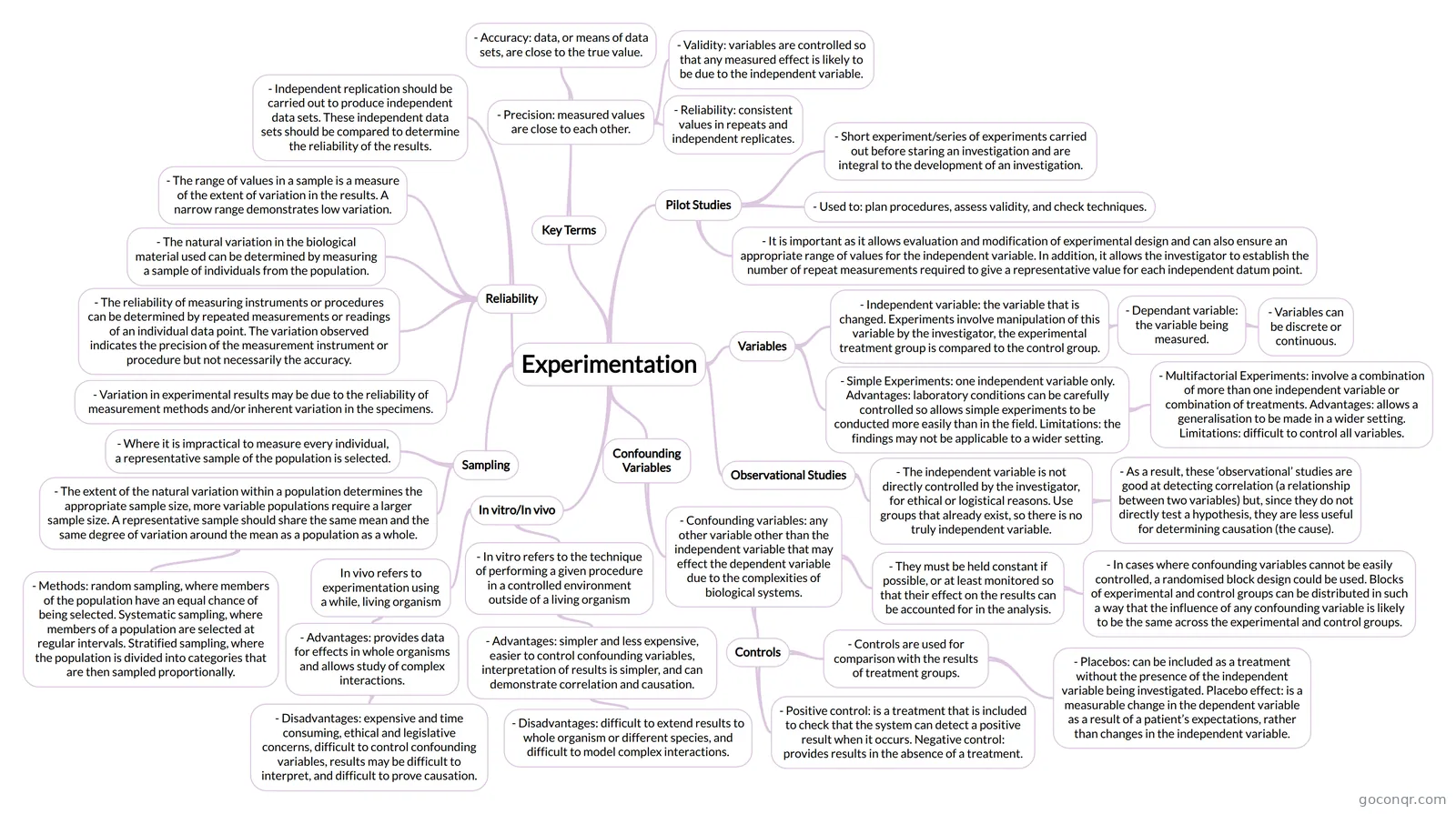
Mind map: Experimentation
Inhalt der Mindmap
Experimentation
Key Terms
- - Precision: measured values are close to each other.
- - Accuracy: data, or means of data sets, are close to the true value.
- - Reliability: consistent values in repeats and independent replicates.
- - Validity: variables are controlled so that any measured effect is likely to be due to the independent variable.
- - Precision: measured values are close to each other.
Pilot Studies
- - Short experiment/series of experiments carried out before staring an investigation and are integral to the development of an investigation.
- - It is important as it allows evaluation and modification of experimental design and can also ensure an appropriate range of values for the independent variable. In addition, it allows the investigator to establish the number of repeat measurements required to give a representative value for each independent datum point.
- - Used to: plan procedures, assess validity, and check techniques.
Variables
- - Independent variable: the variable that is changed. Experiments involve manipulation of this variable by the investigator, the experimental treatment group is compared to the control group.
- - Dependant variable: the variable being measured.
- - Variables can be discrete or continuous.
- - Dependant variable: the variable being measured.
- - Simple Experiments: one independent variable only. Advantages: laboratory conditions can be carefully controlled so allows simple experiments to be conducted more easily than in the field. Limitations: the findings may not be applicable to a wider setting.
- - Multifactorial Experiments: involve a combination of more than one independent variable or combination of treatments. Advantages: allows a generalisation to be made in a wider setting. Limitations: difficult to control all variables.
- - Independent variable: the variable that is changed. Experiments involve manipulation of this variable by the investigator, the experimental treatment group is compared to the control group.
Observational Studies
- - The independent variable is not directly controlled by the investigator, for ethical or logistical reasons. Use groups that already exist, so there is no truly independent variable.
- - As a result, these ‘observational’ studies are good at detecting correlation (a relationship between two variables) but, since they do not directly test a hypothesis, they are less useful for determining causation (the cause).
- - The independent variable is not directly controlled by the investigator, for ethical or logistical reasons. Use groups that already exist, so there is no truly independent variable.
Confounding Variables
- - Confounding variables: any other variable other than the independent variable that may effect the dependent variable due to the complexities of biological systems.
- - They must be held constant if possible, or at least monitored so that their effect on the results can be accounted for in the analysis.
- - In cases where confounding variables cannot be easily controlled, a randomised block design could be used. Blocks of experimental and control groups can be distributed in such a way that the influence of any confounding variable is likely to be the same across the experimental and control groups.
- Controls
- - Controls are used for comparison with the results of treatment groups.
- - Placebos: can be included as a treatment without the presence of the independent variable being investigated. Placebo effect: is a measurable change in the dependent variable as a result of a patient’s expectations, rather than changes in the independent variable.
- - Positive control: is a treatment that is included to check that the system can detect a positive result when it occurs. Negative control: provides results in the absence of a treatment.
- - Controls are used for comparison with the results of treatment groups.
- - They must be held constant if possible, or at least monitored so that their effect on the results can be accounted for in the analysis.
- - Confounding variables: any other variable other than the independent variable that may effect the dependent variable due to the complexities of biological systems.
In vitro/In vivo
- - In vitro refers to the technique of performing a given procedure in a controlled environment outside of a living organism
- - Advantages: simpler and less expensive, easier to control confounding variables, interpretation of results is simpler, and can demonstrate correlation and causation.
- - Disadvantages: difficult to extend results to whole organism or different species, and difficult to model complex interactions.
- - Advantages: simpler and less expensive, easier to control confounding variables, interpretation of results is simpler, and can demonstrate correlation and causation.
- In vivo refers to experimentation using a while, living organism
- - Advantages: provides data for effects in whole organisms and allows study of complex interactions.
- - Disadvantages: expensive and time consuming, ethical and legislative concerns, difficult to control confounding variables, results may be difficult to interpret, and difficult to prove causation.
- - Advantages: provides data for effects in whole organisms and allows study of complex interactions.
- - In vitro refers to the technique of performing a given procedure in a controlled environment outside of a living organism
Sampling
- - Where it is impractical to measure every individual, a representative sample of the population is selected.
- - The extent of the natural variation within a population determines the appropriate sample size, more variable populations require a larger sample size. A representative sample should share the same mean and the same degree of variation around the mean as a population as a whole.
- - Methods: random sampling, where members of the population have an equal chance of being selected. Systematic sampling, where members of a population are selected at regular intervals. Stratified sampling, where the population is divided into categories that are then sampled proportionally.
Reliability
- - Variation in experimental results may be due to the reliability of measurement methods and/or inherent variation in the specimens.
- - The reliability of measuring instruments or procedures can be determined by repeated measurements or readings of an individual data point. The variation observed indicates the precision of the measurement instrument or procedure but not necessarily the accuracy.
- - The natural variation in the biological material used can be determined by measuring a sample of individuals from the population.
- - The range of values in a sample is a measure of the extent of variation in the results. A narrow range demonstrates low variation.
- - Independent replication should be carried out to produce independent data sets. These independent data sets should be compared to determine the reliability of the results.
Informationen
- Beschreibung
- Highers Biology Mindmap am Experimentation, erstellt von Alanis McKay am 11/10/2021.
- Erstellt von
- Alanis McKay
- Aufrufe
- 1
- Bewertung