
Mindmap
B1:Cells
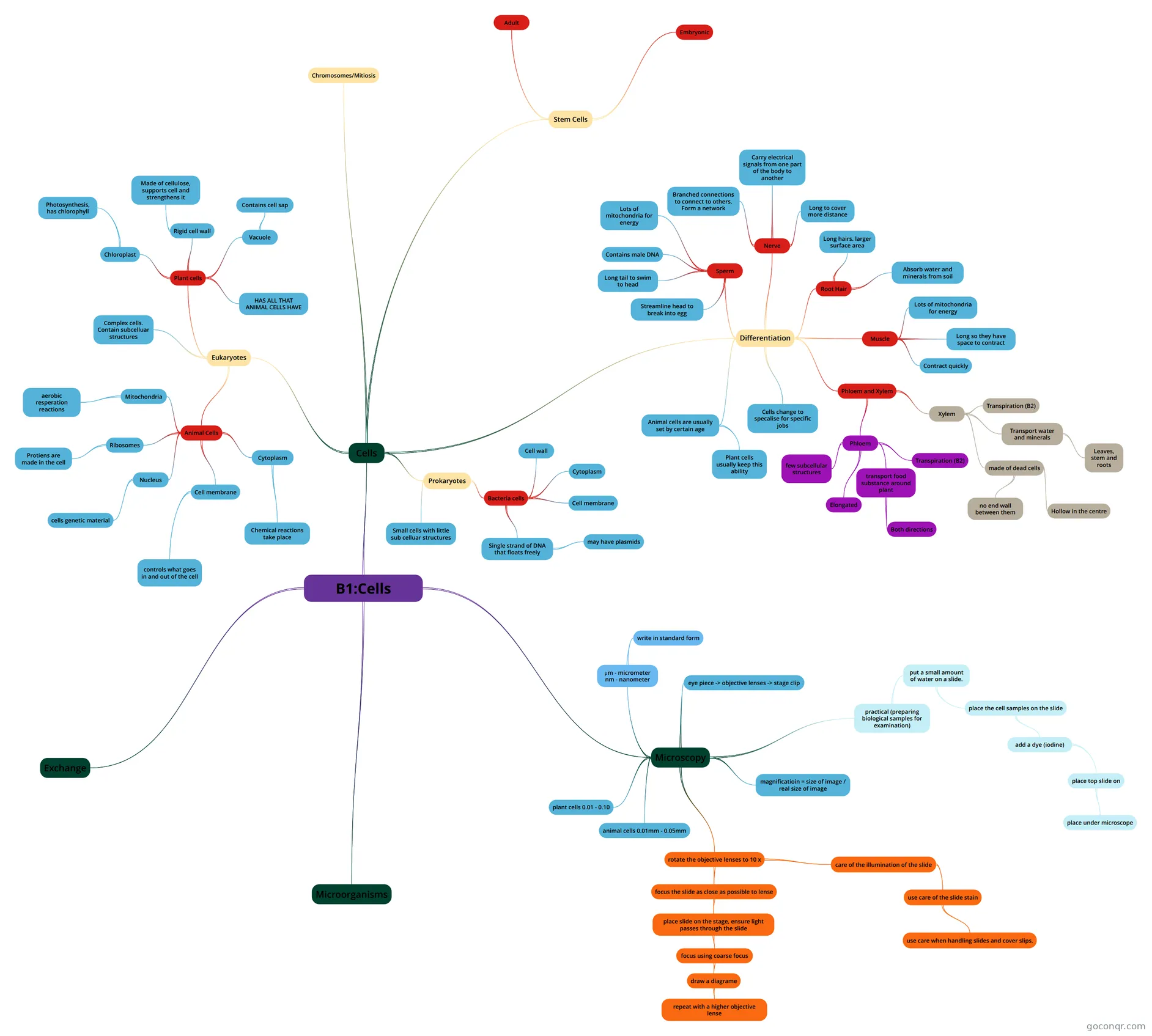
Mind map: B1 cells
Inhalt der Mindmap
B1:Cells
Microscopy
- eye piece -> objective lenses -> stage clip
- magnificatioin = size of image / real size of image
- plant cells 0.01 - 0.10
- animal cells 0.01mm - 0.05mm
- μm - micrometer nm - nanometer
- write in standard form
- practical (preparing biological samples for examination)
- put a small amount of water on a slide.
- place the cell samples on the slide
- add a dye (iodine)
- place top slide on
- place under microscope
- place top slide on
- add a dye (iodine)
- place the cell samples on the slide
- put a small amount of water on a slide.
- rotate the objective lenses to 10 x
- focus the slide as close as possible to lense
- place slide on the stage, ensure light passes through the slide
- focus using coarse focus
- draw a diagrame
- repeat with a higher objective lense
- draw a diagrame
- focus using coarse focus
- place slide on the stage, ensure light passes through the slide
- care of the illumination of the slide
- use care of the slide stain
- use care when handling slides and cover slips.
- use care of the slide stain
- focus the slide as close as possible to lense
Cells
- Eukaryotes
- Complex cells. Contain subcelluar structures
- Plant cells
- HAS ALL THAT ANIMAL CELLS HAVE
- Rigid cell wall
- Made of cellulose, supports cell and strengthens it
- Chloroplast
- Photosynthesis, has chlorophyll
- Vacuole
- Contains cell sap
- Animal Cells
- Nucleus
- cells genetic material
- Cytoplasm
- Chemical reactions take place
- Cell membrane
- controls what goes in and out of the cell
- Ribosomes
- Protiens are made in the cell
- Mitochondria
- aerobic resperation reactions
- Nucleus
- Prokaryotes
- Small cells with little sub celluar structures
- Bacteria cells
- Cell wall
- Cytoplasm
- Cell membrane
- Single strand of DNA that floats freely
- may have plasmids
- Differentiation
- Cells change to specalise for specific jobs
- Animal cells are usually set by certain age
- Plant cells usually keep this ability
- Sperm
- Long tail to swim to head
- Streamline head to break into egg
- Contains male DNA
- Lots of mitochondria for energy
- Nerve
- Carry electrical signals from one part of the body to another
- Long to cover more distance
- Branched connections to connect to others. Form a network
- Muscle
- Lots of mitochondria for energy
- Long so they have space to contract
- Contract quickly
- Root Hair
- Absorb water and minerals from soil
- Long hairs. larger surface area
- Phloem and Xylem
- Phloem
- few subcellular structures
- Elongated
- transport food substance around plant
- Both directions
- Transpiration (B2)
- Xylem
- made of dead cells
- Hollow in the centre
- no end wall between them
- Transport water and minerals
- Leaves, stem and roots
- Transpiration (B2)
- made of dead cells
- Phloem
- Stem Cells
- Embryonic
- Adult
- Chromosomes/Mitiosis
- Eukaryotes
Exchange
Microorganisms