
Mindmap
Sociology, Objectivity & Values
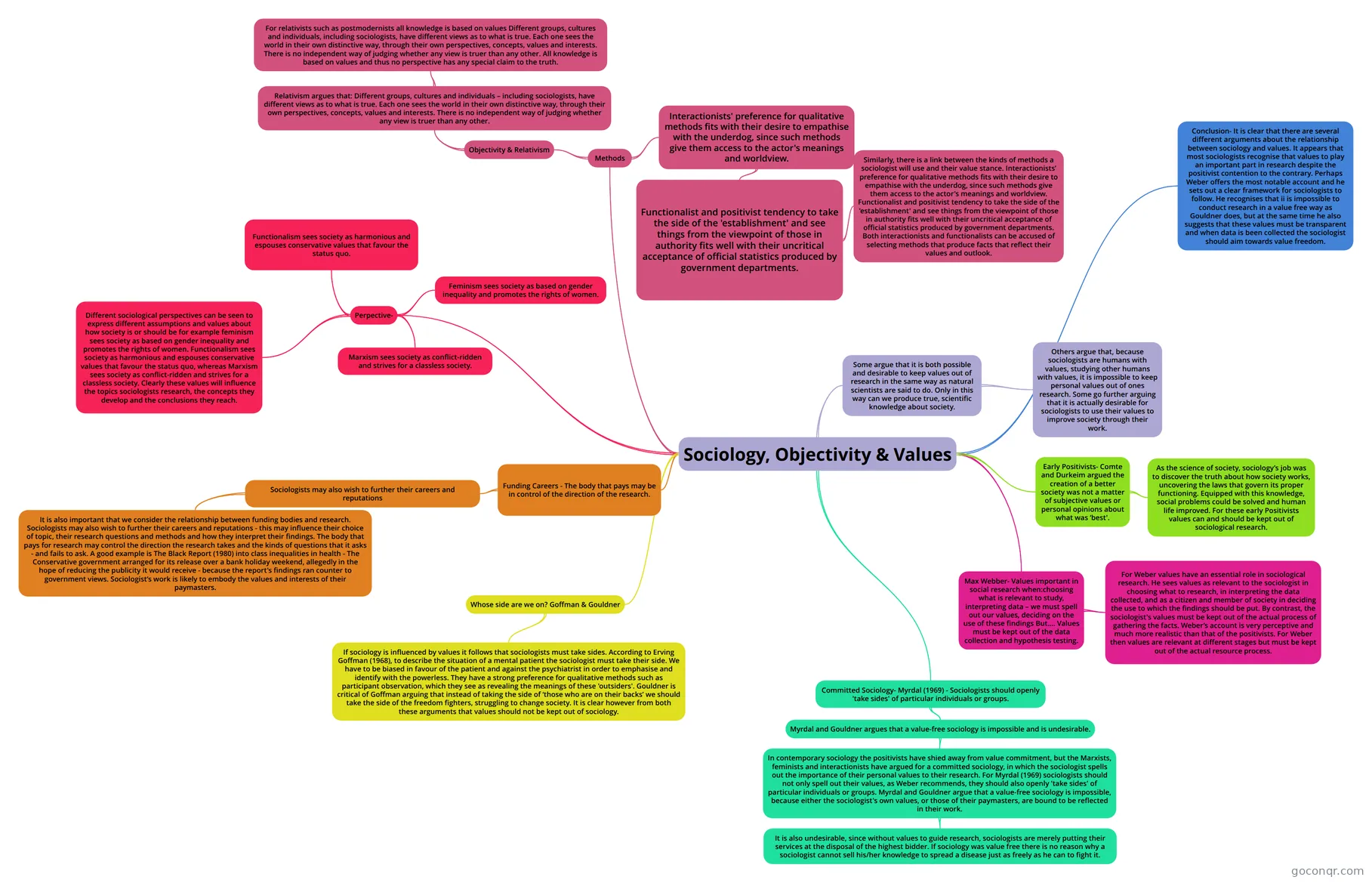
Mind map: Sociology, objectivity and values
Inhalt der Mindmap
Sociology, Objectivity & Values
Some argue that it is both possible and desirable to keep values out of research in the same way as natural scientists are said to do. Only in this way can we produce true, scientific knowledge about society.
- Others argue that, because sociologists are humans with values, studying other humans with values, it is impossible to keep personal values out of ones research. Some go further arguing that it is actually desirable for sociologists to use their values to improve society through their work.
Early Positivists- Comte and Durkeim argued the creation of a better society was not a matter of subjective values or personal opinions about what was ‘best'.
- As the science of society, sociology’s job was to discover the truth about how society works, uncovering the laws that govern its proper functioning. Equipped with this knowledge, social problems could be solved and human life improved. For these early Positivists values can and should be kept out of sociological research.
Max Webber- Values important in social research when:choosing what is relevant to study, interpreting data – we must spell out our values, deciding on the use of these findings But…. Values must be kept out of the data collection and hypothesis testing.
- For Weber values have an essential role in sociological research. He sees values as relevant to the sociologist in choosing what to research, in interpreting the data collected, and as a citizen and member of society in deciding the use to which the findings should be put. By contrast, the sociologist's values must be kept out of the actual process of gathering the facts. Weber’s account is very perceptive and much more realistic than that of the positivists. For Weber then values are relevant at different stages but must be kept out of the actual resource process.
Committed Sociology- Myrdal (1969) - Sociologists should openly 'take sides' of particular individuals or groups.
- Myrdal and Gouldner argues that a value-free sociology is impossible and is undesirable.
- In contemporary sociology the positivists have shied away from value commitment, but the Marxists, feminists and interactionists have argued for a committed sociology, in which the sociologist spells out the importance of their personal values to their research. For Myrdal (1969) sociologists should not only spell out their values, as Weber recommends, they should also openly 'take sides' of particular individuals or groups. Myrdal and Gouldner argue that a value-free sociology is impossible, because either the sociologist's own values, or those of their paymasters, are bound to be reflected in their work.
- It is also undesirable, since without values to guide research, sociologists are merely putting their services at the disposal of the highest bidder. If sociology was value free there is no reason why a sociologist cannot sell his/her knowledge to spread a disease just as freely as he can to fight it.
- In contemporary sociology the positivists have shied away from value commitment, but the Marxists, feminists and interactionists have argued for a committed sociology, in which the sociologist spells out the importance of their personal values to their research. For Myrdal (1969) sociologists should not only spell out their values, as Weber recommends, they should also openly 'take sides' of particular individuals or groups. Myrdal and Gouldner argue that a value-free sociology is impossible, because either the sociologist's own values, or those of their paymasters, are bound to be reflected in their work.
- Myrdal and Gouldner argues that a value-free sociology is impossible and is undesirable.
Whose side are we on? Goffman & Gouldner
- If sociology is influenced by values it follows that sociologists must take sides. According to Erving Goffman (1968), to describe the situation of a mental patient the sociologist must take their side. We have to be biased in favour of the patient and against the psychiatrist in order to emphasise and identify with the powerless. They have a strong preference for qualitative methods such as participant observation, which they see as revealing the meanings of these 'outsiders'. Gouldner is critical of Goffman arguing that instead of taking the side of ‘those who are on their backs’ we should take the side of the freedom fighters, struggling to change society. It is clear however from both these arguments that values should not be kept out of sociology.
Funding Careers - The body that pays may be in control of the direction of the research.
- Sociologists may also wish to further their careers and reputations
- It is also important that we consider the relationship between funding bodies and research. Sociologists may also wish to further their careers and reputations - this may influence their choice of topic, their research questions and methods and how they interpret their findings. The body that pays for research may control the direction the research takes and the kinds of questions that it asks - and fails to ask. A good example is The Black Report (1980) into class inequalities in health - The Conservative government arranged for its release over a bank holiday weekend, allegedly in the hope of reducing the publicity it would receive - because the report's findings ran counter to government views. Sociologist’s work is likely to embody the values and interests of their paymasters.
- Sociologists may also wish to further their careers and reputations
Perpective-
- Feminism sees society as based on gender inequality and promotes the rights of women.
- Functionalism sees society as harmonious and espouses conservative values that favour the status quo.
- Marxism sees society as conflict-ridden and strives for a classless society.
- Different sociological perspectives can be seen to express different assumptions and values about how society is or should be for example feminism sees society as based on gender inequality and promotes the rights of women. Functionalism sees society as harmonious and espouses conservative values that favour the status quo, whereas Marxism sees society as conflict-ridden and strives for a classless society. Clearly these values will influence the topics sociologists research, the concepts they develop and the conclusions they reach.
Methods
- Interactionists' preference for qualitative methods fits with their desire to empathise with the underdog, since such methods give them access to the actor's meanings and worldview.
- Functionalist and positivist tendency to take the side of the 'establishment' and see things from the viewpoint of those in authority fits well with their uncritical acceptance of official statistics produced by government departments.
- Similarly, there is a link between the kinds of methods a sociologist will use and their value stance. Interactionists’ preference for qualitative methods fits with their desire to empathise with the underdog, since such methods give them access to the actor's meanings and worldview. Functionalist and positivist tendency to take the side of the 'establishment' and see things from the viewpoint of those in authority fits well with their uncritical acceptance of official statistics produced by government departments. Both interactionists and functionalists can be accused of selecting methods that produce facts that reflect their values and outlook.
- Functionalist and positivist tendency to take the side of the 'establishment' and see things from the viewpoint of those in authority fits well with their uncritical acceptance of official statistics produced by government departments.
- Objectivity & Relativism
- Relativism argues that: Different groups, cultures and individuals – including sociologists, have different views as to what is true. Each one sees the world in their own distinctive way, through their own perspectives, concepts, values and interests. There is no independent way of judging whether any view is truer than any other.
- For relativists such as postmodernists all knowledge is based on values Different groups, cultures and individuals, including sociologists, have different views as to what is true. Each one sees the world in their own distinctive way, through their own perspectives, concepts, values and interests. There is no independent way of judging whether any view is truer than any other. All knowledge is based on values and thus no perspective has any special claim to the truth.
- Relativism argues that: Different groups, cultures and individuals – including sociologists, have different views as to what is true. Each one sees the world in their own distinctive way, through their own perspectives, concepts, values and interests. There is no independent way of judging whether any view is truer than any other.
- Interactionists' preference for qualitative methods fits with their desire to empathise with the underdog, since such methods give them access to the actor's meanings and worldview.
Conclusion- It is clear that there are several different arguments about the relationship between sociology and values. It appears that most sociologists recognise that values to play an important part in research despite the positivist contention to the contrary. Perhaps Weber offers the most notable account and he sets out a clear framework for sociologists to follow. He recognises that ii is impossible to conduct research in a value free way as Gouldner does, but at the same time he also suggests that these values must be transparent and when data is been collected the sociologist should aim towards value freedom.
Informationen
- Beschreibung
- A-Level Sociology Mindmap am Sociology, Objectivity & Values, erstellt von Ani Islam am 02/11/2015.
- Erstellt von
- Ani Islam
- Aufrufe
- 23
- Bewertung