
Mindmap
THE PROTIST MIND MAP
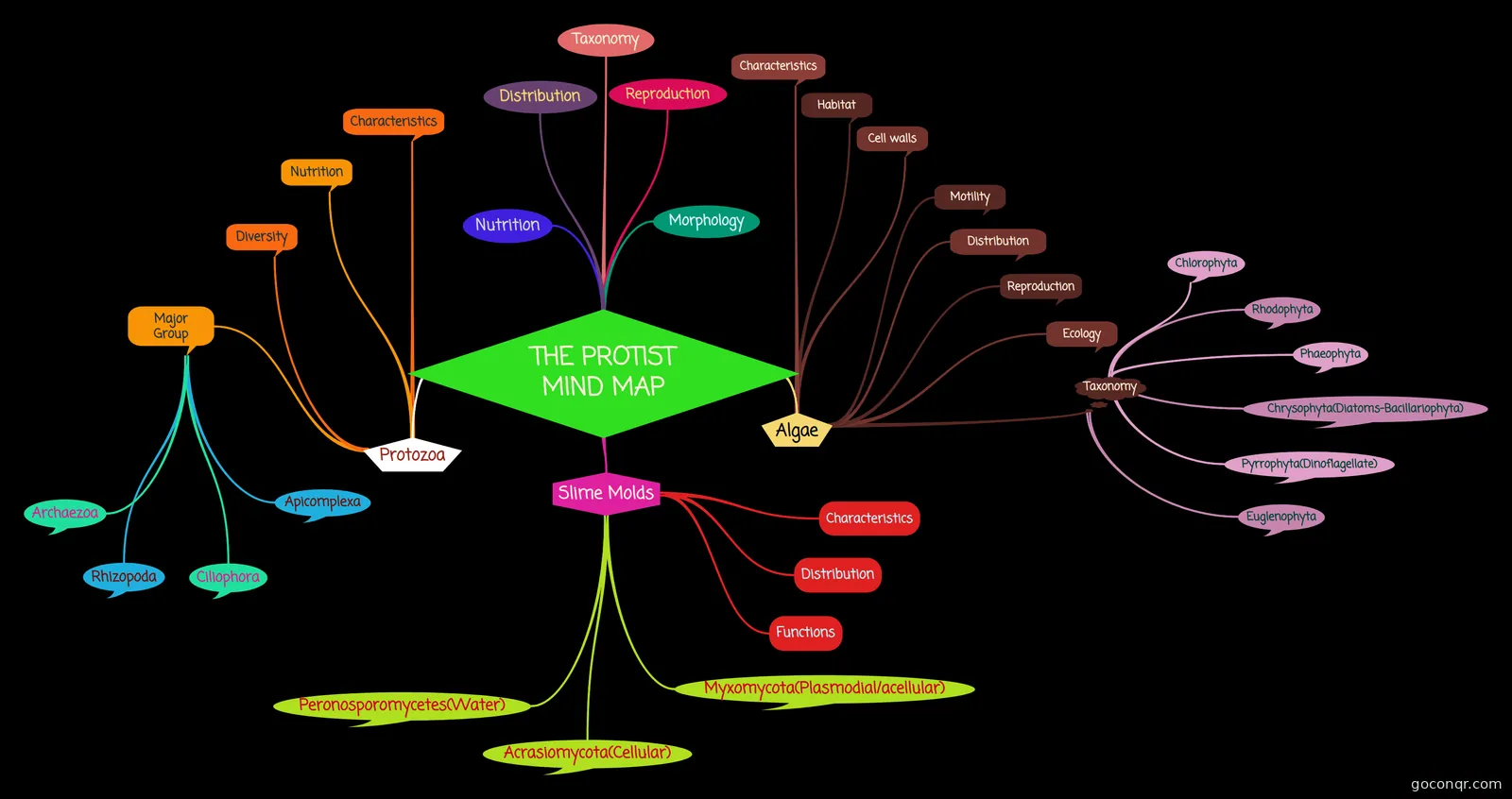
Mind map: protist
Inhalt der Mindmap
THE PROTIST MIND MAP
Distribution
- free living moist habitats chemoorganotrophic formsterrestrial and planktonic forms parasitic forms
Nutrition
- 1.Chemoheterotrophic -saprophyte -osmotrophy -holozoic nutrition 2.Photoautotrophic 3.Mixotrophic
Morphology
- 1. Plasma membrane similar to plants/animals 2. Cytoplasm divided into ectoplasm and endoplasm 3. Pellicle structure for support 4. Contractile vacuoles and phagocytic vacuoles 5. Energy production through mitochondria, chloroplast, hydrogenosomes 6. Cilia/flagella for motility/feeding
Reproduction
- Asexual through binary fission Sexual through gamete fusion
Protozoa
- Diversity
- 1. Microscopic 2. Occur singly/in colonies 3. Swim freely/contacts with substratum/be sedentary 4. Housed in a shell 5. Clothed in scales/be naked 6. May/may not be pigmented 7. Parasitic/symbiotic 8. Encystment
- Nutrition
- 1. Aerobic, anaerobic 2. Photosynthesis 3. Obtain food through ingestion, pinocytosis, phagocytosis, absorption
- Major Group
- Archaezoa
- 1. 2/more flagella 2. move in whiplike manner 3. free-living 4. parasitic-pathogenic 5. freshwater 6. Trypanosoma gambiense 7. African sleeping sickness 8. Live and grow in bloodstream
- Apicomplexa
- 1. Not motile in mature forms 2. Obligate parasites 3. Food absorbed through outer wall 4. Complex life cycle 5. Primarily animal parasites, insects 6. Plasmodium vivax-malaria 7. Toxoplasma-toxoplasmosis
- Rhizopoda
- 1. Amoebas 2. Amoeboid movement by pseudopods 3. Obtain food by phagocytosis 4. Live in freshwater, marine 5. Cause amoeboid dysentery 6. Fecal contamination 7. Amoeba proteus
- Ciliophora
- 1. Posess cilia 2. Micronucleus, macronucleus 3. Paramecium 4. Presence of gullet/cytostome 5. Live in freshwater, marine 6. Balantidium coli
- Archaezoa
- Characteristics
- 1. Large eukaryotes 2. No chlorophyll 3. Lack cell wall 4. Lack fruiting body 5. Unicellular 6. Parasitic, pathogenic 7. Aerobic, anaerobic chemoheterotrophs 8. Colourless, motile 9. Sexual and asexual reproduction 10. Found in water and soil
- Diversity
Algae
- Characteristics
- 1. Simple aquatic plants 2. Eukaryotic + chlorophyll and pigments 3. Lack of vascular conducting system 4. Simple reproductive structure 5. Photoautotrophic 6. Unicellular/in colonies 7. Simple/complex filaments 8. Macroscopic 9. Free-floating phytoplankton 10. Attached to rocks/bottom of sea
- Habitat
- 1. Freshwater, marine, brackish 2. Moist soils, fish tanks, pools 3. Few in dry soils 4. Acidic habitat
- Cell walls
- 1. Cellulose fibrils modified by addition of polysaccharide 2. Strengthened by calcium carbonate 3. Sometimes chitin/silica 4. No cell wall
- Motility
- 1. Single flagella-Euglena 2. 2/4 polar flagella-Chlorophyta 3. 2 flagella/different length & point of insertion-Dinoflagellates 4. Not motile in vegetative stage 5. Form motile gametes only during sexual reproduction
- Distribution
- 1. Aquatic:- a) Planktonic-suspended in aqueous environment b) Benthic-attached & living on the bottom of water c) Neustonic- at water-atmosphere interface 2. Terrestrial-moist rocks, trees, soil Endosymbionts in protozoa, worms, coral, fungi
- Reproduction
- 1. Asexual 2. Sexual - Fragmentation, Spores, Binary fission
- Ecology
- 1. Seaweed 2. Human food 3. Secondary products:- a) Alginic acid from brown algae b) Carrageenan from red algae c) Other applications 4. Macroscopic form 5. Primary producers of the ocean
- Taxonomy
- Chlorophyta
- 1. Green algae 2. Cellulose cell walls 3. Unicellular/multicellular 4. Chlorophyll a and b 5. Store glucose polymer 6. Gave rise to terrestrial plants
- Rhodophyta
- 1. Reddish 2. Delicately branched thalli 3. Chlorophylls a and d, phycocyanin, phycoerythrin 4. Red pigment absorb blue light 5. Multicellular 6. Cellulose/agar cell wall 7. Sexual reproduction 8. Storage material-glucose polymer 9. marine habitant
- Euglenophyta
- 1. Green 2. Unicellular 3. Chlorophylls a and b, carotene 4. Heterotrophic-spontaneously lost chlorophyll 5. No cell wall 6. Rigid plasma membrane-pellicle 7. No sexual reproduction 8. Storage material-glucose polymer 9. Freshwater, marine habitants
- Pyrrophyta(Dinoflagellate)
- 1. Brownish 2. Unicellular plankton 3. 2 flagella in perpendicular opposing grooves 4. Produce neurotoxins 5. Cause red tides 6. Chlorophylls a and c 7. Cellulose cell wall 8. Storage material-starch 9. Freshwater, marine habitants
- Chrysophyta(Diatoms-Bacillariophyta)
- 1. Golden brown 2. Produce domoic acid-domoic acid intoxication 3. Chlorophylls a and c 4. Unicellular 5. Peptin and silica cell wall 6. Sexual reproduction 7. Storage material-oil 8. Fresh water, marine, soil habitants 9. Important in global carbon cycling
- Phaeophyta
- 1. Brownish 2. Macroscopic 3. Chlorophylls a and c, xanthophylls 4. Multicellular 5. Cellulose/algin cell wall 6. Sexual reproduction 7. Storage material-carbohydrate 8. Marine habitant
- Chlorophyta
- Characteristics
Taxonomy
- Difficult to define
Slime Molds
- Characteristics
- 1. Resemble fungi in appearance and lifestyle 2. Different in cellular organization, reproduction, lifecycles
- Myxomycota(Plasmodial/acellular)
- 1. Glistening, viscous masses of slime 2. Saprophytes 3. Multinucleated 4. Motile amoeboid mass(plasmodium) 5. Lack cell wall 6. Phagocytosized dead material
- Peronosporomycetes(Water)
- 1. Diploid 'egg fungi' (oomycetes/oomycota) 2. No chitin in cell wall 3. Grow in cottony masses on dead algae 4. Parasites of fish gills 5. Plant diseases-blue mold or Irish potato blight 6. Sexual reproduction 7. Decomposers in aquatic ecosystems
- Acrasiomycota(Cellular)
- 1. Unicellular amoeboid cells 2. Feed phagocytically 3. Plentiful of food 4. Divide by mitosis, cytokinesis
- Distribution
- 1. Moist terrestrial habitats-soil, decaying wood, dung
- Functions
- 1. Engulf bacteria 2. Decomposer, producer 3. Recycle nutrients 4. Cause disease in plants
- Characteristics