
Mindmap
CLONING
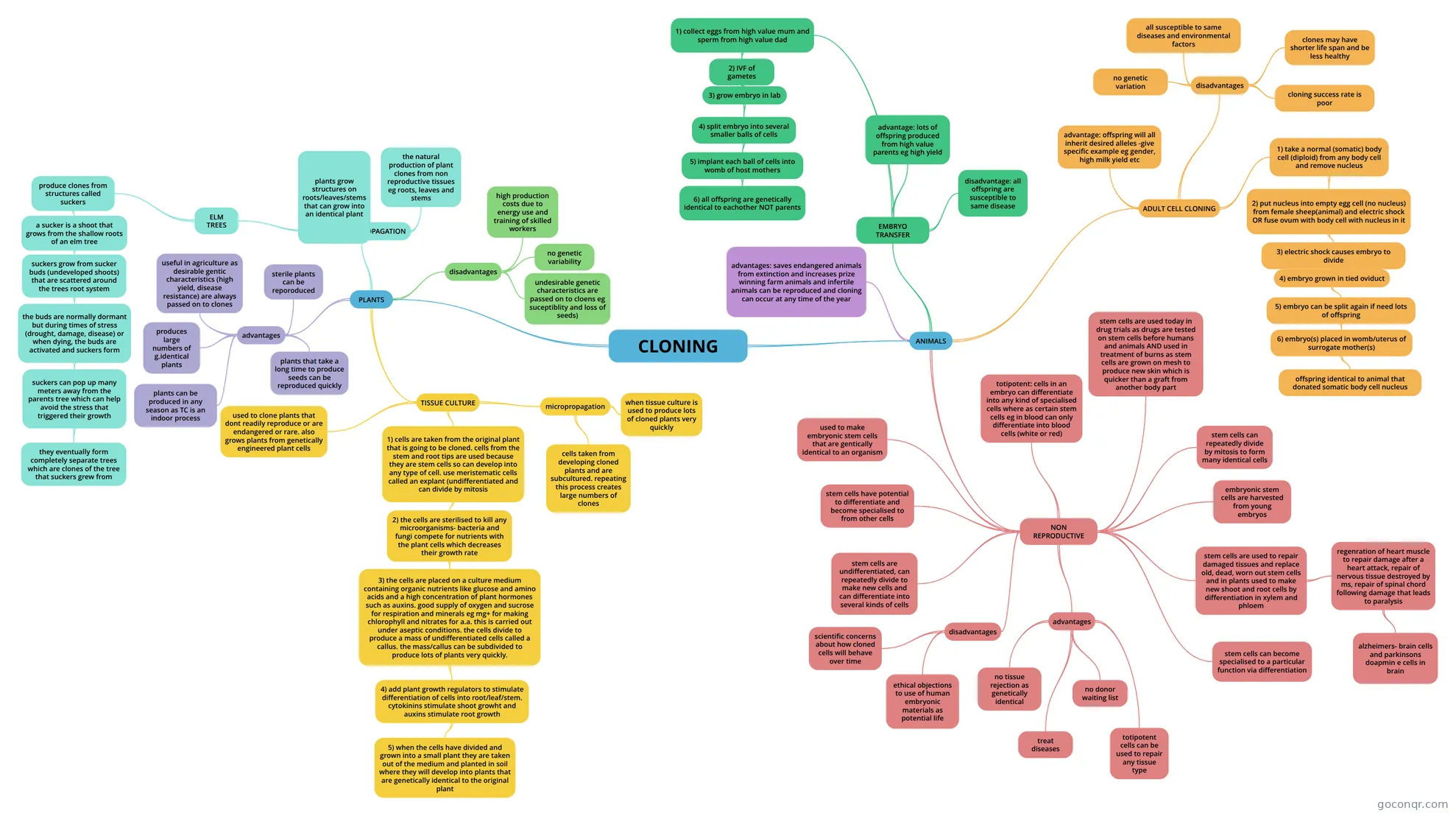
Mind map: Cloning techniques in plants and animals
Inhalt der Mindmap
CLONING
PLANTS
- TISSUE CULTURE
- 1) cells are taken from the original plant that is going to be cloned. cells from the stem and root tips are used because they are stem cells so can develop into any type of cell. use meristematic cells called an explant (undifferentiated and can divide by mitosis
- 2) the cells are sterilised to kill any microorganisms- bacteria and fungi compete for nutrients with the plant cells which decreases their growth rate
- 3) the cells are placed on a culture medium containing organic nutrients like glucose and amino acids and a high concentration of plant hormones such as auxins. good supply of oxygen and sucrose for respiration and minerals eg mg+ for making chlorophyll and nitrates for a.a. this is carried out under aseptic conditions. the cells divide to produce a mass of undifferentiated cells called a callus. the mass/callus can be subdivided to produce lots of plants very quickly.
- 4) add plant growth regulators to stimulate differentiation of cells into root/leaf/stem. cytokinins stimulate shoot growht and auxins stimulate root growth
- 5) when the cells have divided and grown into a small plant they are taken out of the medium and planted in soil where they will develop into plants that are genetically identical to the original plant
- 4) add plant growth regulators to stimulate differentiation of cells into root/leaf/stem. cytokinins stimulate shoot growht and auxins stimulate root growth
- 3) the cells are placed on a culture medium containing organic nutrients like glucose and amino acids and a high concentration of plant hormones such as auxins. good supply of oxygen and sucrose for respiration and minerals eg mg+ for making chlorophyll and nitrates for a.a. this is carried out under aseptic conditions. the cells divide to produce a mass of undifferentiated cells called a callus. the mass/callus can be subdivided to produce lots of plants very quickly.
- 2) the cells are sterilised to kill any microorganisms- bacteria and fungi compete for nutrients with the plant cells which decreases their growth rate
- used to clone plants that dont readily reproduce or are endangered or rare. also grows plants from genetically engineered plant cells
- micropropagation
- when tissue culture is used to produce lots of cloned plants very quickly
- cells taken from developing cloned plants and are subcultured. repeating this process creates large numbers of clones
- 1) cells are taken from the original plant that is going to be cloned. cells from the stem and root tips are used because they are stem cells so can develop into any type of cell. use meristematic cells called an explant (undifferentiated and can divide by mitosis
- VEGETATIVE PROPAGATION
- the natural production of plant clones from non reproductive tissues eg roots, leaves and stems
- plants grow structures on roots/leaves/stems that can grow into an identical plant
- ELM TREES
- produce clones from structures called suckers
- a sucker is a shoot that grows from the shallow roots of an elm tree
- suckers grow from sucker buds (undeveloped shoots) that are scattered around the trees root system
- the buds are normally dormant but during times of stress (drought, damage, disease) or when dying, the buds are activated and suckers form
- suckers can pop up many meters away from the parents tree which can help avoid the stress that triggered their growth
- they eventually form completely separate trees which are clones of the tree that suckers grew from
- suckers can pop up many meters away from the parents tree which can help avoid the stress that triggered their growth
- the buds are normally dormant but during times of stress (drought, damage, disease) or when dying, the buds are activated and suckers form
- suckers grow from sucker buds (undeveloped shoots) that are scattered around the trees root system
- a sucker is a shoot that grows from the shallow roots of an elm tree
- produce clones from structures called suckers
- advantages
- useful in agriculture as desirable gentic characteristics (high yield, disease resistance) are always passed on to clones
- plants can be produced in any season as TC is an indoor process
- sterile plants can be reporoduced
- plants that take a long time to produce seeds can be reproduced quickly
- produces large numbers of g.identical plants
- disadvantages
- undesirable genetic characteristics are passed on to cloens eg suceptiblity and loss of seeds)
- no genetic variability
- high production costs due to energy use and training of skilled workers
- TISSUE CULTURE
ANIMALS
- NON REPRODUCTIVE
- used to make embryonic stem cells that are gentically identical to an organism
- embryonic stem cells are harvested from young embryos
- stem cells have potential to differentiate and become specialised to from other cells
- stem cells are used to repair damaged tissues and replace old, dead, worn out stem cells and in plants used to make new shoot and root cells by differentiation in xylem and phloem
- regenration of heart muscle to repair damage after a heart attack, repair of nervous tissue destroyed by ms, repair of spinal chord following damage that leads to paralysis
- alzheimers- brain cells and parkinsons doapmin e cells in brain
- regenration of heart muscle to repair damage after a heart attack, repair of nervous tissue destroyed by ms, repair of spinal chord following damage that leads to paralysis
- advantages
- no tissue rejection as genetically identical
- no donor waiting list
- totipotent cells can be used to repair any tissue type
- treat diseases
- disadvantages
- ethical objections to use of human embryonic materials as potential life
- scientific concerns about how cloned cells will behave over time
- stem cells can repeatedly divide by mitosis to form many identical cells
- stem cells can become specialised to a particular function via differentiation
- stem cells are undifferentiated, can repeatedly divide to make new cells and can differentiate into several kinds of cells
- totipotent: cells in an embryo can differentiate into any kind of specialised cells where as certain stem cells eg in blood can only differentiate into blood cells (white or red)
- stem cells are used today in drug trials as drugs are tested on stem cells before humans and animals AND used in treatment of burns as stem cells are grown on mesh to produce new skin which is quicker than a graft from another body part
- EMBRYO TRANSFER
- 1) collect eggs from high value mum and sperm from high value dad
- 2) IVF of gametes
- 3) grow embryo in lab
- 4) split embryo into several smaller balls of cells
- 5) implant each ball of cells into womb of host mothers
- 6) all offspring are genetically identical to eachother NOT parents
- 5) implant each ball of cells into womb of host mothers
- 4) split embryo into several smaller balls of cells
- 3) grow embryo in lab
- 2) IVF of gametes
- advantage: lots of offspring produced from high value parents eg high yield
- disadvantage: all offspring are susceptible to same disease
- 1) collect eggs from high value mum and sperm from high value dad
- ADULT CELL CLONING
- 1) take a normal (somatic) body cell (diploid) from any body cell and remove nucleus
- 2) put nucleus into empty egg cell (no nucleus) from female sheep(animal) and electric shock OR fuse ovum with body cell with nucleus in it
- 3) electric shock causes embryo to divide
- 4) embryo grown in tied oviduct
- 5) embryo can be split again if need lots of offspring
- 6) embryo(s) placed in womb/uterus of surrogate mother(s)
- offspring identical to animal that donated somatic body cell nucleus
- 6) embryo(s) placed in womb/uterus of surrogate mother(s)
- 5) embryo can be split again if need lots of offspring
- 4) embryo grown in tied oviduct
- 3) electric shock causes embryo to divide
- 2) put nucleus into empty egg cell (no nucleus) from female sheep(animal) and electric shock OR fuse ovum with body cell with nucleus in it
- advantage: offspring will all inherit desired alleles -give specific example eg gender, high milk yield etc
- disadvantages
- no genetic variation
- all susceptible to same diseases and environmental factors
- clones may have shorter life span and be less healthy
- cloning success rate is poor
- 1) take a normal (somatic) body cell (diploid) from any body cell and remove nucleus
- advantages: saves endangered animals from extinction and increases prize winning farm animals and infertile animals can be reproduced and cloning can occur at any time of the year
- NON REPRODUCTIVE
Informationen
- Beschreibung
- Mindmap am CLONING, erstellt von shannon.kelly4 am 22/11/2015.
- Erstellt von
- shannon.kelly4
- Aufrufe
- 0
- Bewertung
Mehr zu Cloning Plants and Animals