
Mindmap
ccw - causes
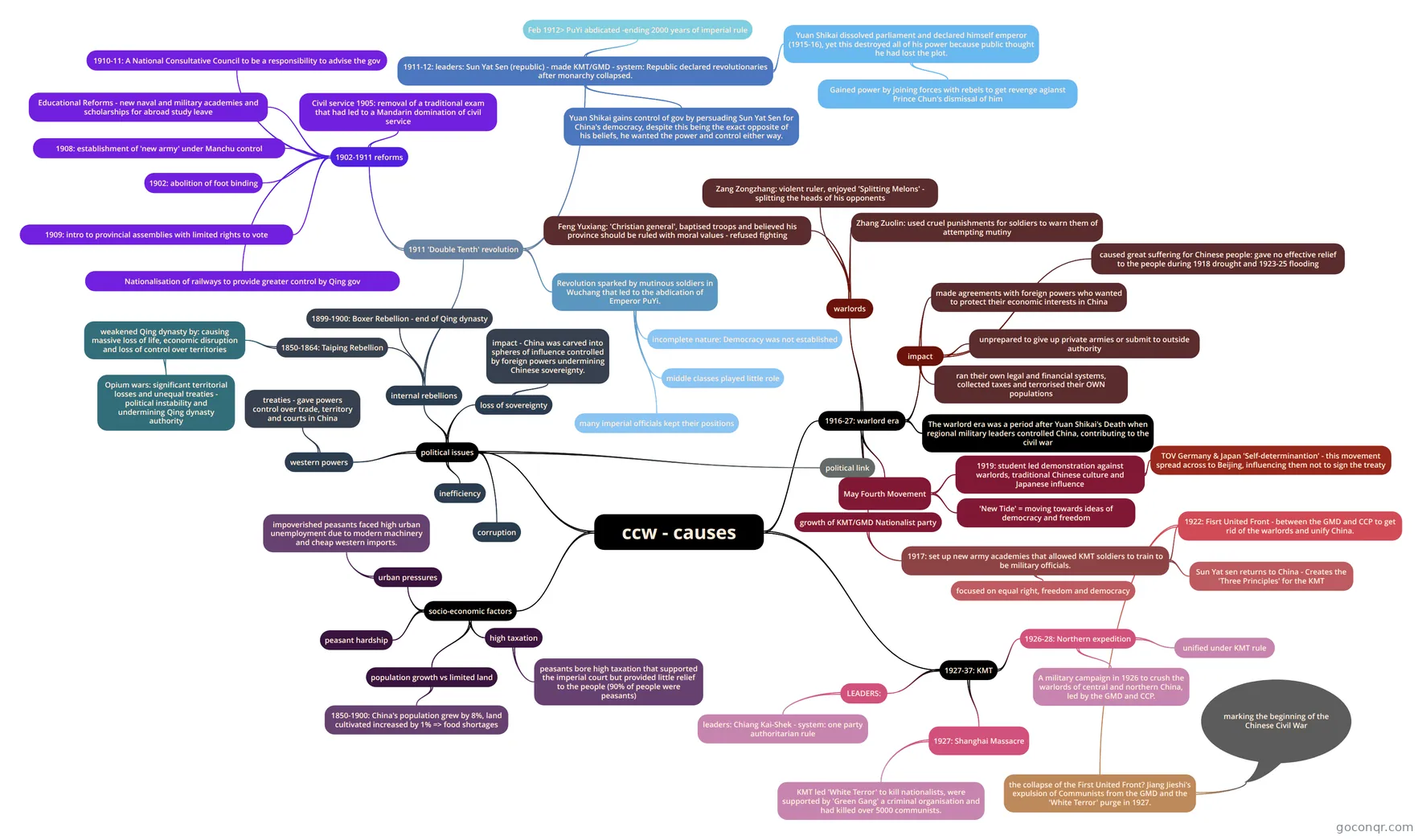
Mind map: Causes of the Chinese Civil War
Inhalt der Mindmap
ccw - causes
socio-economic factors
- peasant hardship
- population growth vs limited land
- 1850-1900: China's population grew by 8%, land cultivated increased by 1% => food shortages
- high taxation
- peasants bore high taxation that supported the imperial court but provided little relief to the people (90% of people were peasants)
- urban pressures
- impoverished peasants faced high urban unemployment due to modern machinery and cheap western imports.
political issues
- western powers
- treaties - gave powers control over trade, territory and courts in China
- loss of sovereignty
- impact - China was carved into spheres of influence controlled by foreign powers undermining Chinese sovereignty.
- corruption
- inefficiency
- internal rebellions
- 1850-1864: Taiping Rebellion
- weakened Qing dynasty by: causing massive loss of life, economic disruption and loss of control over territories
- Opium wars: significant territorial losses and unequal treaties - political instability and undermining Qing dynasty authority
- weakened Qing dynasty by: causing massive loss of life, economic disruption and loss of control over territories
- 1899-1900: Boxer Rebellion - end of Qing dynasty
- 1911 'Double Tenth' revolution
- Revolution sparked by mutinous soldiers in Wuchang that led to the abdication of Emperor PuYi.
- incomplete nature: Democracy was not established
- middle classes played little role
- many imperial officials kept their positions
- 1902-1911 reforms
- 1908: establishment of 'new army' under Manchu control
- 1909: intro to provincial assemblies with limited rights to vote
- 1902: abolition of foot binding
- Educational Reforms - new naval and military academies and scholarships for abroad study leave
- 1910-11: A National Consultative Council to be a responsibility to advise the gov
- Nationalisation of railways to provide greater control by Qing gov
- Civil service 1905: removal of a traditional exam that had led to a Mandarin domination of civil service
- 1911-12: leaders: Sun Yat Sen (republic) - made KMT/GMD - system: Republic declared revolutionaries after monarchy collapsed.
- Yuan Shikai gains control of gov by persuading Sun Yat Sen for China's democracy, despite this being the exact opposite of his beliefs, he wanted the power and control either way.
- Feb 1912> PuYi abdicated -ending 2000 years of imperial rule
- Yuan Shikai dissolved parliament and declared himself emperor (1915-16), yet this destroyed all of his power because public thought he had lost the plot.
- Gained power by joining forces with rebels to get revenge agianst Prince Chun's dismissal of him
- Revolution sparked by mutinous soldiers in Wuchang that led to the abdication of Emperor PuYi.
- 1850-1864: Taiping Rebellion
- political link
- western powers
1916-27: warlord era
- May Fourth Movement
- 1919: student led demonstration against warlords, traditional Chinese culture and Japanese influence
- TOV Germany & Japan 'Self-determinantion' - this movement spread across to Beijing, influencing them not to sign the treaty
- 'New Tide' = moving towards ideas of democracy and freedom
- 1919: student led demonstration against warlords, traditional Chinese culture and Japanese influence
- growth of KMT/GMD Nationalist party
- 1917: set up new army academies that allowed KMT soldiers to train to be military officials.
- focused on equal right, freedom and democracy
- 1922: Fisrt United Front - between the GMD and CCP to get rid of the warlords and unify China.
- the collapse of the First United Front? Jiang Jieshi's expulsion of Communists from the GMD and the 'White Terror' purge in 1927.
- marking the beginning of the Chinese Civil War
- the collapse of the First United Front? Jiang Jieshi's expulsion of Communists from the GMD and the 'White Terror' purge in 1927.
- Sun Yat sen returns to China - Creates the 'Three Principles' for the KMT
- 1917: set up new army academies that allowed KMT soldiers to train to be military officials.
- The warlord era was a period after Yuan Shikai's Death when regional military leaders controlled China, contributing to the civil war
- warlords
- Feng Yuxiang: 'Christian general', baptised troops and believed his province should be ruled with moral values - refused fighting
- Zang Zongzhang: violent ruler, enjoyed 'Splitting Melons' - splitting the heads of his opponents
- Zhang Zuolin: used cruel punishments for soldiers to warn them of attempting mutiny
- impact
- ran their own legal and financial systems, collected taxes and terrorised their OWN populations
- unprepared to give up private armies or submit to outside authority
- made agreements with foreign powers who wanted to protect their economic interests in China
- caused great suffering for Chinese people: gave no effective relief to the people during 1918 drought and 1923-25 flooding
- May Fourth Movement
1927-37: KMT
- 1926-28: Northern expedition
- A military campaign in 1926 to crush the warlords of central and northern China, led by the GMD and CCP.
- unified under KMT rule
- 1927: Shanghai Massacre
- KMT led 'White Terror' to kill nationalists, were supported by 'Green Gang' a criminal organisation and had killed over 5000 communists.
- LEADERS:
- leaders: Chiang Kai-Shek - system: one party authoritarian rule
- 1926-28: Northern expedition
Informationen
- Beschreibung
- Mindmap for causes of Chines Civil War
- Erstellt von
- D K
- Aufrufe
- 15
- Tags
- Bewertung