
Mindmap
EN6 - Thyroid Gland 1
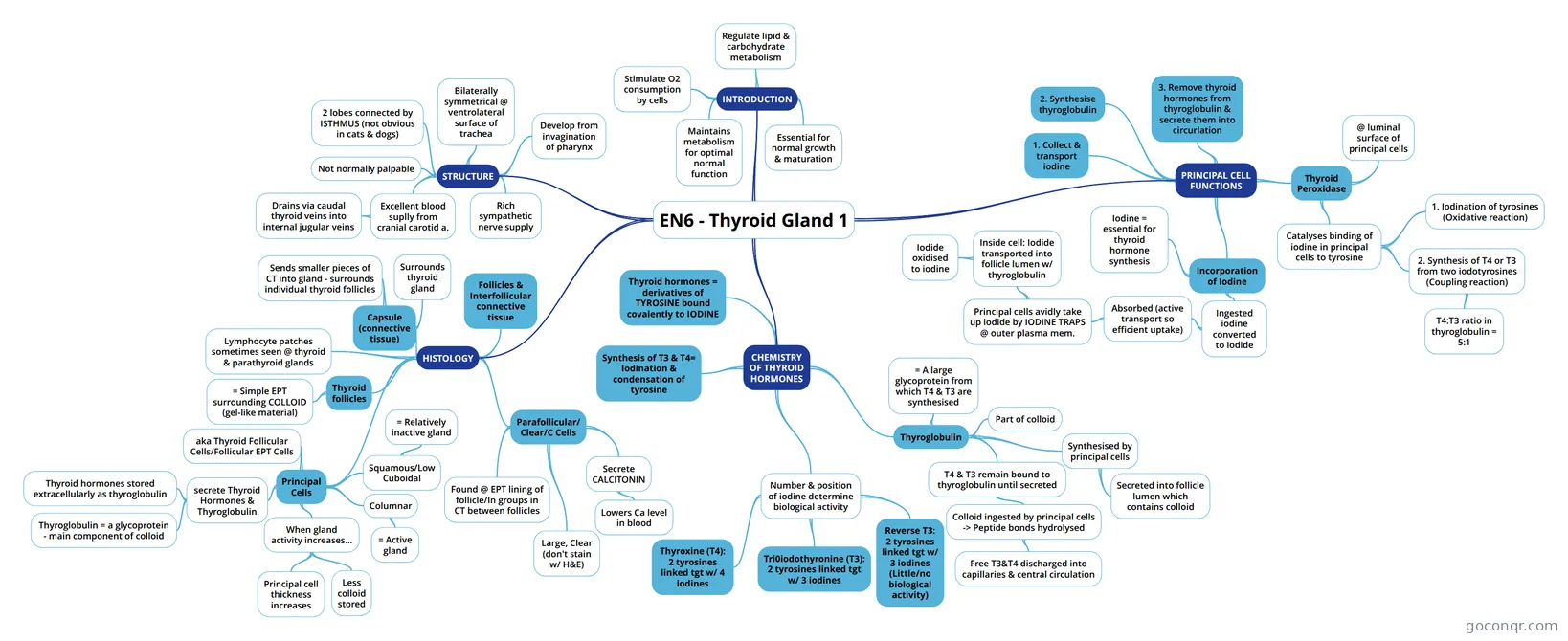
Mind map: Thyroid Gland Structure and Function
Inhalt der Mindmap
EN6 - Thyroid Gland 1
INTRODUCTION
- Maintains metabolism for optimal normal function
- Stimulate O2 consumption by cells
- Regulate lipid & carbohydrate metabolism
- Essential for normal growth & maturation
STRUCTURE
- Develop from invagination of pharynx
- Bilaterally symmetrical @ ventrolateral surface of trachea
- 2 lobes connected by ISTHMUS (not obvious in cats & dogs)
- Not normally palpable
- Excellent blood suplly from cranial carotid a.
- Drains via caudal thyroid veins into internal jugular veins
- Rich sympathetic nerve supply
HISTOLOGY
- Follicles & Interfollicular connective tissue
- Capsule (connective tissue)
- Surrounds thyroid gland
- Sends smaller pieces of CT into gland - surrounds individual thyroid follicles
- Lymphocyte patches sometimes seen @ thyroid & parathyroid glands
- Thyroid follicles
- = Simple EPT surrounding COLLOID (gel-like material)
- Principal Cells
- aka Thyroid Follicular Cells/Follicular EPT Cells
- secrete Thyroid Hormones & Thyroglobulin
- Thyroid hormones stored extracellularly as thyroglobulin
- Thyroglobulin = a glycoprotein - main component of colloid
- When gland activity increases...
- Principal cell thickness increases
- Less colloid stored
- Squamous/Low Cuboidal
- = Relatively inactive gland
- Columnar
- = Active gland
- Parafollicular/ Clear/C Cells
- Found @ EPT lining of follicle/In groups in CT between follicles
- Large, Clear (don't stain w/ H&E)
- Secrete CALCITONIN
- Lowers Ca level in blood
CHEMISTRY OF THYROID HORMONES
- Thyroid hormones = derivatives of TYROSINE bound covalently to IODINE
- Number & position of iodine determine biological activity
- Thyroxine (T4): 2 tyrosines linked tgt w/ 4 iodines
- Tri0iodothyronine (T3): 2 tyrosines linked tgt w/ 3 iodines
- Reverse T3: 2 tyrosines linked tgt w/ 3 iodines (Little/no biological activity)
- Thyroglobulin
- = A large glycoprotein from which T4 & T3 are synthesised
- Part of colloid
- Synthesised by principal cells
- Secreted into follicle lumen which contains colloid
- T4 & T3 remain bound to thyroglobulin until secreted
- Colloid ingested by principal cells -> Peptide bonds hydrolysed
- Free T3&T4 discharged into capillaries & central circulation
- Colloid ingested by principal cells -> Peptide bonds hydrolysed
- Synthesis of T3 & T4= Iodination & condensation of tyrosine
PRINCIPAL CELL FUNCTIONS
- 1. Collect & transport iodine
- 2. Synthesise thyroglobulin
- 3. Remove thyroid hormones from thyroglobulin & secrete them into circurlation
- Incorporation of Iodine
- Iodine = essential for thyroid hormone synthesis
- Ingested iodine converted to iodide
- Absorbed (active transport so efficient uptake)
- Principal cells avidly take up iodide by IODINE TRAPS @ outer plasma mem.
- Inside cell: Iodide transported into follicle lumen w/ thyroglobulin
- Iodide oxidised to iodine
- Inside cell: Iodide transported into follicle lumen w/ thyroglobulin
- Principal cells avidly take up iodide by IODINE TRAPS @ outer plasma mem.
- Absorbed (active transport so efficient uptake)
- Thyroid Peroxidase
- Catalyses binding of iodine in principal cells to tyrosine
- 1. Iodination of tyrosines (Oxidative reaction)
- 2. Synthesis of T4 or T3 from two iodotyrosines (Coupling reaction)
- T4:T3 ratio in thyroglobulin = 5:1
- @ luminal surface of principal cells
- Catalyses binding of iodine in principal cells to tyrosine
Informationen
- Beschreibung
- AB3 Endocrinology Mindmap am EN6 - Thyroid Gland 1, erstellt von Letitia Pang am 30/01/2016.
- Erstellt von
- Letitia Pang
- Aufrufe
- 0
- Bewertung