
Mindmap
Cognitive psychology
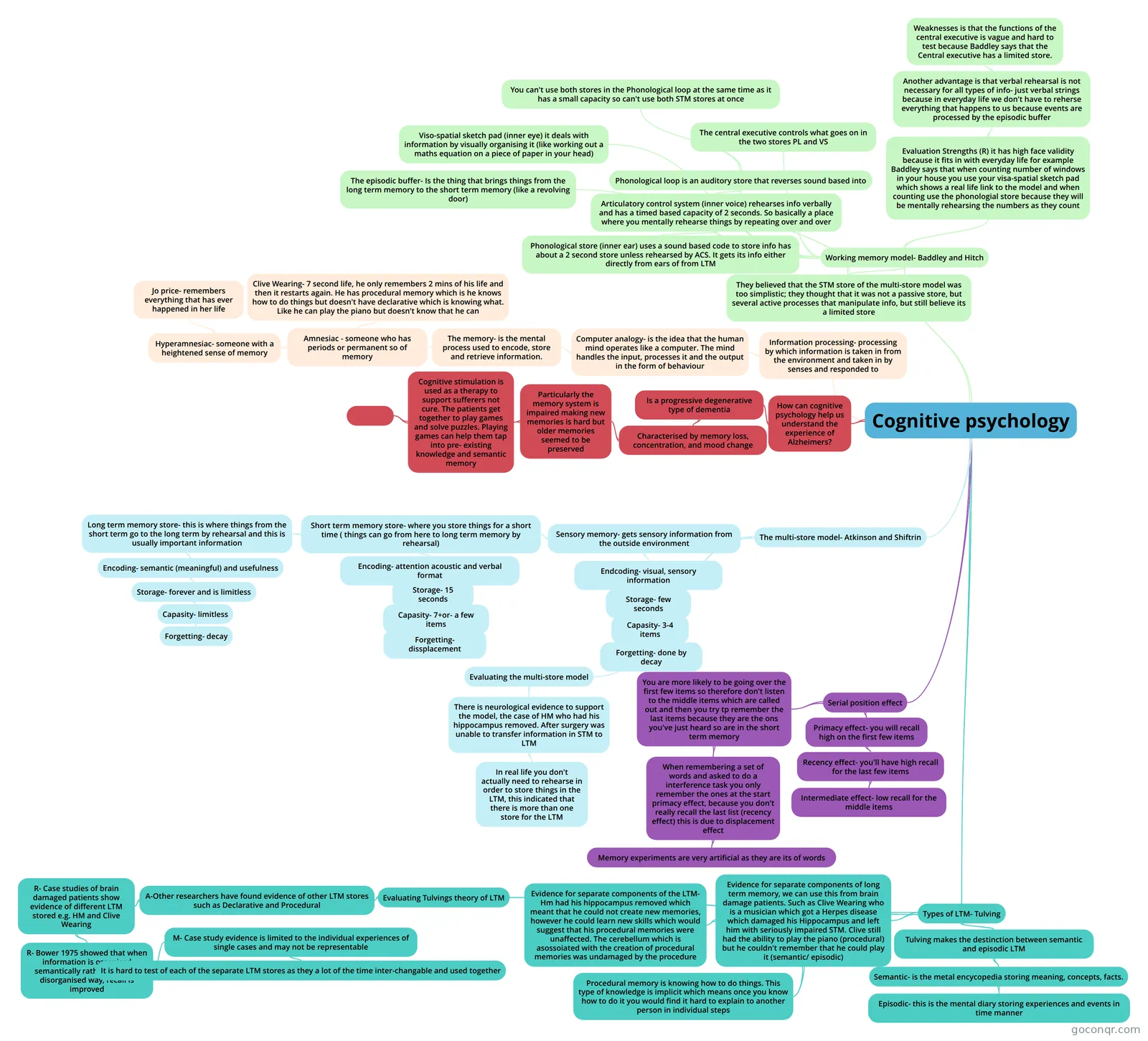
Mind map: Cognitive psychology
Inhalt der Mindmap
Cognitive psychology
How can cognitive psychology help us understand the experience of Alzheimers?
- Is a progressive degenerative type of dementia
- Characterised by memory loss, concentration, and mood change
- Particularly the memory system is impaired making new memories is hard but older memories seemed to be preserved
- Cognitive stimulation is used as a therapy to support sufferers not cure. The patients get together to play games and solve puzzles. Playing games can help them tap into pre- existing knowledge and semantic memory
- Cognitive stimulation is used as a therapy to support sufferers not cure. The patients get together to play games and solve puzzles. Playing games can help them tap into pre- existing knowledge and semantic memory
- Particularly the memory system is impaired making new memories is hard but older memories seemed to be preserved
- Characterised by memory loss, concentration, and mood change
- Is a progressive degenerative type of dementia
The multi-store model- Atkinson and Shiftrin
- Sensory memory- gets sensory information from the outside environment
- Endcoding- visual, sensory information
- Storage- few seconds
- Capasity- 3-4 items
- Forgetting- done by decay
- Capasity- 3-4 items
- Storage- few seconds
- Short term memory store- where you store things for a short time ( things can go from here to long term memory by rehearsal)
- Encoding- attention acoustic and verbal format
- Storage- 15 seconds
- Capasity- 7+or- a few items
- Forgetting- dissplacement
- Capasity- 7+or- a few items
- Storage- 15 seconds
- Long term memory store- this is where things from the short term go to the long term by rehearsal and this is usually important information
- Encoding- semantic (meaningful) and usefulness
- Storage- forever and is limitless
- Capasity- limitless
- Forgetting- decay
- Capasity- limitless
- Storage- forever and is limitless
- Encoding- semantic (meaningful) and usefulness
- Encoding- attention acoustic and verbal format
- Endcoding- visual, sensory information
- Evaluating the multi-store model
- There is neurological evidence to support the model, the case of HM who had his hippocampus removed. After surgery was unable to transfer information in STM to LTM
- In real life you don't actually need to rehearse in order to store things in the LTM, this indicated that there is more than one store for the LTM
- There is neurological evidence to support the model, the case of HM who had his hippocampus removed. After surgery was unable to transfer information in STM to LTM
- Sensory memory- gets sensory information from the outside environment
Information processing- processing by which information is taken in from the environment and taken in by senses and responded to
- Computer analogy- is the idea that the human mind operates like a computer. The mind handles the input, processes it and the output in the form of behaviour
- The memory- is the mental process used to encode, store and retrieve information.
- Amnesiac - someone who has periods or permanent so of memory
- Hyperamnesiac- someone with a heightened sense of memory
- Jo price- remembers everything that has ever happened in her life
- Clive Wearing- 7 second life, he only remembers 2 mins of his life and then it restarts again. He has procedural memory which is he knows how to do things but doesn't have declarative which is knowing what. Like he can play the piano but doesn't know that he can
- Hyperamnesiac- someone with a heightened sense of memory
- Amnesiac - someone who has periods or permanent so of memory
- The memory- is the mental process used to encode, store and retrieve information.
- Computer analogy- is the idea that the human mind operates like a computer. The mind handles the input, processes it and the output in the form of behaviour
Serial position effect
- Primacy effect- you will recall high on the first few items
- Recency effect- you'll have high recall for the last few items
- Intermediate effect- low recall for the middle items
- Recency effect- you'll have high recall for the last few items
- You are more likely to be going over the first few items so therefore don't listen to the middle items which are called out and then you try tp remember the last items because they are the ons you've just heard so are in the short term memory
- When remembering a set of words and asked to do a interference task you only remember the ones at the start primacy effect, because you don't really recall the last list (recency effect) this is due to displacement effect
- Memory experiments are very artificial as they are its of words
- When remembering a set of words and asked to do a interference task you only remember the ones at the start primacy effect, because you don't really recall the last list (recency effect) this is due to displacement effect
- Primacy effect- you will recall high on the first few items
Types of LTM- Tulving
- Evidence for separate components of long term memory, we can use this from brain damage patients. Such as Clive Wearing who is a musician which got a Herpes disease which damaged his Hippocampus and left him with seriously impaired STM. Clive still had the ability to play the piano (procedural) but he couldn't remember that he could play it (semantic/ episodic)
- Evidence for separate components of the LTM- Hm had his hippocampus removed which meant that he could not create new memories, however he could learn new skills which would suggest that his procedural memories were unaffected. The cerebellum which is asossoiated with the creation of procedural memories was undamaged by the procedure
- Procedural memory is knowing how to do things. This type of knowledge is implicit which means once you know how to do it you would find it hard to explain to another person in individual steps
- Tulving makes the destinction between semantic and episodic LTM
- Semantic- is the metal encycopedia storing meaning, concepts, facts.
- Episodic- this is the mental diary storing experiences and events in time manner
- Semantic- is the metal encycopedia storing meaning, concepts, facts.
- Evaluating Tulvings theory of LTM
- A-Other researchers have found evidence of other LTM stores such as Declarative and Procedural
- R- Case studies of brain damaged patients show evidence of different LTM stored e.g. HM and Clive Wearing
- R- Bower 1975 showed that when information is organised semantically rather than in a disorganised way, recall is improved
- M- Case study evidence is limited to the individual experiences of single cases and may not be representable
- It is hard to test of each of the separate LTM stores as they a lot of the time inter-changable and used together
- M- Case study evidence is limited to the individual experiences of single cases and may not be representable
- R- Bower 1975 showed that when information is organised semantically rather than in a disorganised way, recall is improved
- R- Case studies of brain damaged patients show evidence of different LTM stored e.g. HM and Clive Wearing
- A-Other researchers have found evidence of other LTM stores such as Declarative and Procedural
- Evidence for separate components of long term memory, we can use this from brain damage patients. Such as Clive Wearing who is a musician which got a Herpes disease which damaged his Hippocampus and left him with seriously impaired STM. Clive still had the ability to play the piano (procedural) but he couldn't remember that he could play it (semantic/ episodic)
Working memory model- Baddley and Hitch
- They believed that the STM store of the multi-store model was too simplistic; they thought that it was not a passive store, but several active processes that manipulate info, but still believe its a limited store
- Phonological loop is an auditory store that reverses sound based into
- Articulatory control system (inner voice) rehearses info verbally and has a timed based capacity of 2 seconds. So basically a place where you mentally rehearse things by repeating over and over
- Phonological store (inner ear) uses a sound based code to store info has about a 2 second store unless rehearsed by ACS. It gets its info either directly from ears of from LTM
- You can't use both stores in the Phonological loop at the same time as it has a small capacity so can't use both STM stores at once
- Articulatory control system (inner voice) rehearses info verbally and has a timed based capacity of 2 seconds. So basically a place where you mentally rehearse things by repeating over and over
- Phonological loop is an auditory store that reverses sound based into
- Viso-spatial sketch pad (inner eye) it deals with information by visually organising it (like working out a maths equation on a piece of paper in your head)
- The episodic buffer- Is the thing that brings things from the long term memory to the short term memory (like a revolving door)
- Evaluation Strengths (R) it has high face validity because it fits in with everyday life for example Baddley says that when counting number of windows in your house you use your visa-spatial sketch pad which shows a real life link to the model and when counting use the phonologial store because they will be mentally rehearsing the numbers as they count
- Another advantage is that verbal rehearsal is not necessary for all types of info- just verbal strings because in everyday life we don't have to reherse everything that happens to us because events are processed by the episodic buffer
- Weaknesses is that the functions of the central executive is vague and hard to test because Baddley says that the Central executive has a limited store.
- Another advantage is that verbal rehearsal is not necessary for all types of info- just verbal strings because in everyday life we don't have to reherse everything that happens to us because events are processed by the episodic buffer
- The central executive controls what goes on in the two stores PL and VS
- They believed that the STM store of the multi-store model was too simplistic; they thought that it was not a passive store, but several active processes that manipulate info, but still believe its a limited store
Informationen
- Beschreibung
- Mindmap am Cognitive psychology, erstellt von Sasha salsa am 20/04/2016.
- Erstellt von
- Sasha salsa
- Aufrufe
- 0
- Bewertung