
Mindmap
Research Methods
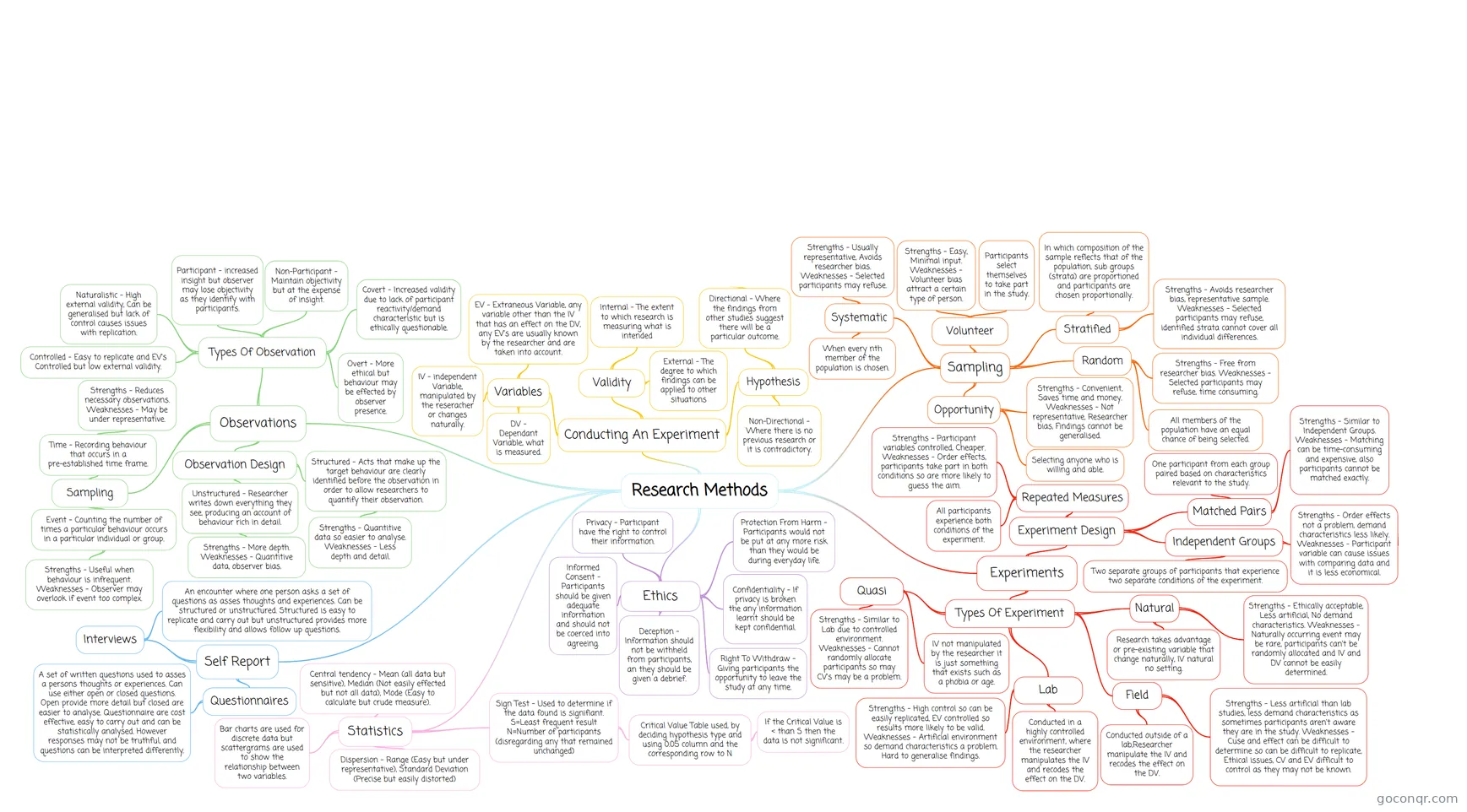
Mind map: Research methods
Inhalt der Mindmap
Research Methods
Conducting An Experiment
- Hypothesis
- Directional - Where the findings from other studies suggest there will be a particular outcome.
- Non-Directional - Where there is no previous research or it is contradictory.
- Directional - Where the findings from other studies suggest there will be a particular outcome.
- Variables
- IV - independent Variable, manipulated by the reseracher or changes naturally.
- DV - Dependant Variable, what is measured.
- EV - Extraneous Variable, any variable other than the IV that has an effect on the DV, any EV's are usually known by the researcher and are taken into account.
- Validity
- Internal - The extent to which research is measuring what is intended
- External - The degree to which findings can be applied to other situations
- Hypothesis
Experiments
- Experiment Design
- Repeated Measures
- Strengths - Participant variables controlled, Cheaper. Weaknesses - Order effects, participants take part in both conditions so are more likely to guess the aim.
- All participants experience both conditions of the experiment.
- Matched Pairs
- Strengths - Similar to Independent Groups. Weaknesses - Matching can be time-consuming and expensive, also participants cannot be matched exactly.
- One participant from each group paired based on characteristics relevant to the study.
- Independent Groups
- Two separate groups of participants that experience two separate conditions of the experiment.
- Strengths - Order effects not a problem, demand characteristics less likely. Weaknesses - Participant variable can cause issues with comparing data and it is less economical.
- Repeated Measures
- Types Of Experiment
- Quasi
- Strengths - Similar to Lab due to controlled environment. Weaknesses - Cannot randomly allocate participants so may CV's may be a problem.
- IV not manipulated by the researcher it is just something that exists such as a phobia or age.
- Field
- Strengths - Less artificial than lab studies, less demand characteristics as sometimes participants aren't aware they are in the study. Weaknesses - Cuse and effect can be difficult to determine so can be difficult to replicate, Ethical issues, CV and EV difficult to control as they may not be known.
- Conducted outside of a lab,Researcher manipulate the IV and recodes the effect on the DV.
- Natural
- Strengths - Ethically acceptable, Less artificial, No demand characteristics. Weaknesses - Naturally occurring event may be rare, participants can't be randomly allocated and IV and DV cannot be easily determined.
- Research takes advantage or pre-existing variable that change naturally, IV natural no setting.
- Lab
- Strengths - High control so can be easily replicated, EV controlled so results more likely to be valid. Weaknesses - Artificial environment so demand characteristics a problem, Hard to generalise findings.
- Conducted in a highly controlled environment, where the researcher manipulates the IV and recodes the effect on the DV.
- Quasi
- Experiment Design
Ethics
- Deception - Information should not be withheld from participants, an they should be given a debrief.
- Protection From Harm - Participants would not be put at any more risk than they would be during everyday life.
- Privacy - Participant have the right to control their information.
- Confidentiality - If privacy is broken the any information learnt should be kept confidential.
- Informed Consent - Participants should be given adequate information and should not be coerced into agreeing.
- Right To Withdraw - Giving participants the opportunity to leave the study at any time.
Observations
- Types Of Observation
- Naturalistic - High external validity, Can be generalised but lack of control causes issues with replication.
- Controlled - Easy to replicate and EV's Controlled but low external validity.
- Covert - Increased validity due to lack of participant reactivity/demand characteristic but is ethically questionable.
- Overt - More ethical but behaviour may be effected by observer presence.
- Non-Participant - Maintain objectivity but at the expense of insight.
- Participant - increased insight but observer may lose objectivity as they identify with participants.
- Observation Design
- Unstructured - Researcher writes down everything they see, producing an account of behaviour rich in detail.
- Strengths - More depth. Weaknesses - Quantitive data, observer bias.
- Structured - Acts that make up the target behaviour are clearly identified before the observation in order to allow researchers to quantify their observation.
- Strengths - Quantitive data so easier to analyse. Weaknesses - Less depth and detail.
- Unstructured - Researcher writes down everything they see, producing an account of behaviour rich in detail.
- Sampling
- Event - Counting the number of times a particular behaviour occurs in a particular individual or group.
- Strengths - Useful when behaviour is infrequent. Weaknesses - Observer may overlook if event too complex.
- Time - Recording behaviour that occurs in a pre-established time frame.
- Strengths - Reduces necessary observations. Weaknesses - May be under representative.
- Event - Counting the number of times a particular behaviour occurs in a particular individual or group.
- Types Of Observation
Self Report
- Questionnaires
- A set of written questions used to asses a persons thoughts or experiences. Can use either open or closed questions. Open provide more detail but closed are easier to analyse. Questionnaire are cost effective, easy to carry out and can be statistically analysed. However responses may not be truthful, and questions can be interpreted differently.
- Interviews
- An encounter where one person asks a set of questions as asses thoughts and experiences. Can be structured or unstructured. Structured is easy to replicate and carry out but unstructured provides more flexibility and allows follow up questions.
- Questionnaires
Statistics
- Central tendency - Mean (all data but sensitive), Median (Not easily effected but not all data), Mode (Easy to calculate but crude measure).
- Dispersion - Range (Easy but under representative), Standard Deviation (Precise but easily distorted)
- Bar charts are used for discrete data but scattergrams are used to show the relationship between two variables.
- Sign Test - Used to determine if the data found is signifiant. S=Least frequent result N=Number of participants (disregarding any that remained unchanged)
- Critical Value Table used, by deciding hypothesis type and using 0.05 column and the corresponding row to N
- If the Critical Value is < than S then the data is not significant.
- Critical Value Table used, by deciding hypothesis type and using 0.05 column and the corresponding row to N
Sampling
- Systematic
- When every nth member of the population is chosen.
- Strengths - Usually representative, Avoids researcher bias. Weaknesses - Selected participants may refuse.
- Stratified
- In which composition of the sample reflects that of the population, sub groups (strata) are proportioned and participants are chosen proportionally.
- Strengths - Avoids researcher bias, representative sample. Weaknesses - Selected participants may refuse, identified strata cannot cover all individual differences.
- Random
- All members of the population have an equal chance of being selected.
- Strengths - Free from researcher bias. Weaknesses - Selected participants may refuse, time consuming.
- Volunteer
- Participants select themselves to take part in the study.
- Strengths - Easy, Minimal input. Weaknesses - Volunteer bias attract a certain type of person.
- Opportunity
- Selecting anyone who is willing and able.
- Strengths - Convenient, Saves time and money. Weaknesses - Not representative, Researcher bias, Findings cannot be generalised.
- Systematic
Informationen
- Beschreibung
- A-Level Psychology (Research Methods) Mindmap am Research Methods, erstellt von Emmie Westley am 28/10/2016.
- Erstellt von
- Emmie Westley
- Aufrufe
- 5
- Verlauf
-
- Erstellt von Emmie Westley · 25 Okt 2016
- Kopiert von Emmie Westley · 25 Okt 2016
- Kopiert von Emmie Westley · 28 Okt 2016
- Bewertung