
Mindmap
PCR
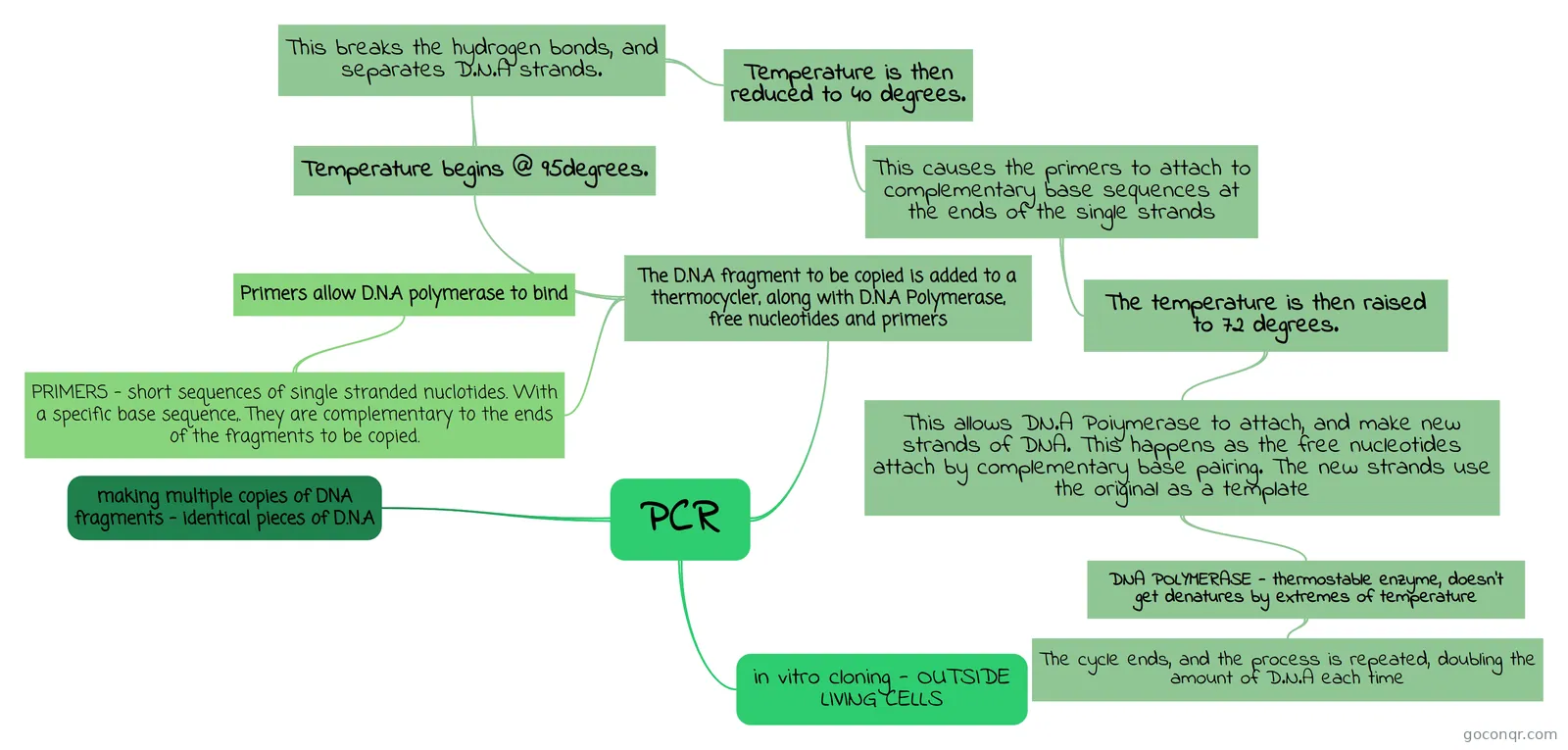
Mind map: PCR
Inhalt der Mindmap
PCR
making multiple copies of DNA fragments - identical pieces of D.N.A
The D.N.A fragment to be copied is added to a thermocycler, along with D.N.A Polymerase, free nucleotides and primers
- Temperature begins @ 95degrees.
- This breaks the hydrogen bonds, and separates D.N.A strands.
- Temperature is then reduced to 40 degrees.
- This causes the primers to attach to complementary base sequences at the ends of the single strands
- The temperature is then raised to 72 degrees.
- This allows DN.A Poiymerase to attach, and make new strands of DNA. This happens as the free nucleotides attach by complementary base pairing. The new strands use the original as a template
- DNA POLYMERASE - thermostable enzyme, doesn't get denatures by extremes of temperature
- The cycle ends, and the process is repeated, doubling the amount of D.N.A each time
- DNA POLYMERASE - thermostable enzyme, doesn't get denatures by extremes of temperature
- This allows DN.A Poiymerase to attach, and make new strands of DNA. This happens as the free nucleotides attach by complementary base pairing. The new strands use the original as a template
- The temperature is then raised to 72 degrees.
- This causes the primers to attach to complementary base sequences at the ends of the single strands
- Temperature is then reduced to 40 degrees.
- This breaks the hydrogen bonds, and separates D.N.A strands.
- PRIMERS - short sequences of single stranded nuclotides. With a specific base sequence,. They are complementary to the ends of the fragments to be copied.
- Primers allow D.N.A polymerase to bind
- Temperature begins @ 95degrees.
in vitro cloning - OUTSIDE LIVING CELLS
Informationen
- Beschreibung
- A level Biology Mindmap am PCR, erstellt von Emily Mather am 09/02/2017.
- Erstellt von
- Emily Mather
- Aufrufe
- 10
- Bewertung
Mehr zu PCR and Gel Electrophoresis