
Mindmap
Effective people management
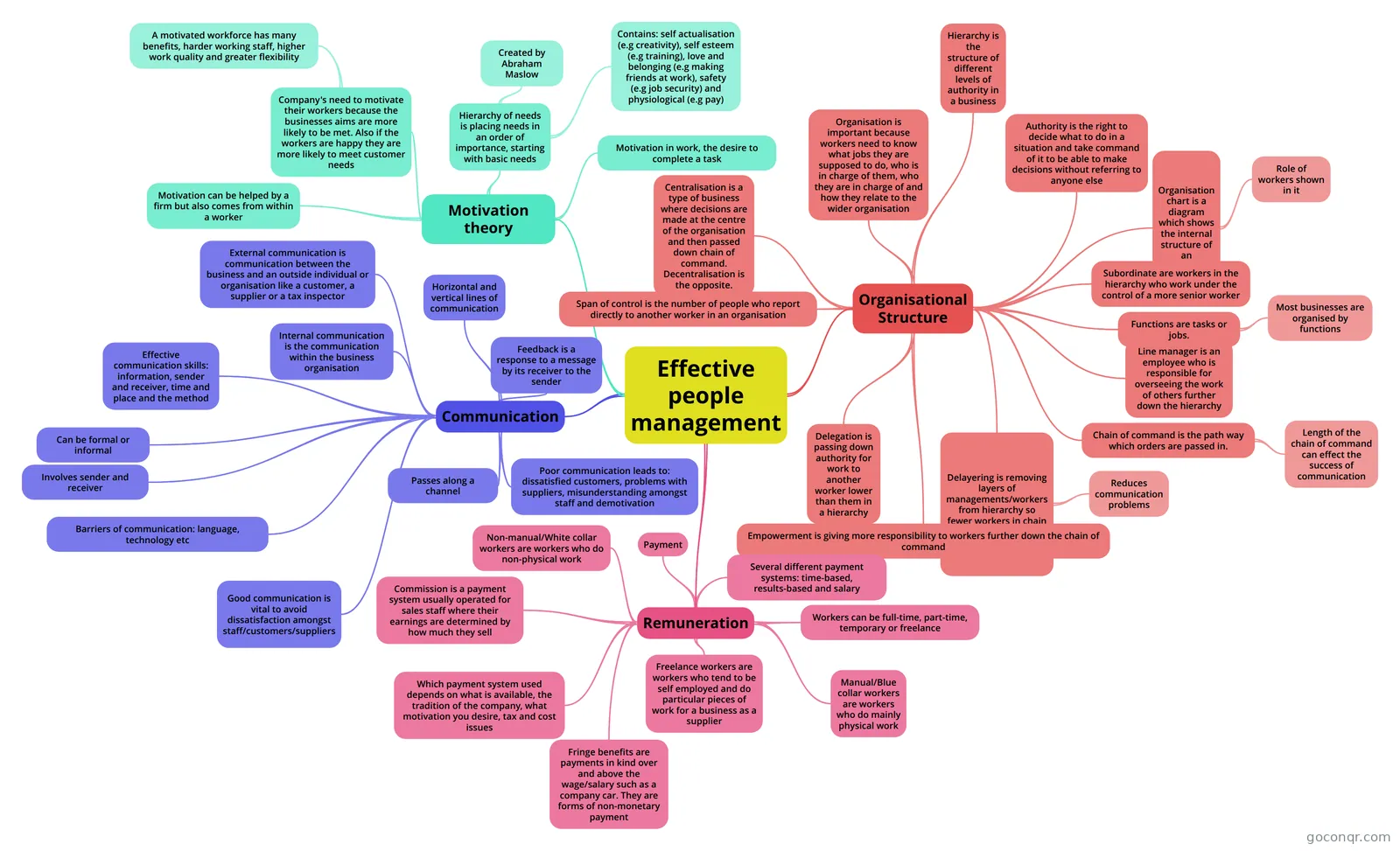
Mind map: Effective people management
Inhalt der Mindmap
Effective people management
Organisational Structure
- Organisation chart is a diagram which shows the internal structure of an organisation
- Role of workers shown in it
- Hierarchy is the structure of different levels of authority in a business
- Line manager is an employee who is responsible for overseeing the work of others further down the hierarchy
- Functions are tasks or jobs.
- Most businesses are organised by functions
- Authority is the right to decide what to do in a situation and take command of it to be able to make decisions without referring to anyone else
- Subordinate are workers in the hierarchy who work under the control of a more senior worker
- Chain of command is the path way which orders are passed in.
- Length of the chain of command can effect the success of communication
- Organisation is important because workers need to know what jobs they are supposed to do, who is in charge of them, who they are in charge of and how they relate to the wider organisation
- Delayering is removing layers of managements/workers from hierarchy so fewer workers in chain of command
- Reduces communication problems
- Empowerment is giving more responsibility to workers further down the chain of command
- Delegation is passing down authority for work to another worker lower than them in a hierarchy
- Centralisation is a type of business where decisions are made at the centre of the organisation and then passed down chain of command. Decentralisation is the opposite.
- Span of control is the number of people who report directly to another worker in an organisation
- Organisation chart is a diagram which shows the internal structure of an organisation
Motivation theory
- Motivation in work, the desire to complete a task
- Hierarchy of needs is placing needs in an order of importance, starting with basic needs
- Created by Abraham Maslow
- Contains: self actualisation (e.g creativity), self esteem (e.g training), love and belonging (e.g making friends at work), safety (e.g job security) and physiological (e.g pay)
- Company's need to motivate their workers because the businesses aims are more likely to be met. Also if the workers are happy they are more likely to meet customer needs
- A motivated workforce has many benefits, harder working staff, higher work quality and greater flexibility
- Motivation can be helped by a firm but also comes from within a worker
Communication
- Feedback is a response to a message by its receiver to the sender
- Internal communication is the communication within the business organisation
- External communication is communication between the business and an outside individual or organisation like a customer, a supplier or a tax inspector
- Effective communication skills: information, sender and receiver, time and place and the method
- Barriers of communication: language, technology etc
- Poor communication leads to: dissatisfied customers, problems with suppliers, misunderstanding amongst staff and demotivation
- Involves sender and receiver
- Can be formal or informal
- Passes along a channel
- Horizontal and vertical lines of communication
- Good communication is vital to avoid dissatisfaction amongst staff/customers/suppliers
Remuneration
- Payment
- Manual/Blue collar workers are workers who do mainly physical work
- Non-manual/White collar workers are workers who do non-physical work
- Commission is a payment system usually operated for sales staff where their earnings are determined by how much they sell
- Freelance workers are workers who tend to be self employed and do particular pieces of work for a business as a supplier
- Fringe benefits are payments in kind over and above the wage/salary such as a company car. They are forms of non-monetary payment
- Several different payment systems: time-based, results-based and salary
- Workers can be full-time, part-time, temporary or freelance
- Which payment system used depends on what is available, the tradition of the company, what motivation you desire, tax and cost issues
Informationen
- Beschreibung
- GCSE Business Mindmap am Effective people management, erstellt von tiffanyh am 09/05/2013.
- Erstellt von
- tiffanyh
- Aufrufe
- 30
- Tags
- Bewertung