
Mindmap
classification and biodiversity
Inhalt der Mindmap
classification and biodiversity
phylogenetic classification
- reflecting evolutionary relatedness
- polygenetic tree; diagram showing evolutionary descent
Taxonomy; the identification and naming of organisms
classification; putting items into groups
hierarchy; any group within a system of classification
- D>K>F>C>O>F>G>S
- members of the same species can interbreed to produce fertile offspring
Taxa are discrete, at any level of classification, an organism belongs in one taxon and in no other
the 3 domains- similarities in DNA base sequence
- Eubacteria;familiar bacteria, they are prokaryotes
- Archea; unusual metabolism, are prokaryotes
- Eukaryota; plantae, animilia , fungi and protocista
5 kingdom system- basis on their physical appearances
- 3 domain
- Eubacteria
- prokaryota Ribosomes 70s
- microscopic, contains all the bacteria and cyanobacteria(blue-green algae)
- saprotrophic- feeds on dead/decaying matter by extracellular digestion and absorption. parasitic or autotrophic
- cell wall- peptidoglycan
- saprotrophic- feeds on dead/decaying matter by extracellular digestion and absorption. parasitic or autotrophic
- microscopic, contains all the bacteria and cyanobacteria(blue-green algae)
- prokaryota Ribosomes 70s
- archaea
- Eukaryota
- Protoctista, fungi, plantae, animalia Ribosomes 70s
- protoctista
- some single celled, some plant like some animal like and some both like cells
- autotrophic/heterotrophic
- cell wall- cellulose or none
- autotrophic/heterotrophic
- some single celled, some plant like some animal like and some both like cells
- plantae
- reproduce with spores or seeds (plants)
- autotrophic
- cell wall- cellulose
- autotrophic
- reproduce with spores or seeds (plants)
- fungi
- yeast are single celled. Moulds have hypae that weave together to form the body of the fungus, a mycelium. In some, cross cell walls, called septa sub divide the hypae
- saprothrophic or parasitic
- cell wall- chitin
- saprothrophic or parasitic
- yeast are single celled. Moulds have hypae that weave together to form the body of the fungus, a mycelium. In some, cross cell walls, called septa sub divide the hypae
- animilia ; animals
- heterotrophic
- cell wall- non
- heterotrophic
- protoctista
- Protoctista, fungi, plantae, animalia Ribosomes 70s
- 5 Kingdoms
homologous structures; have a similar arrangement of component parts and a similar developmental origin but different functions
divergent evolution; a common ancestral structure has evolved and performs different functions e.g
- pentadactyl; have five digits
convergent evolution; structures evolve similiar properties but have different developmental origins, such structures are analogous
- analogous structures; have a corresponding function and similar shape, but have a different development origin
Assessing relatedness with genetic evience
- DNA sequences
- confirm evolutionary relationships and correct mistakes made in classification based on physical characteristics
- DNA hybridisation
- comparing the DNA base sequences of 2 species. DNA separated from both and cut into fragments which are then mixed and where they have complemantry base sequences they hybridise together
- amino acid sequences
- the sequence is determined by DNA base sequence, similarity in sequence shows how closely related the species are
- immunology
- proteins of different species can be compared, if you mix the antigens of one species such as the blood protein albumin, with specific antibodies of another, the antigens and antibodies make a precipitate. the closer the evolutionary relationship, the more the antigen and antibody react to make a ppt
- DNA sequences
Taxonomy; identification and naming of organisms
biodiversity; the number of species and the number of individuals in each species in a specified region
- high energy input by sun so at equator means high energy input in ecosystems so greater bidiversity
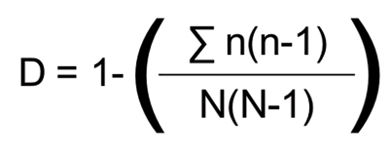
biodiversity index; Simpsons index
- higher the value, higher the biodiversity
a genes position on a chromosomes is its locus. a locus shows polymorphism; the occurrence of more than one phenotype in a population that cannot be accounted for by mutation alone
genetic/DNA fingerprinting/profile; terms of a pattern unique for each individual, related to the base sequences of their DNA
- non coding sequence sequences in DNA undergo mutation. when 1 base that differs its called SNPs (snips) single nucleotide polymorphism. Unique longer base sequences of non coding DNA is called hyper variable regions(HVR) or short tandem repeats (STR)
Natural selection; the gradual process in which inherited characteristics become more or less common in a population in response of the environment determining the breeding success of individuals processing those characteristics
Bilder und Dateien der Mindmap
Informationen
- Beschreibung
- A2 Biology Mindmap am classification and biodiversity, erstellt von Ishea Mehmood am 20/03/2017.
- Erstellt von
- Ishea Mehmood
- Aufrufe
- 47
- Bewertung