
Mindmap
Sampling - Advantages and Disadvantages
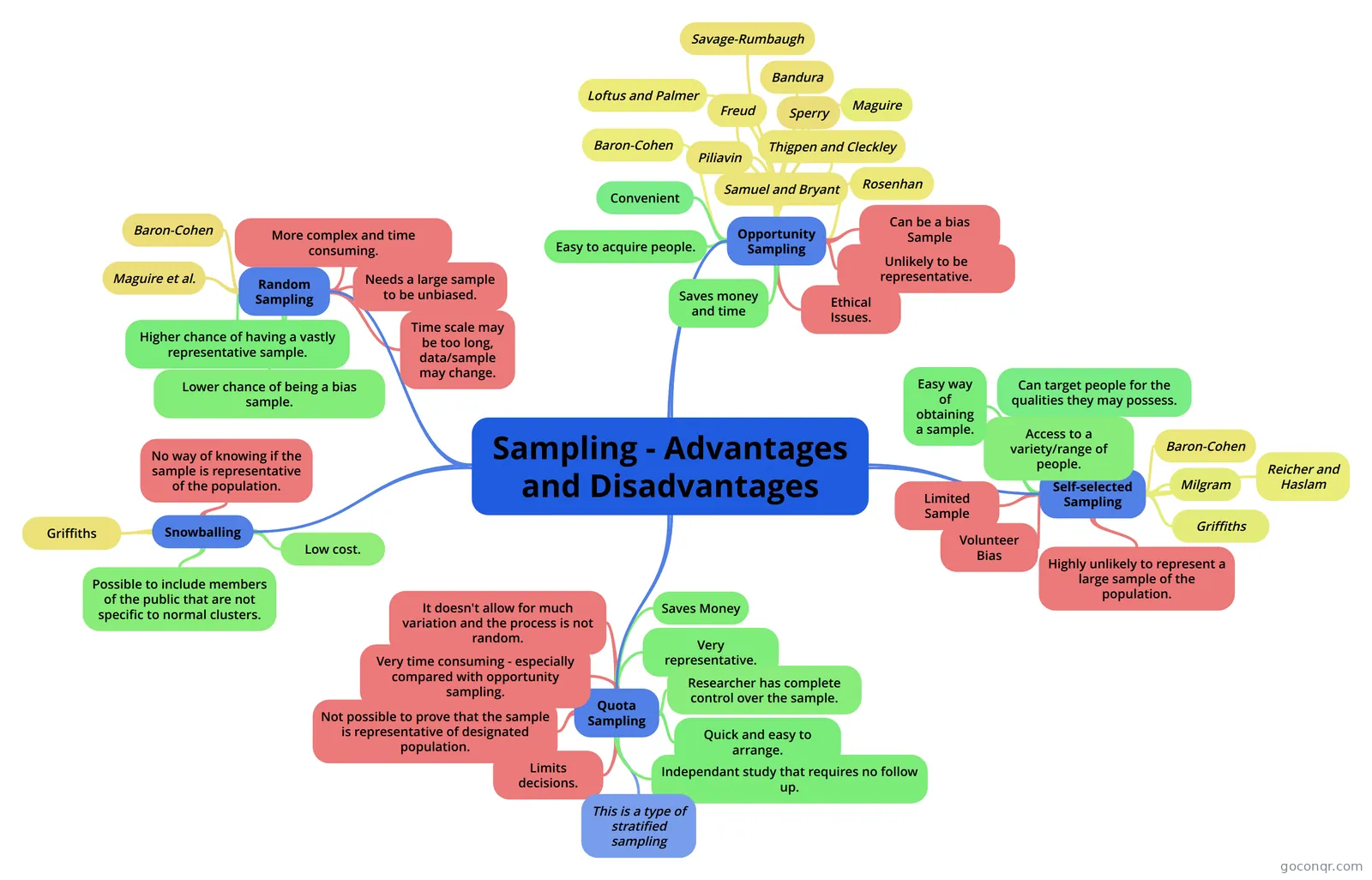
Mind map: sampling advantages and disadvantages
Inhalt der Mindmap
Sampling - Advantages and Disadvantages
- Red - Disadvantage or weakness Green - Advantage or strength Yellow - Studys that use it
Opportunity Sampling
- The researchers uses people who are present/available to them at that time.
- Saves money and time
- Easy to acquire people.
- Convenient
- Can be a bias Sample
- Especially if they are taken from a group meeting, like the Tourettes group from the Baron-Cohen Study, or from the same general area.
- Unlikely to be representative.
- Ethical Issues.
- If asking a group, if one says yes the others may feel obliged/pressed to join.
- Baron-Cohen
- The Tourettes syndrome group were taken from Referal meeteing in central London.
- Loftus and Palmer
- Sample taken from Psychology classes from within the University.
- Savage-Rumbaugh
- The pygmy chimps were a spot of luck for Savage-Rumbaugh and she used the chimps appearance to study them.
- Freud
- It was by chance that Little Hans' father started sending observations of Hans to Freud.
- Bandura
- The Stamford University Nursery was used.
- Sperry
- Only participants who had had the opportunity to have their carpus callosum could be used In the study.
- Piliavin
- Only people who decided to take the train and end up in that compartment were used in the study.
- Samuel and Bryant
- The playschools and schools in Devon.
- Rosenhan
- The staff in both the first and second experiment were opportunistic.
- Thigpen and Cleckley
- Eve was referred to Thigpen and Cleckley due to her 'severe and blinding headaches'.
- Maguire
- The Cab drivers may have been an opportunistic sample. There is no note of it, but it is the only categorey that they fit.
Self-selected Sampling
- People respond to an advertisement to become a participant.
- Volunteer Bias
- Only a certain type of person will reply to the avert - more likely to be extrovert for example.
- Reicher and Haslam
- An advert went out to which 332 people responded to. By psychometric testing and clinical variables the 332 participants were whittled down to 15.
- Access to a variety/range of people.
- Easy way of obtaining a sample.
- Can target people for the qualities they may possess.
- Highly unlikely to represent a large sample of the population.
- Limited Sample
- Milgram
- From ana advertisement in
- Baron-Cohen
- The Autistic/Asperge Syndrome group were self-selected from a national autism magazine.
- Griffiths
- Responded to an advertisement put up in Plymouth Unversities and colleges.
Random Sampling
- Baron-Cohen
- The 50 normal participants were randomly selected from the general population of Cambridge.
- Maguire et al.
- The 50 normal participants were selected at random from the same clinic that the cab drivers were scanned.
- Needs a large sample to be unbiased.
- Higher chance of having a vastly representative sample.
- More complex and time consuming.
- Lower chance of being a bias sample.
- Time scale may be too long, data/sample may change.
- For example, if some random paricipants are selected and it is a while before another batch of random participants to be selected, participants from the first participant sample may leave the study, changing the possible representation of the sample.
- Baron-Cohen
Quota Sampling
- Put target populations into subgroups and pick from those subgroups.
- Very time consuming - especially compared with opportunity sampling.
- Very representative.
- In the terms of a specific sample type from the sub-groups.
- Researcher has complete control over the sample.
- Independant study that requires no follow up.
- Quick and easy to arrange.
- Saves Money
- It doesn't allow for much variation and the process is not random.
- So being able to detect a specific area is not possible.
- Limits decisions.
- Not possible to prove that the sample is representative of designated population.
- This is a type of stratified sampling
- Stratified Sampling - Classifying the (chosen) population into categories and then choosing a sample which consists of participants from each category in the same proportions (from each category) to make a representative sample.
Snowballing
- The researcher asks someone to be their participant as awell as asking them to ask others to join in the study, and for those newer participants to ask others to also participate in the study.
- Griffiths
- Griffths asked some friends, who he knew to be regular gamblers, to join the study and for them to ask their friends.
- Possible to include members of the public that are not specific to normal clusters.
- e.g Drug users who are less lkely to join normal sampling but more likely with snowball sampling because of similiar characteristics with who asked them to participate.
- No way of knowing if the sample is representative of the population.
- Low cost.
Informationen
- Beschreibung
- A-Level Psychology (AS/Psychological Investigations) Mindmap am Sampling - Advantages and Disadvantages, erstellt von Robyn Chamberlain am 06/05/2014.
- Erstellt von
- Robyn Chamberlain
- Aufrufe
- 229
- Tags
- Bewertung