
Mindmap
Research Methods
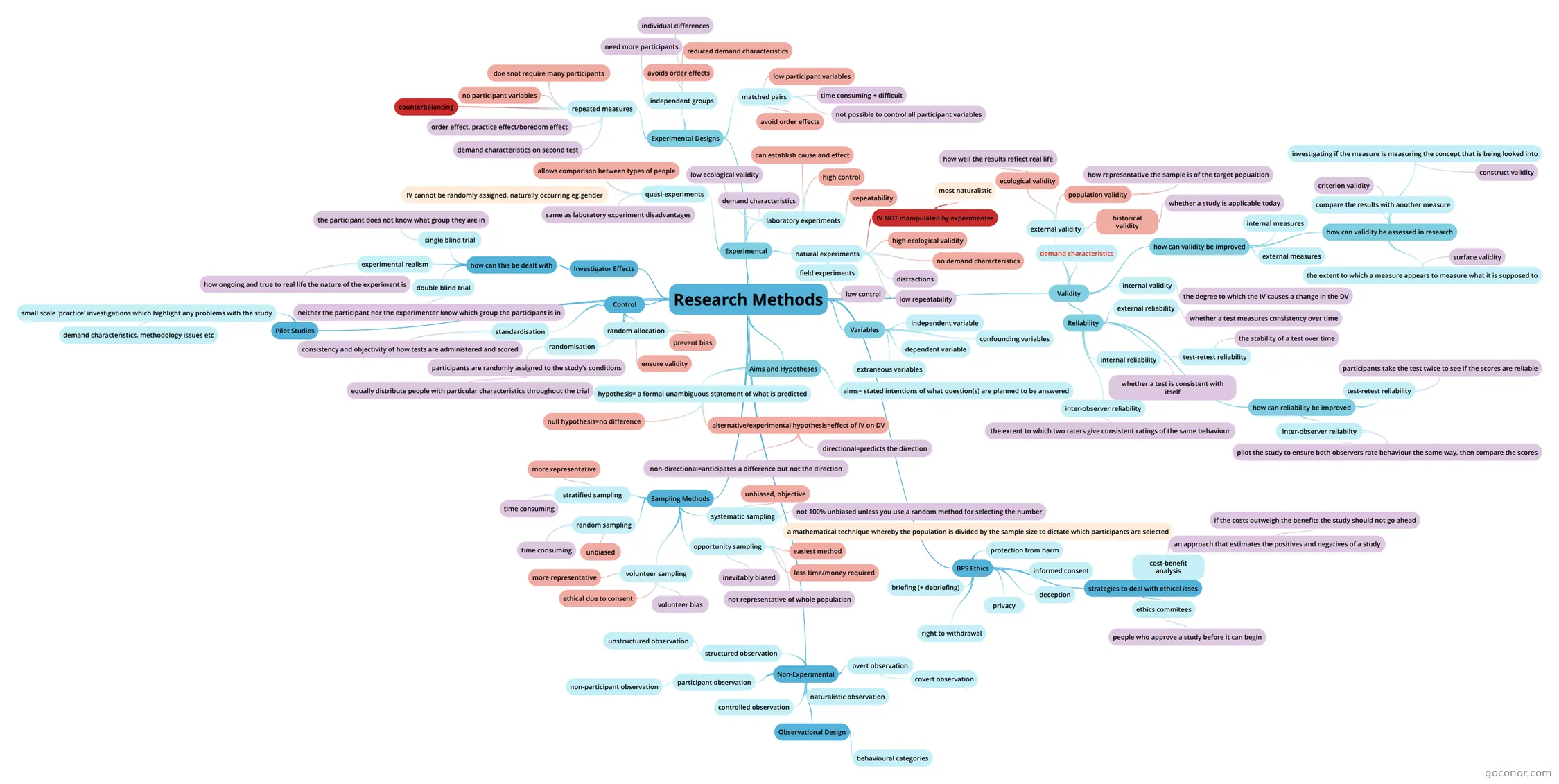
Mind map: Research methods
Inhalt der Mindmap
Research Methods
Experimental
- laboratory experiments
- high control
- repeatability
- can establish cause and effect
- demand characteristics
- low ecological validity
- natural experiments
- high ecological validity
- no demand characteristics
- low control
- low repeatability
- distractions
- field experiments
- IV NOT manipulated by experimenter
- most naturalistic
- quasi-experiments
- allows comparison between types of people
- same as laboratory experiment disadvantages
- IV cannot be randomly assigned, naturally occurring eg.gender
- Experimental Designs
- independent groups
- avoids order effects
- reduced demand characteristics
- individual differences
- need more participants
- repeated measures
- doe snot require many participants
- no participant variables
- order effect, practice effect/boredom effect
- demand characteristics on second test
- counterbalancing
- half do one condition first, half the other reduces order effects
- matched pairs
- avoid order effects
- low participant variables
- time consuming + difficult
- not possible to control all participant variables
- only focus on variablesknown to be relevant, others may also be important
- independent groups
- laboratory experiments
Variables
- independent variable
- the variable that is manipulated
- dependent variable
- the variable that is measured
- extraneous variables
- anything other than the IV which might have an effect on the DV
- confounding variables
- variables that aren't controlled and affect the results
- independent variable
Aims and Hypotheses
- aims= stated intentions of what question(s) are planned to be answered
- hypothesis= a formal unambiguous statement of what is predicted
- null hypothesis=no difference
- a statement of no difference between the populations being studied
- alternative/experimental hypothesis=effect of IV on DV
- makes a prediction about the effect os the IV on the DV or about the difference between the samples as a result of the IV
- directional=predicts the direction
- based on previous research, one tailed
- non-directional=anticipates a difference but not the direction
- no previous research, two tailed
- null hypothesis=no difference
Validity
- external validity
- ecological validity
- how well the results reflect real life
- population validity
- how representative the sample is of the target popualtion
- historical validity
- whether a study is applicable today
- ecological validity
- demand characteristics
- participants changing their behaviour due to guessing the nature of the research, lowers validity
- internal validity
- the degree to which the IV causes a change in the DV
- eg/ if no demand characteristics, no confounding variables
- the degree to which the IV causes a change in the DV
- Reliability
- external reliability
- whether a test measures consistency over time
- eg/ the IQ of someone should remain constant over their adult life
- whether a test measures consistency over time
- internal reliability
- whether a test is consistent with itself
- test-retest reliability
- the stability of a test over time
- inter-observer reliability
- the extent to which two raters give consistent ratings of the same behaviour
- how can reliability be improved
- test-retest reliability
- participants take the test twice to see if the scores are reliable
- inter-observer reliabilty
- pilot the study to ensure both observers rate behaviour the same way, then compare the scores
- test-retest reliability
- external reliability
- how can validity be improved
- internal measures
- 1.operationalise the variables 2.run a pilot study
- external measures
- 1.make the study as realistic as possible 2.use a variety of people in the sample 3.avoid demand characteristics by keeping participants niave
- how can validity be assessed in research
- compare the results with another measure
- criterion validity
- the extent to which a measure appears to measure what it is supposed to
- surface validity
- investigating if the measure is measuring the concept that is being looked into
- construct validity
- compare the results with another measure
- internal measures
- external validity
Investigator Effects
- researcher features that influence participant responses typre of confounding variable
- how can this be dealt with
- single blind trial
- the participant does not know what group they are in
- double blind trial
- neither the participant nor the experimenter know which group the participant is in
- experimental realism
- how ongoing and true to real life the nature of the experiment is
- eg/ if assessing fear the fear felt during the experiment should be the same level of fear that they would feel in real life
- how ongoing and true to real life the nature of the experiment is
- single blind trial
Control
- random allocation
- ensure validity
- prevent bias
- randomisation
- participants are randomly assigned to the study's conditions
- equally distribute people with particular characteristics throughout the trial
- participants are randomly assigned to the study's conditions
- standardisation
- consistency and objectivity of how tests are administered and scored
- random allocation
Pilot Studies
- small scale 'practice' investigations which highlight any problems with the study
- demand characteristics, methodology issues etc
- small scale 'practice' investigations which highlight any problems with the study
Sampling Methods
- opportunity sampling
- easiest method
- less time/money required
- inevitably biased
- not representative of whole population
- random sampling
- every member of the population has an equal chance of being selected
- unbiased
- time consuming
- stratified sampling
- more representative
- time consuming
- systematic sampling
- unbiased, objective
- not 100% unbiased unless you use a random method for selecting the number
- a mathematical technique whereby the population is divided by the sample size to dictate which participants are selected
- volunteer sampling
- more representative
- ethical due to consent
- volunteer bias
- opportunity sampling
BPS Ethics
- informed consent
- privacy
- deception
- protection from harm
- right to withdrawal
- briefing (+ debriefing)
- strategies to deal with ethical isses
- cost-benefit analysis
- an approach that estimates the positives and negatives of a study
- if the costs outweigh the benefits the study should not go ahead
- an approach that estimates the positives and negatives of a study
- ethics commitees
- people who approve a study before it can begin
- cost-benefit analysis
Non-Experimental
- naturalistic observation
- an observation carried out in an everday situation the investigator does not interfere in any way but merely observes
- controlled observation
- behaviour is observed but under sonditions where certain variables have been rganised by the researcher
- overt observation
- observational studies where participants are aware their behaviour is being studied
- covert observation
- observing people without their knowledge
- participant observation
- observations made by someone who is also participating in the activity being observed
- non-participant observation
- the observer is separate from the people being observed
- structured observation
- a researcher uses various systems to organise behaviours
- unstructured observation
- researcher records all relevant behaviour, but has no sysetm
- Observational Design
- behavioural categories
- naturalistic observation
Informationen
- Beschreibung
- A level Psychology Mindmap am Research Methods, erstellt von Meghan Davies am 05/04/2017.
- Erstellt von
- Meghan Davies
- Aufrufe
- 6
- Bewertung