
Mindmap
Defining Social Class
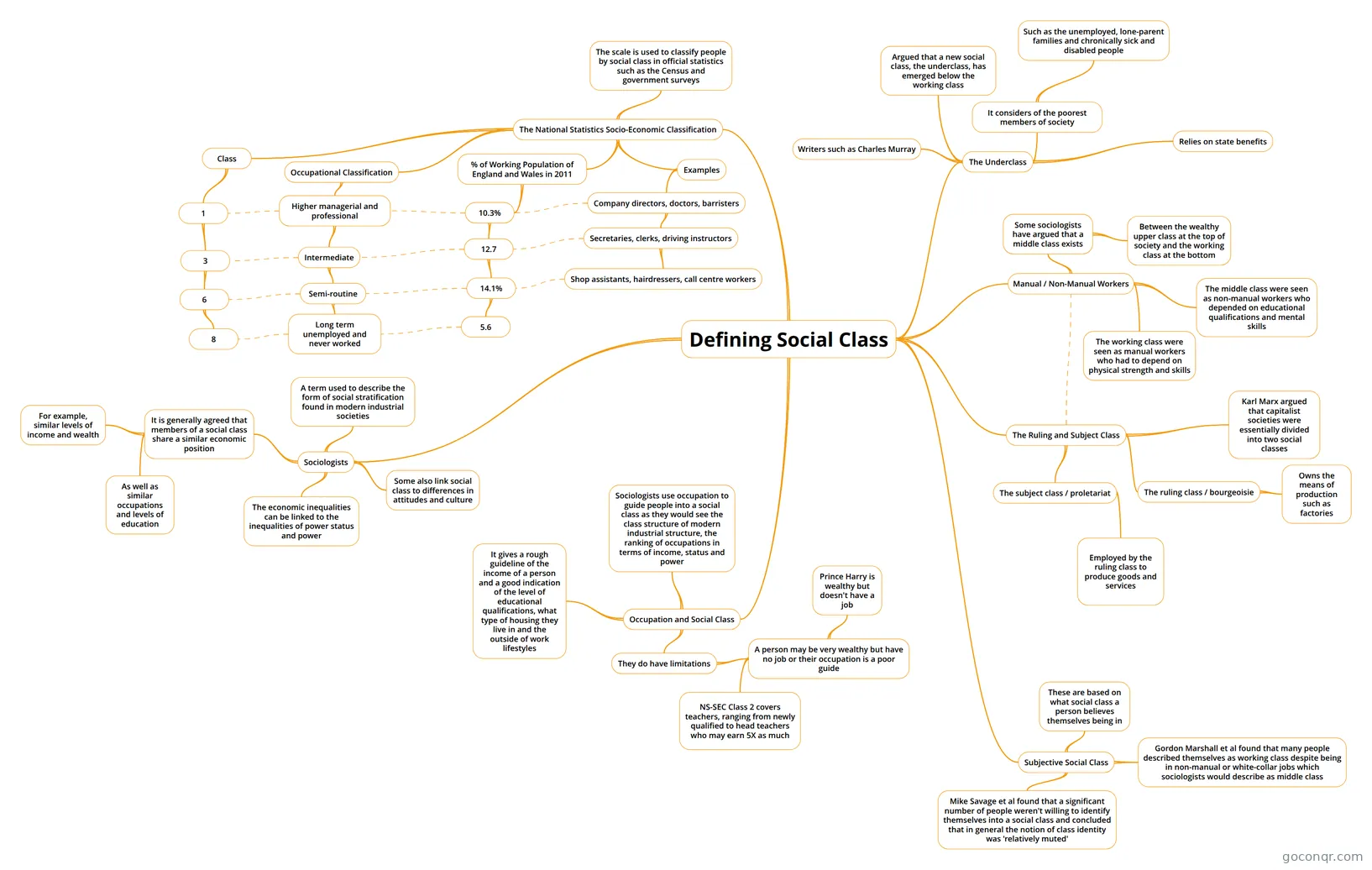
Mind map: Defining social class
Inhalt der Mindmap
Defining Social Class
Sociologists
- A term used to describe the form of social stratification found in modern industrial societies
- It is generally agreed that members of a social class share a similar economic position
- For example, similar levels of income and wealth
- As well as similar occupations and levels of education
- The economic inequalities can be linked to the inequalities of power status and power
- Some also link social class to differences in attitudes and culture
The Ruling and Subject Class
- Karl Marx argued that capitalist societies were essentially divided into two social classes
- The ruling class / bourgeoisie
- Owns the means of production such as factories
- The subject class / proletariat
- Employed by the ruling class to produce goods and services
Manual / Non-Manual Workers
- Some sociologists have argued that a middle class exists
- Between the wealthy upper class at the top of society and the working class at the bottom
- The middle class were seen as non-manual workers who depended on educational qualifications and mental skills
- The working class were seen as manual workers who had to depend on physical strength and skills
- Some sociologists have argued that a middle class exists
The Underclass
- Writers such as Charles Murray
- Argued that a new social class, the underclass, has emerged below the working class
- It considers of the poorest members of society
- Such as the unemployed, lone-parent families and chronically sick and disabled people
- Relies on state benefits
The National Statistics Socio-Economic Classification
- The scale is used to classify people by social class in official statistics such as the Census and government surveys
- Class
- 1
- 3
- 6
- 8
- 6
- 3
- 1
- % of Working Population of England and Wales in 2011
- 10.3%
- 12.7
- 14.1%
- 5.6
- 14.1%
- 12.7
- 10.3%
- Examples
- Company directors, doctors, barristers
- Secretaries, clerks, driving instructors
- Shop assistants, hairdressers, call centre workers
- Secretaries, clerks, driving instructors
- Company directors, doctors, barristers
- Occupational Classification
- Higher managerial and professional
- Intermediate
- Semi-routine
- Long term unemployed and never worked
- Semi-routine
- Intermediate
- Higher managerial and professional
Occupation and Social Class
- Sociologists use occupation to guide people into a social class as they would see the class structure of modern industrial structure, the ranking of occupations in terms of income, status and power
- It gives a rough guideline of the income of a person and a good indication of the level of educational qualifications, what type of housing they live in and the outside of work lifestyles
- They do have limitations
- A person may be very wealthy but have no job or their occupation is a poor guide
- Prince Harry is wealthy but doesn't have a job
- NS-SEC Class 2 covers teachers, ranging from newly qualified to head teachers who may earn 5X as much
- A person may be very wealthy but have no job or their occupation is a poor guide
Subjective Social Class
- These are based on what social class a person believes themselves being in
- Gordon Marshall et al found that many people described themselves as working class despite being in non-manual or white-collar jobs which sociologists would describe as middle class
- Mike Savage et al found that a significant number of people weren't willing to identify themselves into a social class and concluded that in general the notion of class identity was 'relatively muted'
Informationen
- Beschreibung
- A-Level Sociology (Social Inequalities - Social Class) Mindmap am Defining Social Class, erstellt von Chloe Pilkington am 19/04/2017.
- Erstellt von
- Chloe Pilkington
- Aufrufe
- 1
- Bewertung
Mehr zu Class Structure and Identity