
Mindmap
Block 1
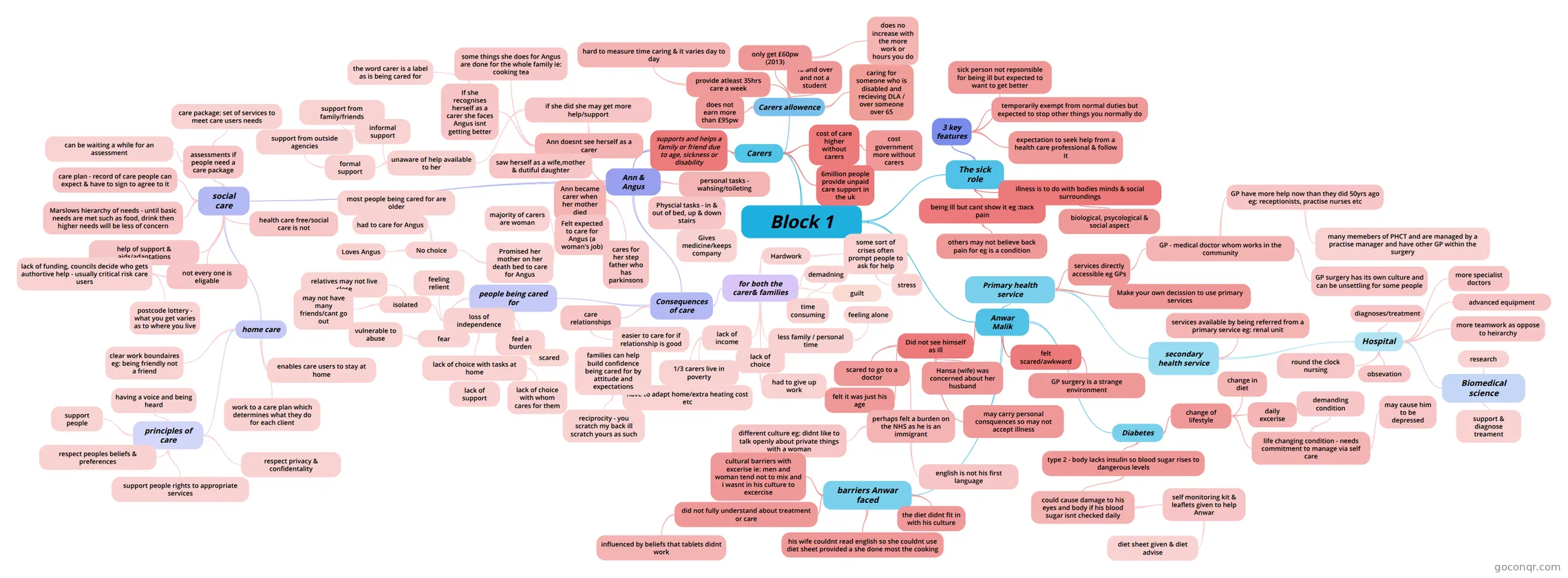
Mind map: carers and the sick role
Inhalt der Mindmap
Block 1
Carers
- supports and helps a family or friend due to age, sickness or disability
- Ann & Angus
- Ann became carer when her mother died
- Felt expected to care for Angus (a woman's job)
- Promised her mother on her death bed to care for Angus
- No choice
- Loves Angus
- had to care for Angus
- most people being cared for are older
- No choice
- majority of carers are woman
- Promised her mother on her death bed to care for Angus
- cares for her step father who has parkinsons
- Felt expected to care for Angus (a woman's job)
- Ann doesnt see herself as a carer
- saw herself as a wife,mother & dutiful daughter
- If she recognises herself as a carer she faces Angus isnt getting better
- the word carer is a label as is being cared for
- if she did she may get more help/support
- unaware of help available to her
- informal support
- support from family/friends
- formal support
- support from outside agencies
- informal support
- unaware of help available to her
- some things she does for Angus are done for the whole family ie: cooking tea
- personal tasks - wahsing/toileting
- Physcial tasks - in & out of bed, up & down stairs
- Gives medicine/keeps company
- Physcial tasks - in & out of bed, up & down stairs
- Consequences of care
- for both the carer& families
- Hardwork
- some sort of crises often prompt people to ask for help
- stress
- some sort of crises often prompt people to ask for help
- demadning
- time consuming
- guilt
- lack of income
- 1/3 carers live in poverty
- have to adapt home/extra heating cost etc
- less family / personal time
- feeling alone
- lack of choice
- had to give up work
- Hardwork
- care relationships
- easier to care for if relationship is good
- families can help build confidence being cared for by attitude and expectations
- reciprocity - you scratch my back ill scratch yours as such
- families can help build confidence being cared for by attitude and expectations
- easier to care for if relationship is good
- people being cared for
- loss of independence
- feeling relient
- isolated
- relatives may not live close
- may not have many friends/cant go out
- lack of choice with tasks at home
- lack of choice with whom cares for them
- lack of support
- feel a burden
- scared
- fear
- vulnerable to abuse
- loss of independence
- for both the carer& families
- social care
- assessments if people need a care package
- care package: set of services to meet care users needs
- can be waiting a while for an assessment
- care plan - record of care people can expect & have to sign to agree to it
- Marslows hierarchy of needs - until basic needs are met such as food, drink then higher needs will be less of concern
- help of support & aids/adaptations
- not every one is eligable
- lack of funding, councils decide who gets authortive help - usually critical risk care users
- postcode lottery - what you get varies as to where you live
- lack of funding, councils decide who gets authortive help - usually critical risk care users
- health care free/social care is not
- home care
- enables care users to stay at home
- work to a care plan which determines what they do for each client
- clear work boundaires eg: being friendly not a friend
- principles of care
- support people
- having a voice and being heard
- respect peoples beliefs & preferences
- support people rights to appropriate services
- respect privacy & confidentality
- assessments if people need a care package
- Ann became carer when her mother died
- Ann & Angus
- cost of care higher without carers
- cost government more without carers
- 6million people provide unpaid care support in the uk
- Carers allowence
- provide atleast 35hrs care a week
- hard to measure time caring & it varies day to day
- 16 and over and not a student
- caring for someone who is disabled and recieving DLA / over someone over 65
- does not earn more than £95pw
- only get £60pw (2013)
- does no increase with the more work or hours you do
- provide atleast 35hrs care a week
- supports and helps a family or friend due to age, sickness or disability
The sick role
- 3 key features
- sick person not repsonsible for being ill but expected to want to get better
- temporarily exempt from normal duties but expected to stop other things you normally do
- expectation to seek help from a health care professional & follow it
- being ill but cant show it eg :back pain
- others may not believe back pain for eg is a condition
- illness is to do with bodies minds & social surroundings
- biological, psycological & social aspect
- 3 key features
Anwar Malik
- Did not see himself as ill
- scared to go to a doctor
- perhaps felt a burden on the NHS as he is an immigrant
- english is not his first language
- different culture eg: didnt like to talk openly about private things with a woman
- perhaps felt a burden on the NHS as he is an immigrant
- Hansa (wife) was concerned about her husband
- felt it was just his age
- may carry personal consquences so may not accept illness
- scared to go to a doctor
- Primary health service
- services directly accessible eg GPs
- GP - medical doctor whom works in the community
- GP have more help now than they did 50yrs ago eg: receptionists, practise nurses etc
- many memebers of PHCT and are managed by a practise manager and have other GP within the surgery
- GP surgery has its own culture and can be unsettling for some people
- GP have more help now than they did 50yrs ago eg: receptionists, practise nurses etc
- GP - medical doctor whom works in the community
- Make your own decission to use primary services
- secondary health service
- services available by being referred from a primary service eg: renal unit
- Hospital
- diagnoses/treatment
- more specialist doctors
- advanced equipment
- round the clock nursing
- obsevation
- Biomedical science
- support & diagnose treament
- research
- more teamwork as oppose to heirarchy
- services directly accessible eg GPs
- felt scared/awkward
- GP surgery is a strange environment
- Diabetes
- type 2 - body lacks insulin so blood sugar rises to dangerous levels
- could cause damage to his eyes and body if his blood sugar isnt checked daily
- self monitoring kit & leaflets given to help Anwar
- diet sheet given & diet advise
- self monitoring kit & leaflets given to help Anwar
- could cause damage to his eyes and body if his blood sugar isnt checked daily
- change of lifestyle
- change in diet
- daily excerise
- life changing condition - needs commitment to manage via self care
- demanding condition
- may cause him to be depressed
- type 2 - body lacks insulin so blood sugar rises to dangerous levels
- barriers Anwar faced
- the diet didnt fit in with his culture
- his wife couldnt read english so she couldnt use diet sheet provided a she done most the cooking
- cultural barriers with excerise ie: men and woman tend not to mix and i wasnt in his culture to excercise
- did not fully understand about treatment or care
- influenced by beliefs that tablets didnt work
- Did not see himself as ill
Informationen
- Beschreibung
- Mindmap am Block 1, erstellt von Linzi Kent am 17/05/2014.
- Erstellt von
- Linzi Kent
- Aufrufe
- 89
- Tags
- Bewertung