
Mindmap
Biology Unit 2 - Adaptions
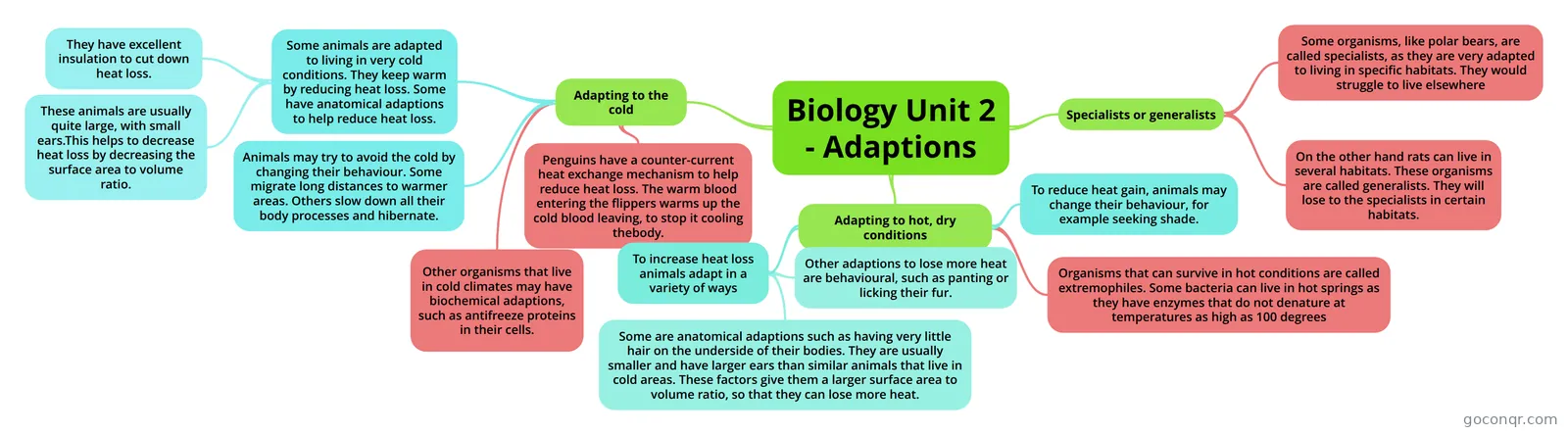
Mind map: Biology Unit 2 adaptations
Inhalt der Mindmap
Biology Unit 2 - Adaptions
Adapting to the cold
- Some animals are adapted to living in very cold conditions. They keep warm by reducing heat loss. Some have anatomical adaptions to help reduce heat loss.
- They have excellent insulation to cut down heat loss.
- These animals are usually quite large, with small ears.This helps to decrease heat loss by decreasing the surface area to volume ratio.
- Animals may try to avoid the cold by changing their behaviour. Some migrate long distances to warmer areas. Others slow down all their body processes and hibernate.
- Penguins have a counter-current heat exchange mechanism to help reduce heat loss. The warm blood entering the flippers warms up the cold blood leaving, to stop it cooling thebody.
- Other organisms that live in cold climates may have biochemical adaptions, such as antifreeze proteins in their cells.
- Some animals are adapted to living in very cold conditions. They keep warm by reducing heat loss. Some have anatomical adaptions to help reduce heat loss.
Adapting to hot, dry conditions
- To increase heat loss animals adapt in a variety of ways
- Some are anatomical adaptions such as having very little hair on the underside of their bodies. They are usually smaller and have larger ears than similar animals that live in cold areas. These factors give them a larger surface area to volume ratio, so that they can lose more heat.
- Other adaptions to lose more heat are behavioural, such as panting or licking their fur.
- To reduce heat gain, animals may change their behaviour, for example seeking shade.
- Organisms that can survive in hot conditions are called extremophiles. Some bacteria can live in hot springs as they have enzymes that do not denature at temperatures as high as 100 degrees
- To increase heat loss animals adapt in a variety of ways
Specialists or generalists
- Some organisms, like polar bears, are called specialists, as they are very adapted to living in specific habitats. They would struggle to live elsewhere
- On the other hand rats can live in several habitats. These organisms are called generalists. They will lose to the specialists in certain habitats.
Informationen
- Beschreibung
- GCSE Biology Mindmap am Biology Unit 2 - Adaptions, erstellt von rebekah.putnam am 30/05/2014.
- Erstellt von
- rebekah.putnam
- Aufrufe
- 17
- Bewertung