
Mindmap
Evolution
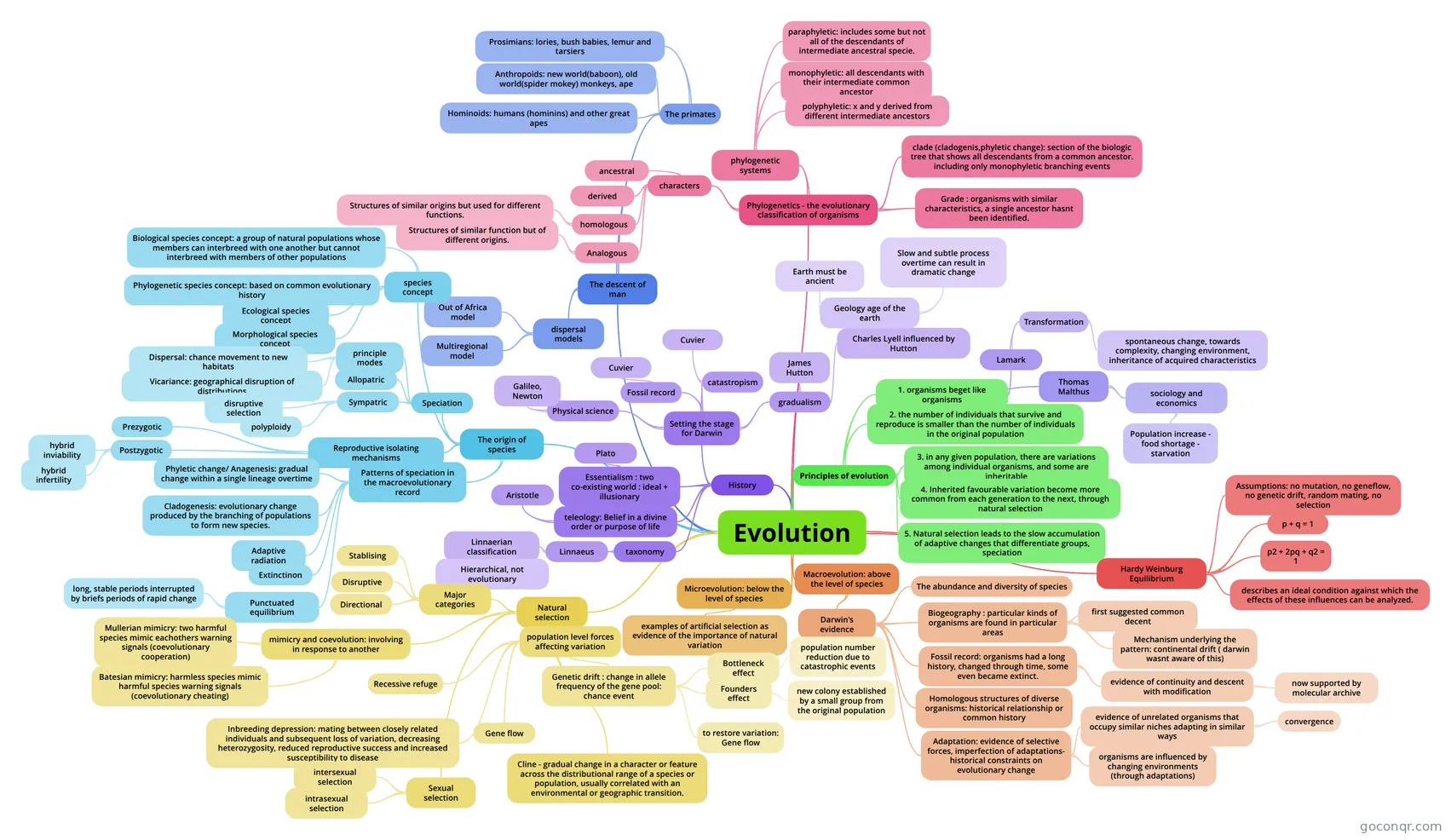
Mind map: Evolution
Inhalt der Mindmap
Evolution
Principles of evolution
- 1. organisms beget like organisms
- Lamark
- Transformation
- spontaneous change, towards complexity, changing environment, inheritance of acquired characteristics
- Transformation
- Lamark
- 2. the number of individuals that survive and reproduce is smaller than the number of individuals in the original population
- Thomas Malthus
- sociology and economics
- Population increase - food shortage - starvation
- sociology and economics
- Thomas Malthus
- 3. in any given population, there are variations among individual organisms, and some are inheritable
- 4. Inherited favourable variation become more common from each generation to the next, through natural selection
- 5. Natural selection leads to the slow accumulation of adaptive changes that differentiate groups, speciation
- 1. organisms beget like organisms
History
- Setting the stage for Darwin
- Physical science
- Galileo, Newton
- Fossil record
- Cuvier
- catastropism
- Cuvier
- gradualism
- James Hutton
- Charles Lyell influenced by Hutton
- Geology age of the earth
- Earth must be ancient
- Slow and subtle process overtime can result in dramatic change
- Geology age of the earth
- Physical science
- Essentialism : two co-existing world : ideal + illusionary
- Plato
- teleology: Belief in a divine order or purpose of life
- Aristotle
- taxonomy
- Linnaeus
- Linnaerian classification
- Hierarchical, not evolutionary
- Linnaerian classification
- Linnaeus
- Setting the stage for Darwin
Macroevolution: above the level of species
- Darwin's evidence
- The abundance and diversity of species
- Biogeography : particular kinds of organisms are found in particular areas
- first suggested common decent
- Mechanism underlying the pattern: continental drift ( darwin wasnt aware of this)
- Fossil record: organisms had a long history, changed through time, some even became extinct.
- evidence of continuity and descent with modification
- now supported by molecular archive
- evidence of continuity and descent with modification
- Homologous structures of diverse organisms: historical relationship or common history
- Adaptation: evidence of selective forces, imperfection of adaptations- historical constraints on evolutionary change
- organisms are influenced by changing environments (through adaptations)
- evidence of unrelated organisms that occupy similar niches adapting in similar ways
- convergence
- Darwin's evidence
Microevolution: below the level of species
- examples of artificial selection as evidence of the importance of natural variation
Natural selection
- Major categories
- Stablising
- Disruptive
- Directional
- Sexual selection
- intersexual selection
- intrasexual selection
- population level forces affecting variation
- Recessive refuge
- Genetic drift : change in allele frequency of the gene pool: chance event
- Bottleneck effect
- population number reduction due to catastrophic events
- Founders effect
- new colony established by a small group from the original population
- to restore variation: Gene flow
- Bottleneck effect
- Gene flow
- Inbreeding depression: mating between closely related individuals and subsequent loss of variation, decreasing heterozygosity, reduced reproductive success and increased susceptibility to disease
- mimicry and coevolution: involving in response to another
- Mullerian mimicry: two harmful species mimic eachothers warning signals (coevolutionary cooperation)
- Batesian mimicry: harmless species mimic harmful species warning signals (coevolutionary cheating)
- Cline - gradual change in a character or feature across the distributional range of a species or population, usually correlated with an environmental or geographic transition.
- Major categories
The origin of species
- Speciation
- Allopatric
- Sympatric
- polyploidy
- disruptive selection
- principle modes
- Dispersal: chance movement to new habitats
- Vicariance: geographical disruption of distributions
- Reproductive isolating mechanisms
- Prezygotic
- Postzygotic
- hybrid inviability
- hybrid infertility
- Patterns of speciation in the macroevolutionary record
- Phyletic change/ Anagenesis: gradual change within a single lineage overtime
- Cladogenesis: evolutionary change produced by the branching of populations to form new species.
- Adaptive radiation
- Extinctinon
- Punctuated equilibrium
- long, stable periods interrupted by briefs periods of rapid change
- species concept
- Biological species concept: a group of natural populations whose members can interbreed with one another but cannot interbreed with members of other populations
- Phylogenetic species concept: based on common evolutionary history
- Ecological species concept
- Morphological species concept
- Speciation
Phylogenetics - the evolutionary classification of organisms
- characters
- ancestral
- derived
- homologous
- Structures of similar origins but used for different functions.
- Analogous
- Structures of similar function but of different origins.
- Grade : organisms with similar characteristics, a single ancestor hasnt been identified.
- clade (cladogenis,phyletic change): section of the biologic tree that shows all descendants from a common ancestor. including only monophyletic branching events
- phylogenetic systems
- polyphyletic: x and y derived from different intermediate ancestors
- monophyletic: all descendants with their intermediate common ancestor
- paraphyletic: includes some but not all of the descendants of intermediate ancestral specie.
- characters
The descent of man
- The primates
- Prosimians: lories, bush babies, lemur and tarsiers
- Anthropoids: new world(baboon), old world(spider mokey) monkeys, ape
- Hominoids: humans (hominins) and other great apes
- dispersal models
- Out of Africa model
- Multiregional model
- The primates
Hardy Weinburg Equilibrium
- p2 + 2pq + q2 = 1
- p + q = 1
- Assumptions: no mutation, no geneflow, no genetic drift, random mating, no selection
- describes an ideal condition against which the effects of these influences can be analyzed.
Informationen
- Beschreibung
- Mindmap am Evolution, erstellt von tingingtina am 02/06/2014.
- Erstellt von
- tingingtina
- Aufrufe
- 23
- Bewertung