
Mindmap
Educational achievement- social class
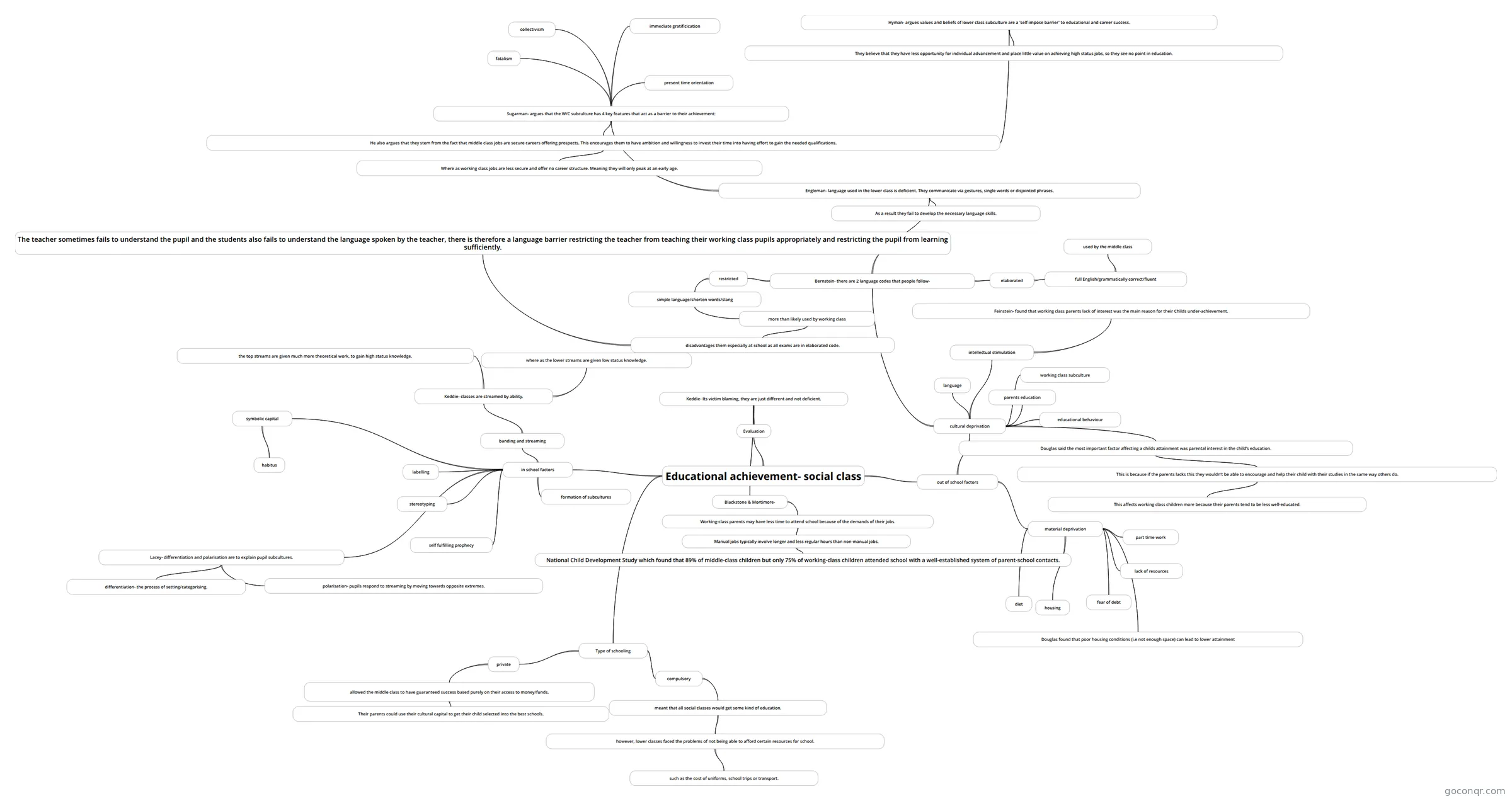
Mind map: Educational achievement and social class
Inhalt der Mindmap
Educational achievement- social class
out of school factors
- cultural deprivation
- language
- intellectual stimulation
- Feinstein- found that working class parents lack of interest was the main reason for their Childs under-achievement.
- working class subculture
- parents education
- educational behaviour
- Bernstein- there are 2 language codes that people follow-
- restricted
- simple language/shorten words/slang
- more than likely used by working class
- disadvantages them especially at school as all exams are in elaborated code.
- The teacher sometimes fails to understand the pupil and the students also fails to understand the language spoken by the teacher, there is therefore a language barrier restricting the teacher from teaching their working class pupils appropriately and restricting the pupil from learning sufficiently.
- disadvantages them especially at school as all exams are in elaborated code.
- more than likely used by working class
- simple language/shorten words/slang
- elaborated
- full English/grammatically correct/fluent
- used by the middle class
- full English/grammatically correct/fluent
- Engleman- language used in the lower class is deficient. They communicate via gestures, single words or disjointed phrases.
- As a result they fail to develop the necessary language skills.
- Sugarman- argues that the W/C subculture has 4 key features that act as a barrier to their achievement:
- collectivism
- immediate gratificication
- fatalism
- present time orientation
- He also argues that they stem from the fact that middle class jobs are secure careers offering prospects. This encourages them to have ambition and willingness to invest their time into having effort to gain the needed qualifications.
- Where as working class jobs are less secure and offer no career structure. Meaning they will only peak at an early age.
- Hyman- argues values and beliefs of lower class subculture are a 'self impose barrier' to educational and career success.
- They believe that they have less opportunity for individual advancement and place little value on achieving high status jobs, so they see no point in education.
- restricted
- Douglas said the most important factor affecting a childs attainment was parental interest in the child’s education.
- This is because if the parents lacks this they wouldn’t be able to encourage and help their child with their studies in the same way others do.
- This affects working class children more because their parents tend to be less well-educated.
- This is because if the parents lacks this they wouldn’t be able to encourage and help their child with their studies in the same way others do.
- material deprivation
- diet
- housing
- fear of debt
- lack of resources
- part time work
- Douglas found that poor housing conditions (i.e not enough space) can lead to lower attainment
- cultural deprivation
in school factors
- labelling
- stereotyping
- self fulfilling prophecy
- banding and streaming
- Keddie- classes are streamed by ability.
- the top streams are given much more theoretical work, to gain high status knowledge.
- where as the lower streams are given low status knowledge.
- Keddie- classes are streamed by ability.
- formation of subcultures
- symbolic capital
- habitus
- Lacey- differentiation and polarisation are to explain pupil subcultures.
- differentiation- the process of setting/categorising.
- polarisation- pupils respond to streaming by moving towards opposite extremes.
Type of schooling
- private
- allowed the middle class to have guaranteed success based purely on their access to money/funds.
- Their parents could use their cultural capital to get their child selected into the best schools.
- allowed the middle class to have guaranteed success based purely on their access to money/funds.
- compulsory
- meant that all social classes would get some kind of education.
- however, lower classes faced the problems of not being able to afford certain resources for school.
- such as the cost of uniforms, school trips or transport.
- however, lower classes faced the problems of not being able to afford certain resources for school.
- meant that all social classes would get some kind of education.
- private
Evaluation
- Keddie- Its victim blaming, they are just different and not deficient.
- Blackstone & Mortimore-
- Working-class parents may have less time to attend school because of the demands of their jobs.
- Manual jobs typically involve longer and less regular hours than non-manual jobs.
- National Child Development Study which found that 89% of middle-class children but only 75% of working-class children attended school with a well-established system of parent-school contacts.
- Manual jobs typically involve longer and less regular hours than non-manual jobs.
- Working-class parents may have less time to attend school because of the demands of their jobs.
- Blackstone & Mortimore-
- Keddie- Its victim blaming, they are just different and not deficient.
Informationen
- Beschreibung
- revision
- Erstellt von
- Tabby Neal
- Aufrufe
- 16
- Bewertung
Mehr zu Social Class and Educational Achievement