
Notizen
Herpes Simplex Virus - created from Mind Map
Inhalt der Notizen (1)
Seite 1
2 Types
Maintains high levels of infection through reactivation and shedding
Endemic in all populations
Neurotropic
Common Sites
Lytic Infection
Latent infection
Treatment
Models
HSV genome
HSV 1
HSV2
Prevalence of antibodies against it increases with age
Mostly oral
Establishes latency in trigeminal ganglion
Reactivation seeds to oral or nasal mucosa
Typically transmitted during childhood
Preferentially establishes latency in neurons with A5 marker
Encephalitis
Mild gingivostomatitis (ulceration and pain when severe)
Shedding in saliva provides transmission route
Maintenance of latency requires NGF interaction with receptor TrkA
Transfer of LAT exon 1 deletes regions responsible for productive infection of A5 + and KH10 +
Express Gal beta1-4GlcNAc-R epitote
Immnoreactive to calcitonin gene-related peptide
Function mapping productive infection between LAT TATA box and Pvul site 44bp
Believed to help by repressing lytic genes or inhibiting apoptosis
Reaches lumbar cord more effectively
Almost identical to HSV2 except for apparent 20bp deletion of region required for productive A5 + infection
Related to ability to establish latency in sympathetic fibers?
Less prevalent type
Mostly genital
Establishes latency in sacral dorsal root ganglia
Preferentially establishes latency in neurons identified with KH10
2 regulatory sequences in LAT for productive infection
Recurrent meningitis
Sexually transmitted but often asymptomatic
Recurs more frequently
Sheds more frequently
More painful
Can remit spontaneously
A5+ permissive for productive infection
Express Gal alpha1-3Gal beta1-4NAc-R epitote
Colabel with lectin BSL-IB4
Population of small-diameter glial cell-line-derived neurotrophic factor-response neurons
Determined in part by LAT
Reaches sacral cord more effectively
dLAT (deletion in promoter) much less effective in A5+
NotI-NotI promotes productive infection in A5 +
LAP2 inhibits productive infection in KH10+
LAT sequence containing 5' exon and LAT intron has essential elements for type-specific reactivation
Transferable
Not transferable as independent functional element
Contributes to virulence
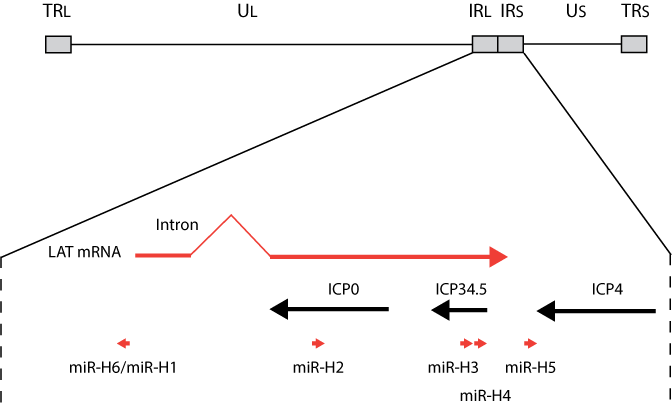
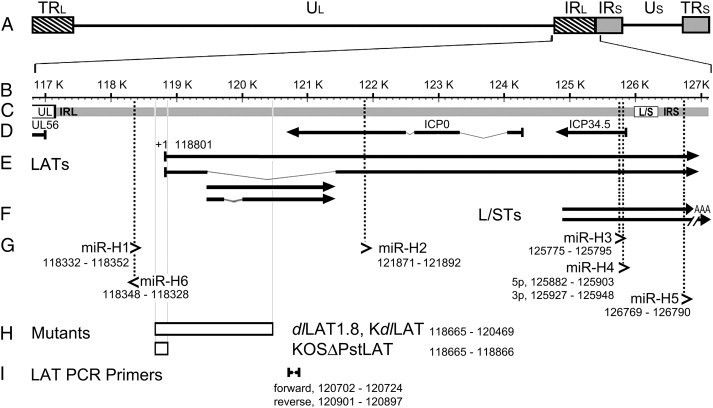
Transcribed from repeat region in antisense direction from ICP0 and ICP345
Spliced into one stable intron (two in HSV1)
Establishes latency in primary sensory neurons
Enters sensory nerve terminals and travels backwards
Travels back to periphery to facilitate epithelial cell infection
Have single bifurcated axon
Reach neurons in a manner proportional to representation in unaffected ganglia
Both types equally permissive for accumulation of HSV-1 and HSV-2 LAT
Both sensory trigeminal ganglion and sympathetic superior ganglion neurons expressed adrenergic receptors and glucocorticoid receptors
Periphery
Spinal cord
Epinephrine treatment increases levels of HSV-1 replication in SCG but not TG
Corticosterone decreases levels of HSV-2 in SCG but not TG
Autonomic neurons more responsive than sensory neurons
Different responses to stress in different HSV types
Neuronal populations express different patterns of receptors
Epinephrine involved in cAMP levels
Autonomic role in pathogenesis
Shows immune suppression may not be only factor
Increased cAMP levels shown to reactivate HSV-1 in SCG
Serum- and glucocorticoid-regulated protein kinases implicated in HSV_1 replication stimulation
Retrograde microtubule-associated transport
Skin
Eye
CNS
Congenital/neonatal
Caused in other dorsal root ganglia by infected secretions
Bad with atopic dermatitis
Major cause of corneal blindness
Recurrent acute bilateral keratoconjuctivitis causing dendritic ulcers
Rare form of encephalitis
Alzheimer's?
Acquired in birth canal or uterus
High mortality
Characterized by classes of gene products
Protein synthesis in cytoplasm, but nucleocapsids assembled in nucleus
Highly cytolytic
Virus enters cytoplasm
Immediate Early
Early
Late
Leaky late
Require presence of VP16
Regulation of viral gene expression
Role in immune invasion
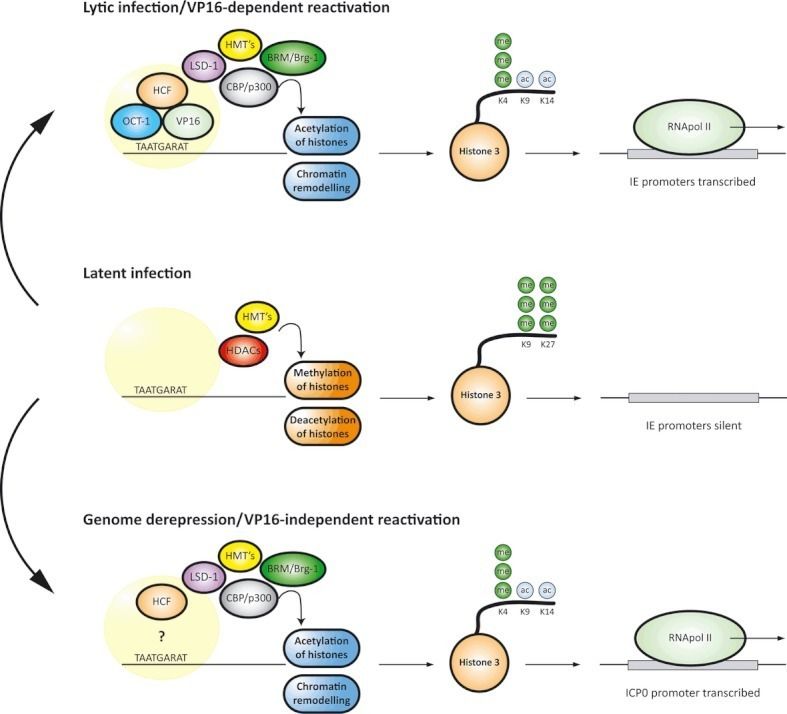
Defined by TAATGARAT VP-16 response elements within promoters
Inhibit host RNA translation
Create an environment for the lytic cycle
Virion transactivator protein
One of the most powerful transcriptional activation domains yet described
Late structural component of tegument layer
Binds to host cell factor 1 w/ nuclear localization sequence
Protein network between envelope and capsid
Transported to nucleus
Forms trimeric complex on consensus VREs in IE promoters
with
Stimulates IE transcription cascade
Impaired by restrictions in member availability?
During reactivation
Molecular trigger following hyperthermic stress?
October binding protein - 1
Homeodomain protein
Downregulated
HCF-1 localized in cytoplasm of sensory neurons
Interacts with
Histone acetyltransferases (CBP/p300)
Chromatin remodeling factors (BGRT-1 and BRM)
Histone methyltransferases (HMT's)
Lysine-specific demethylase-1 (LSD-1)
If so, Oct-1 and HCF-1 also probably important
HCF-1 relocalizes from Golgi to nucleus and associates with promoters
Recruits LSD to reverse repressive methylation at IE promoters
IE1 (ICP0)
IE2 (ICP27)
IE3 (ICP4)
IE4 (ICP22)
Likely has crucial role in reactivation
Roles
Harbors E3 ubiquitin ligase RING finger domain
Disrupts CoREST/REST repressor complex
Most likely candidate for initiation of lytic expression and exit from latency
ND10 bodies (similar distribution)
Nuclear accumulations of proteins regulated by interferons
Role in replication of DNA viruses
Domain change to favor lytic transcription?
Transcription factors associated with domains
Associations with cell proteins involved in transcription
Cell cycle regulation
DNA repair
Interferon response
Degrades constituents of ND10 bodies
Dissociation of HDACs 1/2
Interacts with HDACs 4, 5, 7
Antagonizing cellular repression such as histone-mediated silencing
Role during reactivation
Recruitment of LSD1 to IE promoters by HCF1 crucial for both initiation and reactivation
Recruited by repressor element-1 silencing transcription
Component of cellular repressor complex
Can function as corepressor
CoREST may also:
Demethylate histone H3K4
Repress neuronal gene expression in cells that aren't nerves
Function as a coactivator by demethylating repressive H3K9 marks at IE promoters
Interact with ICP0 to disrupt corepressor complex
Interferes with cell death during lytic cycle
IE5 (ICP47)
Major MHC class 1 evasion gene
Disrupts RNA splicing machinery
Promote nuclear export of viral mRNA via ICP27 and CD8 + T cell evasion
Dependent on synthesis of IE products
Seven required for viral DNA replication
Some involved in changing cell environment to support rapid DNA synthesis
Enzymes required for DNA replication
Thymidine kinase
Ribonucleotide reductase
Dependent on prior synthesis of viral DNA
Mostly structural components
Recognize viral genomes
Exits via budding through nuclear membrane
Mature envelope and glycoproteins acquired in membrane-bound organelles
Cleaved into monomers as they are packaged
Capsid transported via microtubule to nucleus
Docks to nuclear pore
DNA released into nucleus
Present in neurons but not satellite cells
Still transcription from viral genome
Establishment of latency
Reactivation
Latency associated transcripts
Overlap IE1 but on opposite strand
Minor LAT
Major LAT
Transcribed from a locus within the repeat regions flanking the ULR
miRNAs by LAT locus
Probably not translated into functional protein in vivo
sRNAs
Not transcribed in all infected
Polyadenylated
Localized to discrete intranuclear foci
8.3 kb
Stable introns spliced from primary LAT transcript
Contains two open reading frames
1.5 & 2 kb
Likely contributes to rapid turnover
Implicated in
Raise coding capacity
Nonimmunogenic
16 in HSV1
18 in HSV 2
Latent/lytic control
Immune evasion
Cell survival
Within 8.3 LAT
Just upstream of start site
1-8 expressed during latency
miRNA-H2
miRNA-H3
miRNA-H4
miRNA-H5
miRNA-H7
miRNA-H8
Shown to reduce ICP0 abundance
Shown to reduce ICP4 abundance
miRNA-H1
miRNA-H6
Overlap
Abundant during productive infection
miRNA-H2 shown to inhibit ICP0
miRNA-H3 & -H4 down regulate neurovirulence factor expression
miRNA?
Capable of inhibiting productive infection in culture
sRNA2 weaker
sRNA1 appears to mediate anti-apoptosis activity
Down regulated ICP4 accumulation
Did not affect RNA levels
Dynamic expression?
Viruses w/o VP16 can't initiate lytic cycle, but can establish latent infection in vivo
Default pathway?
Diverges immediately upon infection
Replication required to be effective
Not mutually exclusive with lytic infection?
Large load may be indicative of abortive lytic infection
Potential for noncytolytic CD8 + T cell inhibition in HSV-1 replication
Large load may predispose to reactivation
Block in expression via IFN gamma secretion and Granzyme B
Also likely to play role in reactivation control
However, specific for immunodominant glycoprotein B epitote - not IE
Copies per cell variable
# of input genomes?
Limited expression prior to latency?
Efficiency at periphery?
Failure of ICP0 expression and genome circularization first step to latency?
Triggers
Molecular Basis
In culture only, leads to rapid spread
Immunosuppression
Febrile illness
UV exposure
Stress
Nerve damage/removal
Removal of neurotropic factor?
Activation of cAMP and protein-kinase C-dependent second messenger pathways?
Heat stressing and corticosteroid treatment
Activation of second messenger systems?
Different from initial infection
CD8+ T cells
Nucleosomally associated rather than extruded
Transcriptionally repressed
No VP16
Recognize glycoprotein B
Just respond to lytic transcript expression?
Suppress reactivation?
Acyclovir = mainstay
Alternates
Resistance rare except in immunocompromised
Future
Converted to active form by viral TK and cellular kinases
Topically, orally, intravenously
Every four hours
Shortens episodes
Reduces recurrences
Incorporated into viral genome, acting as a chain terminator and inhibiting replication
Acyclovir triphosphate
Valacyclovir
Famicyclovir
Penciclovir
Cidoform
Foscarnet
Attacks viral DNA polymerase
Pyrophosphate analogue
Competitively binds DNA polymerase
Prevents chain elongation
Interfere with latency establishment?
Eradicate latent genomes
Vaccination?
Target LATs?
Target IE genes and ICP0
Animal models
In vitro
Humans only natural host
Mouse
Rabbit eye
Guinea pigs
Infection of eye, flank or footpad
Latent infection established but rarely reactivated
Replication at local epithelial site
Transport via axon to sensory neurons
Hypothermia
CD8+ T cell depletion
Skin abrasion
Cornea infected
No spontaneous reactivation
Latency established in trigeminal ganglion
Virus shed in tears
Reproduces clinical course of human infection but not amenable to detailed molecular study
Relies on antiviral drugs or replication defective mutants
Reactivation triggers
Viral genome circularized
LAT expression and virus reactivation only in neuronal systems
Latency established using unnatural block
Preferred neuron types reverse
NGF withdrawal
Histone deacetylase inhibition
ICP0 expression
In sensory ganglia derived from mice
Forskolin
Inducible cyclic AMP early repressor
Capsaicin
Capsase-3 activator C2-ceramide
Protein kinase C activation by phorbol myristate acetate
Transient hypothermia
Sensed by TrkA receptor
Epidermal growth factor (EGF) and GDNF can signal through same pathway, but do not really maintain latency
Responsive A5 + neurons largely calcitonin gene-related peptide-positive
Activates phosphalidylinositol 3-kinase (PI3-K) catalytic subunit
Recruitment of 3-phosphoinositide-dependent protein kinase-1 (PDK1) to plasma membrane
Phosphorylation of serine/threonine kinase Akt
Glial cell line-derived neurotrophic factor-responsive K10 + C fiber neurons colabel with isolectin-B4
Trichostatin A
Heat shock
Treatment with dexamethasone
Linear, double-stranded, 152 kb
Two long and two short regions
Circularizes following nuclear entry
Theta replication at 3 origins, then rolling circle
Maintained as a circle during latency
Cocantemers cléaved into monomeric units
Assembled into nucleosomes
Associated with reversible and nonreversible and nonreversible repressive chromatin modifications
Structure to mediate epigenetic control regulated by PTMs of histones
Euchromatin-like modifications
Heterochromatin-like modifications
Enrichment of acetylated H3K9 and H3K14 at LAT promote and enhancer during latency
Lytic genes enriched w/ methylated H3K27 during latency
Acetylation of H3K9 and H3K14
Enriched in lytic infection
Dimethylation of H3K9
Underrepresented
Informationen
- Beschreibung
- 12th grade Biology Notiz am Herpes Simplex Virus - created from Mind Map, erstellt von Miranda Barnes am 05/07/2018.
- Erstellt von
- Miranda Barnes
- Aufrufe
- 0
- Verlauf
-
- Erstellt von Miranda Barnes · 5 Jul 2018
- Zu Notiz kopiert von Miranda Barnes · 5 Jul 2018
- Bewertung