
Notizen
Topic 5: Chapter 15 Critical thinking
Inhalt der Notizen (1)
Seite 1
Describe the relationship between critical thinking and the nursing process.
Critical thinking separates professional nurses from technical personnel.
Nurses observe changes in patients, recognize potential problems, identify new problems as they arise,and take immediate action when a patient's clinical condition worsens.
Nurses rely on knowledge and experience when deciding if a patient is having complications that call for notification of a health care provider or decides if a teaching plan for a patient is ineffective and needs revision
Nurses observe patients closely, gather information about them, examine ideas and inferences about patient problems, recognize the problems, consider scientific principles relating to the problems, and develop an approach to nursing care.
Concepts for a Critical Thinker
Truth Seeking: seek the true meaning of a situations. Be courageous, honest, and objective about asking questions.
Open-mindedness: be tolerant of different views; be sensitive to the possibility of your own prejudices, respect the right of others to have different opinions.
Analyticity: analyze potentially problematic situations; anticipate possible results or consequences, value reasons, use evidence-based knowledge
Systematicity: be organized, focused; work hard in any inquiry.
Self-confidence: trust in your own reasoning processes.
Inquisitiveness: be eager to acquire knowledge and learn explanations even when applications of the knowledge are not immediately clear. Value learning for learning's sake.
Maturity: multiple solutions are acceptable. Reflect on your own judgments; have cognitive maturity
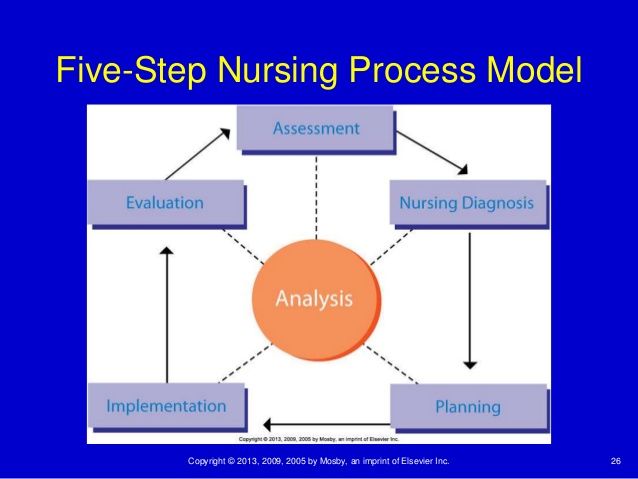
Delineate the phases of the nursing process
The purpose of the nursing process is to diagnose and treat human responses to actual or potential health problems.
human responses include patient symptoms and physiological reactions to treatment, the need for knowledge when health care providers make a new diagnosis or treatment plan, and a patient's ability to cope with loss.
The nursing process requires a nurse to use the general and specific critical thinking competencies to focus on a particular patient's unique needs.
Levels of critical thinking
Level 1: basic critical thinking - thinking is concrete and based on a set of rules or principles. Typically the nurse will follow procedures step by step as they are written instead of adjusting to meet each patient's unique needs.
Level 2: complex critical thinking - nurses analyze and examine choices more independently. The nurse learns that alternative and perhaps conflicting solutions exist. Each solution has benefits and risks that you weigh before making a final decision.
Level 3: commitment - a nurse anticipates when to make choices without assistance from others and accepts accountability for decisions made
General Critical Thinking
scientific method
problems solving
decision making
Specific Critical Thinking
Diagnostic reasoning and inference
Clinical decision making
Informationen
- Beschreibung
- Chapter 15: critical thinking
- Erstellt von
- Brittany Gunn
- Aufrufe
- 328
- Tags
- Bewertung