
Notizen
BIOL 102 LAB Notes
Inhalt der Notizen (6)
Seite 1
Chapter 5: Vertebrates I: Fetal Pig Dissection- Pulmonary & Digestive Systems
Vertebrata: Animals with true backbones
Chordata: Phylum that includes all animals with an internal skeletal support system
Urochordates
Cephalochordates
all chordates share four common features at some stage in their development, usually appearing only during early embryonic development.
1) The presence of a notochord. 2) A dorsal hollow nerve chord 3) paired Pharyngeal gill slits, and 4) a postanal tail
A living endo skeleton which grows with the animal and therefore allows or continuous growth, as opposed to many invertebrates who must shed/molt from their endoskeleton in order to grow.
Endoskeleton takes the form of a dorsally located flexible rod called a notochord in the invertebrate and primitive vertebrate members of the phylum.
In higher chordates, the notochord is typically replaced by a vertebral column, and only remnants of the notochord persist in the adult form. (The gelatinous material in the invertebrate discs in mammals)
In higher chordates, the skeletal support system is more complex, since it consists of an axial component consisting of the Cranium, Vertebral Column, Ribs, and Sternum, and an Appendicular component composed of the Pectoral and Pelvic Girdles, the associated skeletal components of the Appendages.
Hollow Nerve Chord located in the Ventral portion of the body cavity.
The Nerve Chord of Chordates develops into the Central Nervous System which consists of the Brain and Spinal Column.
The anteriormost portion of the digestive tract, located just behind the mouth is termed the Pharynx
The Digestive Tract of Invertebrates runs the entire length of the body, but most chordates have a tail which extends past the end of the digestive tract (The anal opening).
In many chordates, the muscles associated with skeletal elements of the tail are used in some form of locomotion, however when it comes to mans, the tail (coccyx) is vestigial and serves little or no functional purpose.
The animal used for the dissection is Sus Artiodactyla (even-toed or hoofed mammals)
Pigs and humans belong to the same subdivision (Class) of vertebrates called Mammalia
All mammals share certain characteristics:
Endothermal Regulation
Movable eyelids and External Ears
An efficient respiratory and circulatory system with a four chambered heart
A muscular partition (Diaphragm) separating the thoracic and abdominal cavities
Intrauterine embryonic development in which eggs that develop in ovaries are internally fertilized and attach to, and are nourished by, placental membranes
The nourishment of newborns with milk produced by mammary glands
Seite 2
External Anatomy:
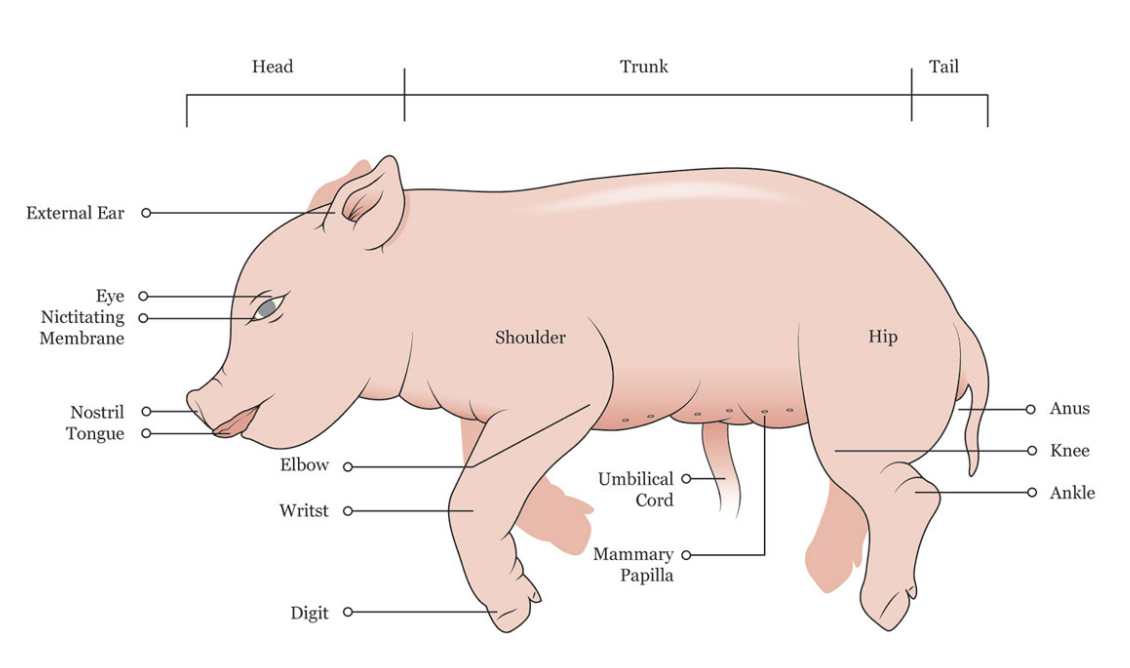
The bodies of mammals are divided to three major regions: 1) the head and neck 2) the trunk with its associated appendages 3) and the tail
Pigs have a very short neck; as is common and seen in many burrowing/rooting animals
The Head and Neck:
Nares(Nostrils)- in the pigs flattened snout (nose).
Tongue- may be protruding from the mouth and small bumps on the tongue's marginal surface are called papillae, these papillae not only contain taste buds but also aid in drawing food into the mouth.
Opening the mouth will reveal a fully developed set Teeth: this is because pigs begin ingesting solid food soon after birth these help them with the mastication of their food (breaking their food down into smaller bits)
Eyes- are located on the sides of their head, this is since they are not on the top of the food chain, so they must be able to what is around them and if they might be attacked by a predator
the eyes of most carnivores are located toward the front of the head, enabling them to better locate their prey
Prying apart the upper and lower eyelid will reveal the Nictitating Membrane- which is a translucent covering over the eye that helps keep the eyeball clean by sweeping across it's surface, it also helps in keeping the eyeball moist
Ears- of the pig are movable
The Auricle- is the flesh-covered cartilaginous structure that is the most obvious part of most ears
The Trunk:
Four appendages; two forelimbs and two hindlimbs. Pigs feet has four digits ending in Hooves. The third & fourth digits are central to the foot and are the largest and bear the most weight of the animal since the pig walks on their toes
Anterior portion of the trunk is called the Thorax and is encased by the rib cage
The Abdomen comprises the bulk of the trunk, running from the posterior end of the tail
Anterior and Posterior limit of the Rib Cage lies in between the forelimbs
Ribs extend ventrally from the dorsal vertebrae (spine)
First seven pairs of ribs are joined directly to the sternum (breastbone) by cartilage
Remaining 5 pair either connect to the sternum indirectly through a common cartilage or are not connected at all and "float"
Posteriormost bone of the sternum called the Xiphoid Process
Along the midline of the abdomen, there will be an Umbilical Cord which is what attaches a developing embryo to its placenta
The umbilical cord contains arteries and veins that bring blood to and from the growing fetus
Another vessel; the Allantoic Stalk, carries waste material from the fetus
On either side of the umbilical cord, two rows of Mammary Papillae (nipples/teats) 5-7 in each row can be seen\
These papillae are outlets from mammary glands that secrete milk to nourish young offspring.
These Papillae are present in both male and female specimens, but only function periodically, developing (growing) during pregnancy and secreting during the stage of the young
Feral pigs have a short gestation period ( approx. 4 months) nd typically produce litters per year with an average of 5, but up to 13 piglets per litter
Directly posterior to the tail lies the external opening of the end of the digestive tract, the Anus.
if female, there will be a second opening which protrudes ventral to the anus, and is called the Genital Papillae along with being a common exit for both the urinary and reproductive tracts
if male, then there will be no second opening but there will instead be two large folds of skin, called the Scrotal Sacs that will contain the testes in the adult male. The Penis of the male leads to the external urogenital opening, the Preputial Orifice, which can be found just posterior to the umbilical cord
The Tail:
The tail is the posteriormost projection from the trunk
Seite 3
Internal Anatomy:
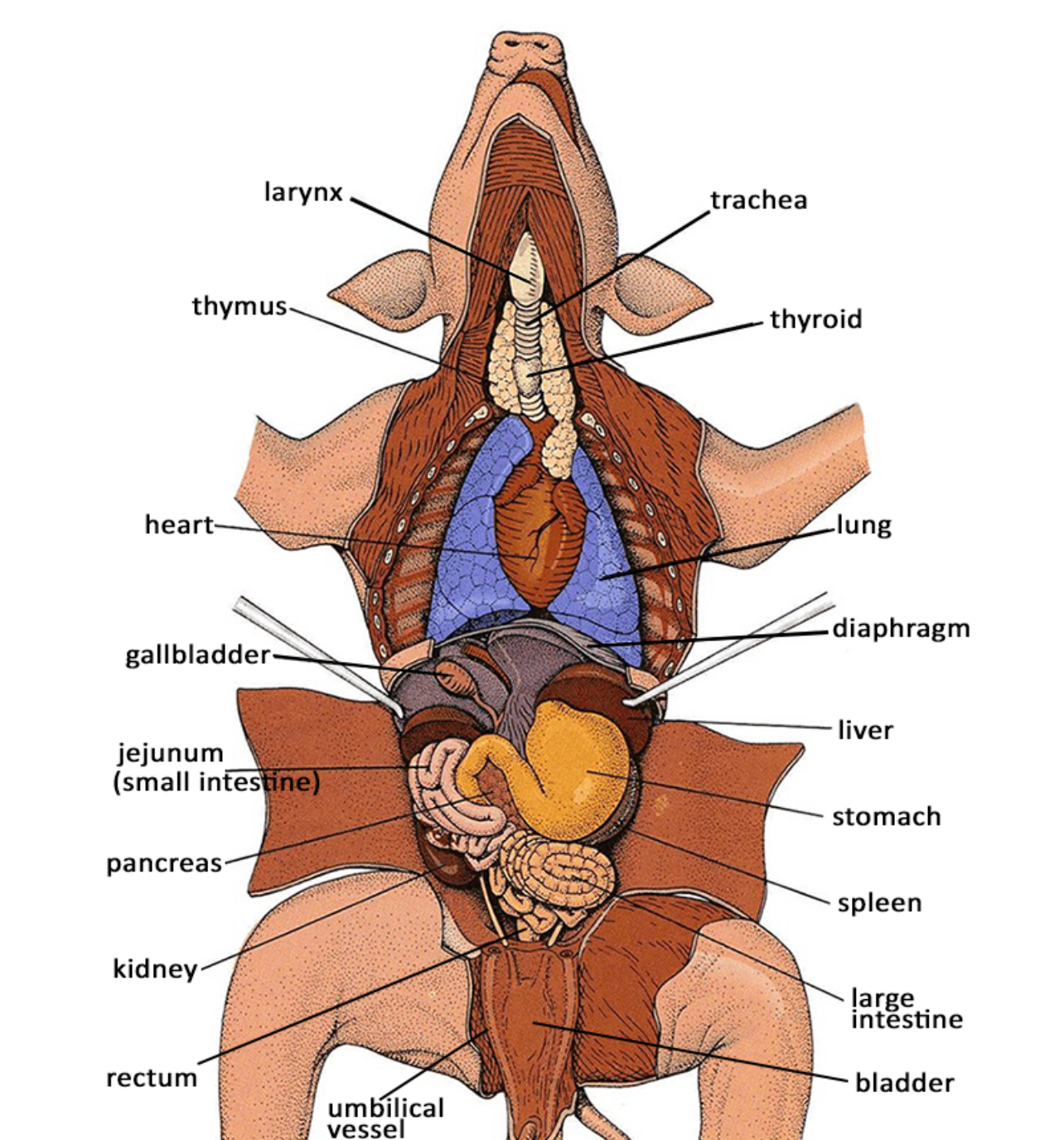
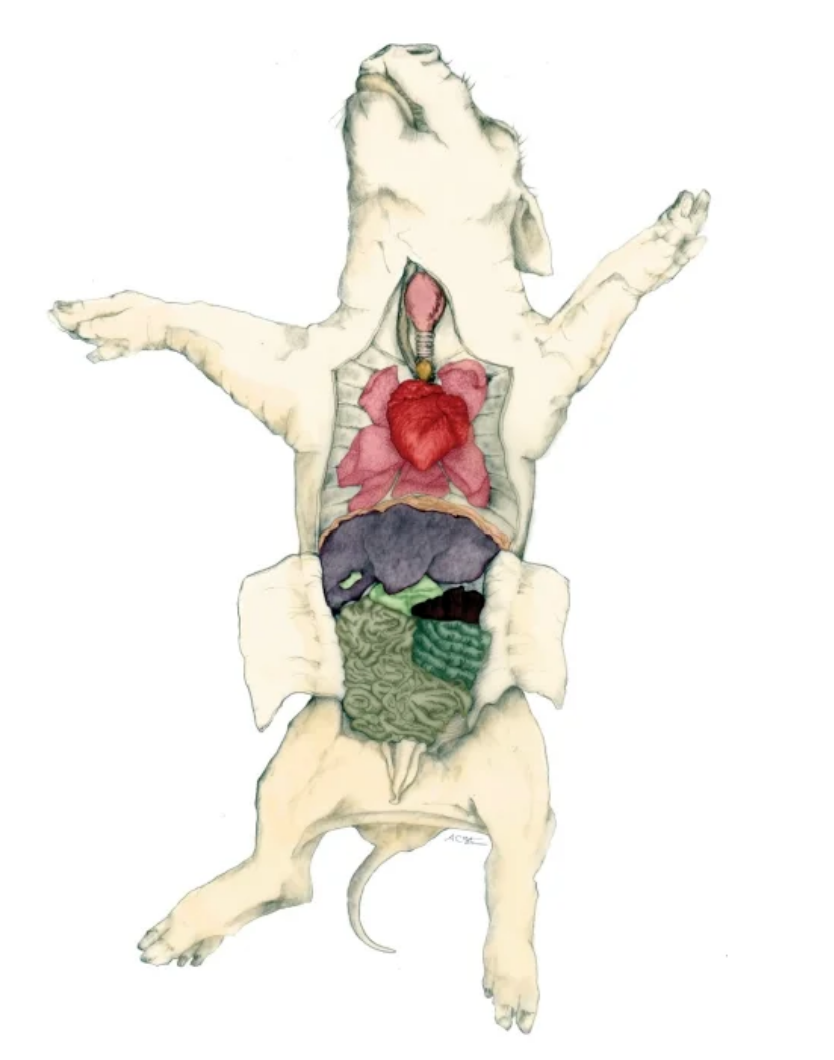
The Thoracic Cavity:
The thoracic cavity is lined by epithelial tissue and associated with this epithelium is an underlying supporting layer of connective tissue; often called a membrane, and it is tightly bound to the inner surface of the wall of the rib cage. Very thin, shiny cellophane -like layer of tissue and may appear white in color
The epithelium that lines a body cavity is termed parietal, the covering of the organs is termed visceral.
In the thoracic cavity, these epithelium are called pleura
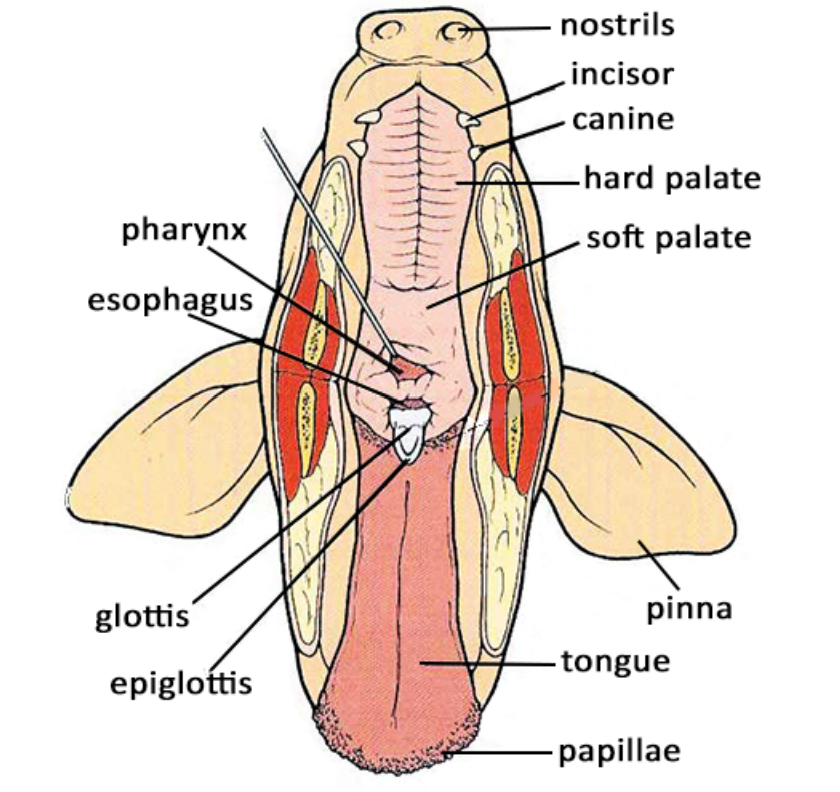
Hard palate: has ridges; separates the oral cavity from the nasal cavities
Soft palate: soft because there is no bone underneath (nasopharynx lies above it)
Buccal cavity: from opening of mouth to the base of the tongue
Pharynx: (throat) common passageway for digestive and respiratory system
Esophagus: tube connecting oral cavity to stomach. Swallowing can be initiated voluntarily, but thereafter it is a reflex controlled by a brain region.
Glottis: the opening to the larynx
Epiglottis: the flap that covers the glottis during swallowing
Seite 4
Chapter 6: Vertebrates II: Fetal Pig Dissection- Circulatory, Urinary, and Reproductive Systems; Sheep Heart
A. Circulatory System
The Circulatory System transports materials throughout an animals body in a fluid called Blood
Arteries, arterioles, and capillaries are vessels that pump blood away from the from the heart
As blood leaves the Capillaries, it travels through vessels of increasing diameter; Venules, and Veins that join to one another to complete the circuit back to the heart
Vessels are characterized by the direction in which they carry material, arteries and arterioles away from the heart and toward the capillaries; veins and venules away from the capillaries and toward the heart
birds and mammals have a four-chambered heart, and the evolution of a four-chambered heart is thought to be an adaptation brought by the high metabolic demands of warm-blooded animals (endotherms)
endotherms expend ten times the amount of energy as compared to cold-blooded animals
Four-chambered heart allows for the complete separation of oxygenated blood from oxygen-depleted blood in a circulatory system that has two separate and independent circuits.
One circuit pumps blood to the lungs, Pulmonary Circulation
The other pumps blood to the rest of the body, Systemic Circulation
these two adaptations, along with a powerful heart, allow for mammals and birds to efficiently provide the tissues of their bodies with oxygen and nutrients required for a high metabolism as well as quickly removing the waste products of those metabolic processes
Oxygen depleted blood returning from the systemic circulation enters the Right Atrium of the heart through the large veins, the Vena Cavae
Coordinated contractions in the cardiac muscle of the right atrium force blood in one fluid motion through the Tricuspid Valve into the Right Ventricle
A wave of muscle contraction in the right ventricle pumps blood through the Pulmonary Semilunar Valve into the right and left pulmonary arteries
Blood passes from the pulmonary arteries and arterioles into the capillary beds of the right and left lung----> where CO2 diffuses out of the blood and Oxygen diffuses in---> binding to hemoglobin molecules contained in red blood cells (erythrocytes)
Blood returns to the heart through the right and left pulmonary veins and enters the left atrium
Contraction of the left atrium forces blood through the Bicuspid valve into left ventricle
Blood passes from the left ventricle into the Aorta through the aortic semilunar valve
Aorta is the largest artery in the mammalian body. The main branch of the aorta travels posteriorly along the dorsal midline of the body, & ultimately supplies the capillaries in the organs of the abdomen and tissues of the hind legs, via small arteries and arterioles with oxygen rich blood
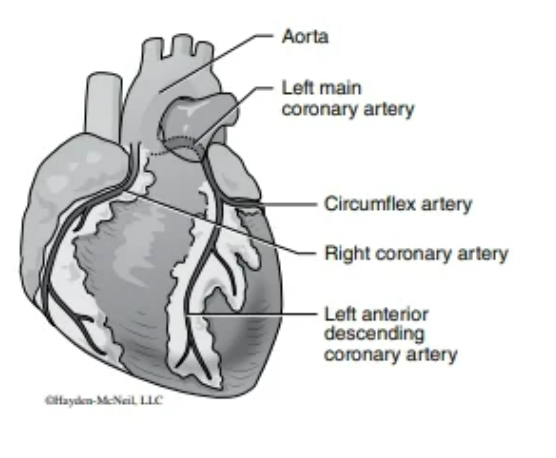
Smaller branches arise from the aorta. the first of which consist of the Coronary Arteries that supply the heart itself with oxygenated blood.
several more branches provide the capillary beds of the head, neck and forelimbs with oxygen rich blood
Metabolic activities in the cells of the body use the oxygen supplied by the arteries and produce carbon dioxide
Oxygen-depleted loaded with carbon dioxide leaves the capillaries and returns to the heart through numerous venules and veins that ultimately join the vena cava
The anterior (superior) vena cava drains the head and forelimbs while the posterior (inferior) vena cava receives blood from the trunk and the hindlimbs.
There are specialized branches in the systemic circulation called Portal Systems, and unidirectional circuit---The lymphatic system-- that drains fluid from the interstitial spaces of the body into veins of the systemic circulatory system
B. THE URINARY SYSTEM
Metabolic activities of the vertebrate body produce many wastes, one waste product of cellular respiration is carbon dioxide.
In mammals, carbon dioxide diffuses through the capillary bed walls to the alveolar spaces and is expelled from the lungs during the exhalation phase of respiration
the liver can eliminate waste in the form of bile pigments
certain alts, metal ions, and tats can be eliminated through the alimentary (gastrointestinal) tract.
The bulk of metabolic waste products, however is handled by the urinary tract
Urinary system is comprised of a pair of Kidneys and he components of the Urinary Tract:
Ureters- the tubes that drain each kidney that lead to the
Urinary bladder- a muscular sac that temporarily stores waste and the
Urethra- a tube that passes waste out of the body
The major function of the urinary system is the elimination of physiological waste, but it also plays roles in osmoregulation (water balance), maintaining blood pressure and pH, detoxification and nutrient conservation.
C. THE REPRODUCTIVE SYSTEM
The reproductive system is responsible for the production of reproductive cells called gametes- spermatozoa in males and ova in females
Gametes arise through meiotic divisions in specialized cells contained within Gonads- testes in males and ovaries in females
These gametes are nurtured and stored within the gonads until they are released so that they can unite and form a zygote n the process known as fertilization
The reproductive system consists of the gonads- the ducts that recieve or transport gametes in order for fertilization to occur, the glands that secrete fluids into theses ducts, and specialized organs (genitalia) for the transfer or reception of the gametes
Seite 5
FETAL PIG DISSECTION (CONT'D):
FETAL PIG DISSECTION (CONT'D)- THE CIRCULATORY SYSTEM
Thoracic Cavity
Abdominal Cavity
FETAL PIG DISSECTION (CONT'D)- The Urinary System
FETAL PIG DISSECTION (CONT'D)- The Reproductive System
Male
Female
Seite 6
Lab 8: Blood
Blood: is a specialized extracellular fluid connective tissue. It's functions are:
1. Transporting gases. O2 from lungs--> tissues & returning CO2 from tissue--> lungs
2. distributing nutrients absorbed from the digestive tract/ released from storage in the liver or adipose tissue
3. Transporting metabolic wastes from tissues to kidney for excretion
4. distributing specific enzymes/hormones throughout e body where specific target tissues & molecules can interact with them.
5. maintaining stable pH & electrolyte composition of interstitial fluid.
6. Preventing loss of fluid s a result of damaged vessels or other injuries
7. carrying toxins produced by infection to the liver & kidney where they are chemically altered for excretion
BLOOD DIVISIONS:
Plasma: Fluid fraction of blood--> contains many dissolved materials: cholesterol, plasma proteins such as albumins, globulins, & fibrinogen, metabolites such as lipids, glucose, amino acids & nitrogenous wastes.
Plasma proteins:
Albumin: produced by the liver, (60% of the total V of plasma proteins).Serves to maintain osmotic balance generating plasma osmotic pressure. Na+ ions are he second major component of POP.
Globulins: (36% of plasma proteins) With 2 classes of globulins: Transport globulins--> made by the liver & bind to less soluble molecules such as lipids, hormones , certain metallic ions such as Fe & vitamins. Immunoglobulins: aka anitibodies are involved in the "humoral" B- cell mediated immune response.
Clotting Proteins: (Fibrinogen, precursor of fibrin) makes 4% of plasma proteins
Formed Elements: cells & cell fragments suspended in plasma: Erythrocytes (RBC's) & Leukocytes (WBC's) and Platelets (cell fragments).
Erythrocytes: membranous sacs filled with hemoglobin (7.5 micrometers in diameter) are the respiratory pigment protein involved in the transport of blood gases. 97% of their protein hemoglobin, highly efficient in picking up O2 from the capillaries around the alveolar sacs of lungs & releasing it to other tissues of the body. RBC's transport ~20% of the body's CO2 from tissues back to the lungs by binding it directly to the amino acids of Hemoglobin (making carboxyhemoglobin)
Leukocytes: WBC's comprise less than 1% of Total blood Vol. These function in elaborate nonspecific & specific defense mechanisms against any pathogens, bacteria/ toxic molecules, dead cells & abnormal proliferating cells. In response to chemical signals aka cytokines, leukocytes migrate out of capillary blood vessels via Diapedesis --> extracellular tissues/ into lymphoid tissue where than can work in inflammatory/ immune response. Some function as phagocytes, ingesting foreign substances and move via pseudopod extensions. 2 classes of leukocytes are granulocytes & lymphocytes
Platelets: cytoplasmic fragments that pinch off from large megakaryocytes at the edge of bone marrow. contain granules with several chemicals that play a role in clotting & vascular growth
Informationen
- Beschreibung
- Biology (BIOL Notes ) Notiz am BIOL 102 LAB Notes , erstellt von Gabriel Galvez am 21/10/2022.
- Erstellt von
- Gabriel Galvez
- Aufrufe
- 9
- Bewertung