
Notizen
The Religious Experience Argument

Inhalt der Notizen (5)
Seite 1
The Argument
Many people have experiences they identify as 'religious.'
Experiences that are a part of a religious life include the ups and downs of faith, doubt, sacrifice, and achievement.
However, the experiences in which it seems to the person as though they are directly aware of God or God's action. The existence of these experiences have led to many arguing of God's existence.
If there is a God, then there are likely to be experience of Him. So, if there are religious experiences, there must be a God - right?
It has been argued that these sentences are not logically connected. Religious experiences may be caused by God, but they might not be. There may be other explanations for experiences we call religious.
Some philosophers have argued that these experiences are importantly similar to perception, an immediate awareness of something other than oneself. We usually treat perceptual experiences as veridical, unless we have a good reason to doubt them.
Furthermore, the fact that other people have similar perceptual experiences supports the claim that perceptual experiences show the world accurately.
Some philosophers have argued that religious experiences are similar to each other, despite occurring to very different people in very different circumstances. The best explanation of these experiences, and their common nature, is that they are genuine, and the experiences are of something divine.
However, there are several important issues to discuss:
What is the similarity between religious experiences, and how do their characteristics support the existence of God?
What philosophical problems are there for thinking that these experiences can give us knowledge of God?
Is there an alternative explanation for these experiences?
William James
James believed that all religious experiences indicated the probability of God (although as a pluralist, he referred to 'the spiritual' and 'higher aspects' of the world and the self).
He was more interested in the effects of religious experiences, as the validity of a religious experience rests upon the effects it produces. e.g) Are lives being changed because of it?
James' argument for the existence of God is very general; the phenomena of religious experiences point to a higher order of reality.
Richard Swinburne
Swinburne's starting point is that a belief in God is reasonably possible, based on all the classic arguments for God's existence (ontological, cosmological, teleological, moral, etc.)
Based on this, Swinburne suggests that there is no reason why claims to religious experience should be treated any differently to ordinary perceptual claims.
He puts forward two principles to support this:
The Principle of Credulity - We must accept what appears to be the case unless we have evidence say this is not the case (falsification rather than verification). The clear evidence may be, for example, that a person was hallucinating under the influence of drugs.
The Principle of Testimony - Unless we have positive evidence that they are misremembering or are untrustworthy, we should believe the testimony. He claims that 'other things being equal, we usually think what others tell us that they perceived, probably happened.'
Swinburne is the best example of a realist.
Strengths
Quantity - Religion, based on the experience of its founders, as been a powerful force in history and recent research (e.g. David Hay) suggests it is widespread.
Effects - The effects of these experiences are profound and positive. They change people's lives in a way that is extremely difficult to explain without making reference to an outside agency, like God.
Similarities - There are considerable similarities between descriptions of religious experiences, even across religions, that would not be present if they were made up.
Weaknesses
Alternate Explanations - There are various explanations of religious experience found in psychology, physiology and sociology. If we can explain experiences naturally, then the force of the argument is limited.
Private - Religious experiences are usually private. The experience might convince the experiencer of God's existence, but do nothing for those nearby. Bertrand Russell rejected the argument as it is impossible to confirm or deny what is happening inside someone else.
Difference - Believers in different faiths all claim that their experiences prove the truth of their faith. They can't all be right.
It's ludicrous to say that religious experiences are the only proof of God - otherwise, we could also say that God doesn't exist if we haven't experienced him. For instance, I haven't had any experience of going to India, I have just heard others talking about it. But that does not mean that it doesn't exist.
Can we really trust the evidence given by religious experiences?
Most people from different cultures have used similar ways of understanding the world, in terms of objects with colour, size, solidarity and so on. By contrast, religious experience has produced very different ideas of what the 'divine reality' might be, from the Christian idea of God to Buddhist ideas of 'nothingness.'
James would respond that we shouldn't think that a religious experience can give us a whole theological system. At most, we can argue to the reality of something spiritual, and perhaps reach tentative conclusions about what reality is like.
We may also argue that people can experience the same thing while disagreeing about what it is they have experienced, (like witnesses disagreeing in court, or the elephant analogy, where people claim it is a fan, a rope, a wall and a tree). Therefore, disagreements between religions don't show that religious experiences are veridical, only that they can tell us very little about the nature of the divine.
However, we may still wonder whether the existence of God is the best explanation of religious experiences, or whether some other explanation is as good. For example, we might argue that people who have a religious experience are simply imposing certain religious ideas or expectations onto an emotional experience which is not awareness of the divine at all.
One response to this points out that there are many cases of conversion as a result of religious experience, in which the person wasn't expecting anything religious to occur.
Seite 2
Challenges to Religious Experience
Some philosophers have noted that religious experiences are like perception and that we usually assume that perceptual experiences are truthful, unless we have reasons to think otherwise. However, other philosophers disagree and argue that religious experiences are not like perception. Thus, we shouldn't necessarily consider them to be truthful, as we can identify several reasons to doubt the experiences.
1) Psychological Explanations
There are well-documented psychological explanations of various forms of religious experience.
Ludwig Feuerbach (1804-1872) argued the idea of God is a human projection. For instance, if we think about God, all his attributes are in our nature - goodness, kindness, knowledge, love - they are all human aspirations and desires. We simply create God in our image. (links to Durkheim's idea that we are worshipping ourselves and society through religion)
"God is man written in large letters." - Feuerbach
But the question is, why would we construct the ultimate being of us? In short, we feel fulfilled in being able to connect and relate to a being that is so much like us.
Sigmund Freud (1856-1939) believed that all human religious behaviour was a neurosis caused by childhood insecurities and a desire for a father figure. According to Freud, religious experiences are hallucinations that are a product of our subconscious and are caused by our desire for security and meaning.
This desire for meaning and security is strong within all of us, and Freud reasons that it is strong enough to evoke the illusion that our wishes are being fulfilled through the hallucination of religious experience.
In a similar way, dreams are said to be caused by our unconscious mind, as a product of our deep desires we may not be aware of.
Because we long for these needs to be met, we literally will it to happen, thus creating a convincing illusion.
Countering Psychological Explanations
Carl Jung (1875-1939) accepted the reality of numinous experiences and argued that development of the spiritual aspect of us was essential to our psychological wholeness. He claimed that each of us have an idea of God within a shared collective unconscious. This idea of God makes us more susceptible to having a religious experience.
William James accepted that there was a psychological element to religious experiences, but did not agree that this meant they were simply psychological events.
James also argued that hallucinations are still real experiences in response to Freud. These hallucinatory experiences directly reveal God, with a feeling that He is beyond our world. This hallucination does fulfil our psychological needs and wishes, but that is no reason to discredit the experience as false.
Can we really evaluate the truth of spiritual reality based on our experiences? According to William James, the effects of a religious experience is much more important than the experience itself. He says that religious experiences must produce real and positive effects on an individual's life, otherwise it is not a religious experience. If it were purely a psychological means of the brain fulfilling its own needs, then would effects be present?
Furthermore, it may be possible that our subconscious is actually part of a spiritual 'reality'. If this is the case, we are always having a religious experience.
However, it can also be said that the subconscious mind cannot cause religious experiences, as the individual must be fully conscious to have such an experience.
Perhaps the reason that we desire meaning and security is because we were created by God to have a relationship with him, so these desires are ingrained within our very existence.
2) Physiological Explanations
In the last 20 years, a lot of work has been focused on the function of the different areas of the brain. This has led some scientists to believe that religious experiences are result of neuropyschological mechanisms.
They refer to the 'causal operator' and the 'holistic operator,' within the brain; which is often seen on brain scans of meditating Buddhist monks.
Because the brain is not fully understood, religious believers have claimed that these neuropyschological mechanisms are caused by experience of something else we do not fully understand - God. But because we don't understand something fully, is not to say that that the explanation we do understand is right.
Countering Physiological Explanations
The fact that there is a physiological element to religious experience does not mean we have to reject the experience completely. All experiences can be reduced down to a series of neurological events that show up on brain scans - does this mean that we doubt our own sense?
Some thinkers have argued that our brains are wired up in such a way that we can experience God.
Meditation itself is to focus the mind, and use more of the brain, so we are more susceptible to the truth. Could this be the truth of God's existence?
3) Difficulties in Interpretation
Religious experiences tend to be described in terms of societal familiarity. A religious experience reflects the society in which you live and have grown up in.
For example, Catholics experience visions of the Virgin Mary and the Hindus experience visions of Shiva - this simply reflects the world they live in. Thus, people interpret the same experience differently, according to what belief system they have been socialised into.
Karl Marx argued that religion was about mythological beliefs and an unreal God that distracted people from their own reality in the physical world.
Countering Difficulties in Interpretation
As James argued, all are experiences are interpretations. Whatever happens to us, we describe it in our own way. You might describe an event differently than a friend, but this does not mean that an event did not happen.
It can also be argued that pluralistic interpretation is possible. People may be experiencing the same higher being, but expressing it through the beliefs of a particular faith.
4) Logically Impossible Argument
Immanuel Kant (1724-1804) argues that our senses can only experience things in the empirical realm. There may be a reality beyond our experience (noumena) , but it is impossible for us to experience this as a matter of logic. Our human senses are limited, therefore it is impossible for humans to experience an unlimited God.
Countering the Logically Impossible Argument
Even if we can't cause an experience of God, it might still be possible to experience Him if he chooses to reveal himself.
William Alston argued that religious experience is similar to our normal sensory perception.
There may be an aspect of our minds that is able to experience God (links to physiological explanations).
C.D. Broad gives the analogy of a blind person evolving the capacity to see. Those who are still blind would be sceptical of the information given by those who can now see. This analogy is similar to Plato's Allegory of the Cave, in which those who have religious experiences are like the prisoner who is freed from the cave, and the sceptics are like the prisoners still chained, who refuse to learn reality.
If it is not possible to experience God directly, then could it be possible to experience the people through which God works? e.g) Virgin Mary, Jesus, prophets etc.
Although it is not possible for our finite senses to experience the entirety of an omnipotent, omniscience and ultimate God, it stands to reason that we would be able to experience a small part of him through religious experience.
Furthermore, we are the only ones who are limited, not God. Surely an omnipotent God would be able to reveal himself in a way that humans can experience him?
Seite 3
William James
Who was William James (1842-1910)?
William James was a psychologist, philosopher and physician, who studied religious experience without religious connotations and understanding.
He wrote The Varieties of Religious Experience which aimed to survey the types of religious experience as a psychologist and to present the findings of this survey and its implications for philosophy.
He argued that it was possible to detect a 'common core' to all (genuine) religious experiences.
What is religion?
James felt that religious experience was at the very heart of religion.
James rejected all the traditional arguments for the existence of God, and believes that feeling/experience should come before philosophy, as philosophy is simply and 'add-on' to what is 'the backbone' or common about all people's experience of religion.
Feeling is 'the deeper source of religion' and philosophy and theology are 'secondary.' Philosophy finds arguments 'for our conviction.'
"The proof is in the eating."
James defined religion as:
"The feelings, acts and experiences of individual men in their solitude, so far as they apprehend themselves to stand in relation to whatever they consider the divine."
He believed that religious experience is the reality of the unseen, that is felt/experienced rather than conceptualised. Having a religious experience is very different to thinking about God or trying to imagine his nature.
However, he didn't argue for the existence of a particular theological concept of God - simply argued in favour some kind of spiritual reality. He stated that in mysticism, there is an 'eternal unanimity' (they are all the same). The existence of different religions and beliefs is good because it reflects different personalities, that fit with the various interpretations of the same spiritual reality.
Religious experiences aren't connected to any particular mode of sense perception (e.g. sight, hearing, etc.). Sometimes they can be, e.g. when a person feels God is directly speaking to them; but the 'inner words' are not normally everything about the experience. They are part of an awareness that transcends sense perception, that doesn't have sensory content. For instance, the person feels they are immediately aware of and connected to God.
This awareness tends to block out everything else temporarily, perhaps even to the degree that the distinction between the person and what they are aware of disappears, resulting in a mystical union.
James defined religious experiences as different to ordinary experiences as they form their own identifiable category. James thus argued three things: mystical states are absolutely authoritative to those who have them, no authority extends to people who have not had them, and they break down the authority of rational empiricism, showing that there are other forms of consciousness and 'other orders of truth.'
However, James theorised that in order to take these experiences seriously, we must connect them up to the rest of our lives (and judge experiences by the effects they produce). Religious experiences are connected to having a religious attitude to life, and James thought that there were three main beliefs of a religious attitude:
a. the visible world is part of a spiritual universe which gives it meaningb. a harmonious relation with that higher universe is our true purpose in life
c. this harmony enables spiritual energy to flow into and affect the visible world
and two main psychological traits:
d. new zest which adds itself like a gift to life
e. assurance of safety and a temper of peace, and, in relation to others, a preponderance of loving affections
Four 'Fruits' of Religious Experience:
The experience leaves the person with an awareness of something beyond the physical world.
Elation - the person is left feeling 'high'.
The experience leaves the person with a feeling of having come into contact with a benevolent and 'friendly power.' Their response to this is one of self-surrender.
The person experiences a change in the emphasis in their life. They move towards a more spiritual, charitable, and morally aware state, characterised by a sense of awe and wonder at the universe.
Those experiences which have no impact on how someone understands life may not be genuine.
James also recognises that these experiences can be induced. Certainly, the effects of a mystical experience can be similar to the effects of substance abuse. He said that religious experience is a movement from 'tenseness, self-responsibility and worry' to 'equanimity, receptivity and peace.' Religious experience involves a sense of inner peace, a sense of a Higher Order, and a sense of a revealed truth.
All religion, according to James, points to the feeling that there is something wrong with us as we stand, and that this is corrected by becoming in touch with a higher power. Realising this is connected to an awareness of being in touch with something 'more' in religious experience.
James notes that all of this is very interesting psychologically, as well as answering the question of whether this awareness is just our own 'higher self' or something more objectively real.
He said we should recognise it as real for two reasons:
1) There is 'more' to us that we consciously realise - so in religious experiences, we are in touch with something external to ourselves as we usually experience ourselves. James is happy to call this reality, considered abstractly, 'God.'
2) Religious experiences must be real because they produce real effects on us. "God is real since he produces real effects."
Our awareness of the 'unseen' may be inarticulate, and beyond our ability to think in any usual terms about it. James said that our conceptualisation comes after the experience.
James noted that religious experiences have great authority for the person who has them and can often have a marked effect in a person's life.
For example, he observed that conversion experiences are characterised by religious beliefs becoming central to a person's life.
James agreed with St Teresa of Avila that the 'acid test' for knowing if a religious experience is genuine or not is the actions of the person following the experience. He thought that the person's experience should be marked by a saintliness and holiness which rises from the personal experience.
As religious experiences can noticeably change people's behaviour, James suggested that religious experiences were the inspiration and source of religious institutions, so much so that religious experiences were, in his opinion, at the heart of religion. This also means that any other aspects of religion are 'second hand'.
Much of his book, The Varieties of Religious Experience, concentrates on descriptions and first-hand accounts of experiences.
Sceptics viewed some of these as examples of psychological disorders, but James disagreed and placed such accounts as central to any understanding of religion.
What are some of the similarities between religious experiences and symptoms of schizophrenia?
https://youtu.be/ehhy-_Cg4QU (Einbetten)
The Four Characteristics
Four characteristics were found to be particularly prominent in mystical religious experiences of God:
Ineffable - the experience is beyond proper description, the direct experience of God goes beyond human powers of description
Noetic - mystics receive knowledge of God that is not otherwise available. In this sense religious experiences are direct revelations from God.
Transient - the experience is a temporary one that cannot be sustained, although it may have long-lasting effects.
Passive - the experience is not initiated by the mystic themselves, but rather something is acting upon them.
(James saw the passiveness of religious experiences as evidence against the argument of sceptics who said that these experiences can be explained by saying a person willed it.)
Defending Religious Experience
James argued that religious experience was a valid argument for the existence of God.
Religious experiences are subjectively convincing, more so than arguments of reason, because the premises with which reason works have been prepared by “your whole subconscious life”. (Lecture III, § 2)
What is personal and subjective is not necessarily ‘unreal’. In fact, every experience must have a personal and subjective element. Experiences of meaning obviously will.
All religion points to the feeling that there is something wrong with us as we stand, and that this is corrected by becoming in touch with higher power. Awareness of this leads to awareness of being in touch with something MORE.
“Whatever it may be on its farther side, the 'more' with which in religious experience we feel ourselves connected is on its hither side the subconscious continuation of our conscious life…” (Lecture XX, § 6) Beyond this we step into ‘over-belief’.
'A Psychological Phenomena'
James saw religious experiences as psychological phenomena; a part of a person's psychological make-up.
He did not, however, see this as a criticism of his argument, but explained that religious experience is natural to a person, just like any other psychological experience like thinking and self-awareness.
James' conclusion rests upon three key principles:
Empiricism - The evidence for religious experiences and their characteristics are based upon empirical (or sensory) data. James argued that this evidence provided us with clues as to the reality beyond what we see and hear. In response to those who might object that he is interpreting the data, James replied that we all interpret our
Pluralism - James' research into different faiths led him to conclude that they were similar. Those having experiences may be experiencing the same ultimate reality, but interpreting it as their religious belief structure. For instance, a Christian may interpret an experience as the Holy Spirit, whereas a Sikh may interpret it differently.
Pragmatism - James believed that truth was not fixed, but that what is true is whatever has great value to us. As a religious experience has great value to those it effects, we have to conclude that there is truth to be found in religion.
James argues that if we say more about God, then we speculate.
We could argue that we can know something about God by the type of effects produced - a zest for life, the predominance of love, the sense that there is something wrong with us without God.
Religious Experience is Not Perception
Firstly, religious experience is universal among people, and is continuously present to us when we are awake. It provides a rich amount of detail and information ('a picture is worth a thousand words').
By contrast, only some people have religious experiences, and only rarely. Additionally, these people find it very difficult to say anything informative.
However, only a small number of people can recognise an 18th century piece of furniture, but that doesn't mean they aren't right or reliable. We can't tell the truth of something from its frequency. Furthermore, while the experience doesn't give much information, that doesn't mean it doesn't give any.
However, the objection is that because religious experiences are rare, we shouldn't assume they are veridical until we have a reason to doubt them. Surely part of the reason that we trust perception is because it is so widespread, common and informative.
Another reason we trust perception is that we have intersubjective agreement; if you and I start seeing things very differently, we wouldn't be so sure. And if I'm not sure about what I see, I can check with you. This isn't true of religious experience, which is more private.
In response, we may appeal to James' five characteristics of a religious attitude. If a religious experience has no transformative consequences, we may doubt it was veridical; if it does transform the person, then we have reason to think it was.
Second, we can argue that religious experiences are more like experiences of what we feel than what we perceive. For instance, I don't check how I'm feeling by seeing how you feel, nor do you have direct access to what I feel.
But we can respond that our feelings, unlike perception, are not assumed to be veridical, as they can often be misguided.
Seite 4
Sigmund Freud
Who was Sigmund Freud?
Sigmund Freud is the father of psychoanalysis, massively influential.
He was led into the field of psychoanalysis by his opposition to religion.
Freud believed that religion was a great hindrance to society, and so set out to prove that it is merely a product of the mind, an illusion.
He offered both a psychological and a historical explanation of the origins of religion.
Freud thought that science was fact, and since there is no concrete scientific evidence (only empirical evidence) for religion or religious experiences, it cannot be true.
Source
https://youtu.be/w5AThYXX_7E (Einbetten)
Wolf-man example: fear of wolves resulted from repressed sexuality and witnessing his parents have sex at a young age - fear of wolves substituted for fear of father. Somewhat like religion - expressing fear/submission to a fatherly God?
The Historical Explanation
Freud’s historical explanation of religion is set out in his Totem and Taboo.
There he imagines a father of a primal horde, whose sons envy his access to the tribe’s women, and so overwhelm and kill him.
Even after their rebellion, the sons cannot fulfil their desire to emulate their father, due to competition between them.
Religion arose out of the frustration and guilt that they felt.
The Psychological Explanation
Freud’s psychological explanation of religion builds on the ideas of Ludwig Feuerbach.
Feuerbach developed the idea that God is projection of the unconscious mind; Freud added to this a psychological foundation.
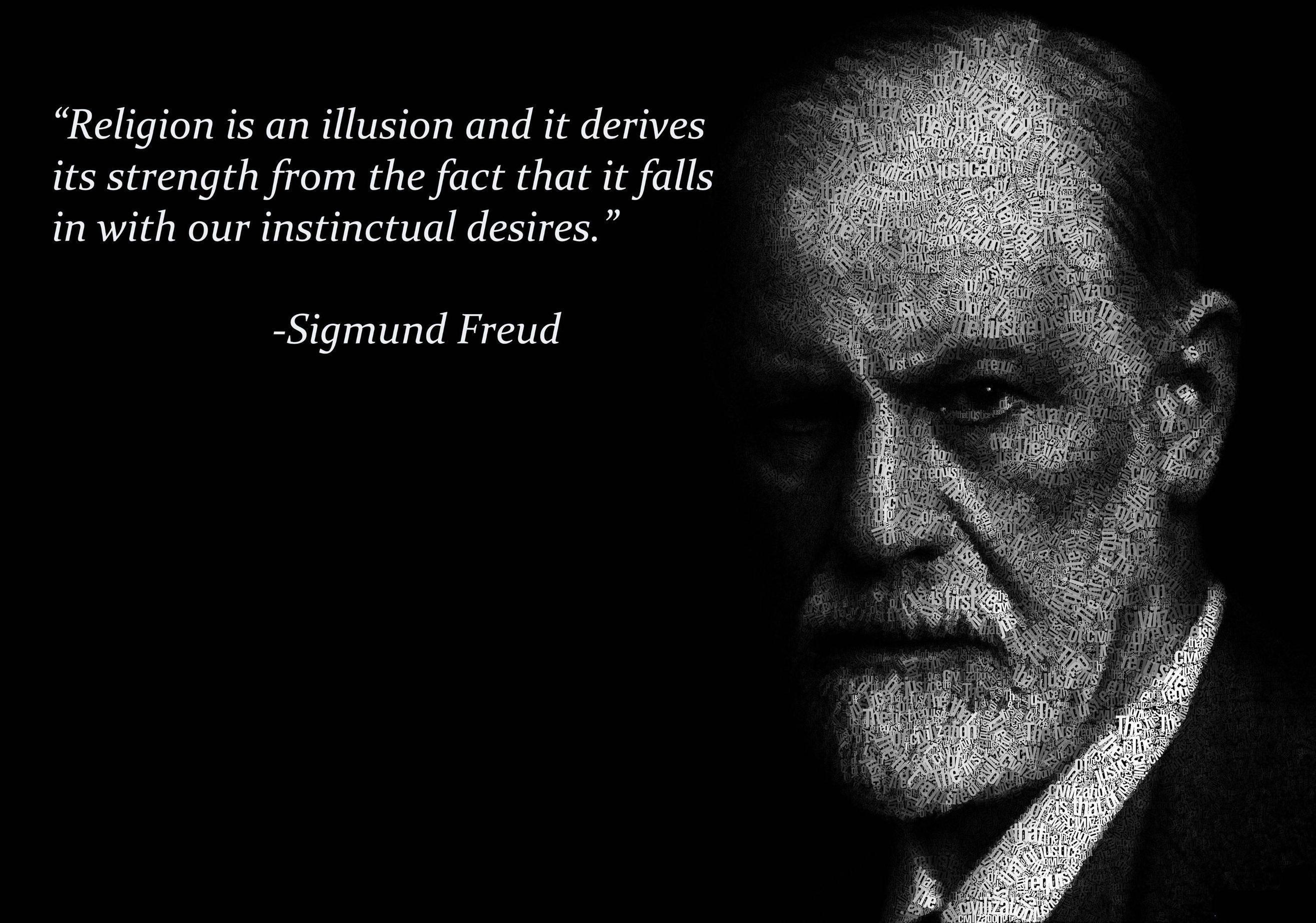
For Freud, as for Feuerbach, religion is wish-fulfilment. Freud adds the explanation that the adoption of religion is a reversion to childish patterns of thought in response to feelings of helplessness and guilt.
We feel a need for security and forgiveness, and so invent a source of security and forgiveness: God.
Religion is thus seen as a childish delusion, and atheism as a grown-up realism.
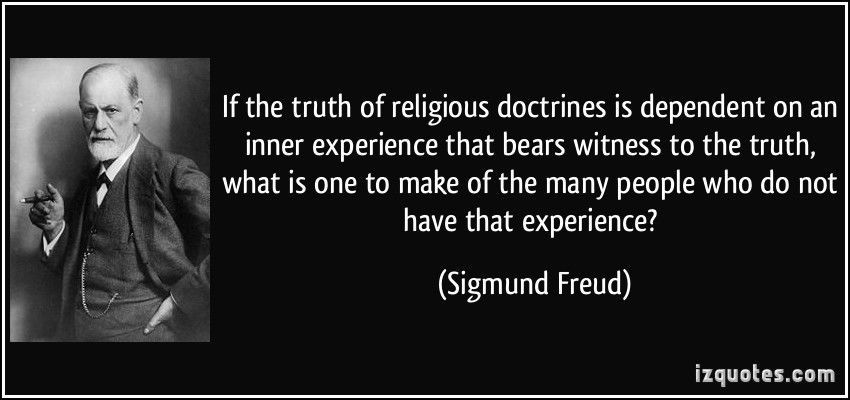
In The Future of and Illusion, Freud presents the explanation that religious experiences are hallucinations, like dreams, caused by the very deep unconscious wish that human beings have. Religious experiences therefore are caused by the desire for security and meaning. In other words, our minds create religious experiences because it's what we want to believe.
This wish is linked back in history to the emergence of the human race, and in each individual, to their earliest infancy.
We are vulnerable, belittled, in the face of nature. “Man’s self-regard, seriously menaced, calls for consolation; life and the universe must be robbed of their terrors” (196)
Our state of helplessness towards nature is similar to what we experienced as infants. We especially feared and admired our father. A similar attitude of fear and admiration towards God is clear in every religion.
These two types of helplessness combine psychologically: “Thus [man’s] longing for a father is a motive identical with his need for protection against the consequences of his human weakness.” (204)
We are able to console ourselves in the face of nature by understanding the forces of nature in terms of our father, and so we created gods. Religion then developed further when a single God (the Father) ruled over nature. And now, “man’s relations to [God] could recover the intimacy and intensity of the child’s relation to his father.” (199)
Early religions focused around controlling nature, and even the religions we have today make us feel safe in the face of uncertainty or danger, as the divine is seen as protective force. Our relationship with God thus takes on the intimacy and intensity of our relationship with our parents, which links in with the infantile feelings of vulnerability.
Religious teachings are “illusions, fulfilments of the oldest, strongest and most urgent wishes of mankind. The secret of their strength lies in the strength of those wishes.” (212) An illusion is not an error, and isn’t necessarily be false – it is a belief derived from a wish. “It is a very striking fact that all this [that religion proclaims] is exactly as we are bound to wish it to be.” (215)
Because these religious beliefs are based on wishes, the religious experiences must be too. The experiences are caused by deep desires for meaning and security, in the form of hallucinatory dreams.
Freud's theory seems to account for many of the characteristics James noted about religious experiences.
If they are hallucinations, then we can expect them to be experiences, rather than thoughts, in which the person seems to be aware of something directly.
Given the nature of the wish, we can expect them to involve intense feelings; and because the wish is abstract, they won't be particularly related to any mode of perception. They will feel like there is something beyond or outside oneself that can offer security, upon which one can depend.
Objections to Freud's Theory
James argued that Freud's theory doesn't undermine the possibility that religious experiences are experiences of God.
We can't evaluate the truth of an experience just by its origin. We should look at its effects, its place in our lives. We must evaluate it bu other things we feel are important, and what we know to be true. Religious experiences produce real effects, which are positive.
We can agree that religious experiences come to us in the first instance from the unconscious. But it is entirely possible that the unconscious is a conduit of spiritual reality. Almost everyone who believes in a spiritual dimension to human beings thinks this goes beyond what we are aware of.
Even if religious experiences are caused by a wish for security and meaning, if God does exist and we do need him, then our wish for contact with God would be realistic - if we are made by God, then a relationship with God would be one of our deepest desires. The wish Freud identifies may not be the result of only the experiences he describes.
Freud would agree with most of this. Knowing why an artist paints may be no help at all in saying whether the painting is beautiful; knowing why a scientist dedicates their life to research won't tell us if what they discover is true.
Freud only argues that religious experience, in itself, gives us no reason to think it is an experience of God. It is perfectly possible for religious experience to have an entirely planned psychological cause, and seem exactly as it does now.
Until we have some independent reason to think God exists, then we cannot use religious experience to support the claim that God exists.
Another objection is that Freud's account of religion is inadequate. For instance, religion is not as conforming as he supposes.
Seite 5
The Brain and Religious Experience
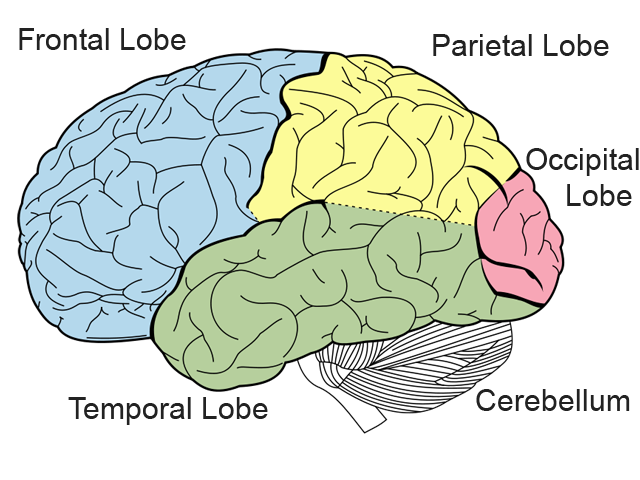
Temporal lobes are located at the sides of the brain, and are associated with sensory input.
Bryan Kolb and Ian Q. Whishaw identified in 1990 that disturbances of vision, hearing and perception occurred when the temporal lobes were damaged.
Damage to the area is also associated with paranoia and aggression
Andrew Newberg has shown that the parietal lobe, which is responsible for sensations associated with personal identity was also active during religious experiences.
Temporal Lobe Epilepsy
Temporal lobe epilepsy (TLE) is a condition where there is abnormal electrical activity in the temporal lobes, causing seizures.
These can range from simple partial seizures, where the sufferer remains conscious, to complex partial seizures, where the sufferer loses awareness.
A group of TLE sufferers were compared with a control group. Both groups were shown a variety of flashcards, with three groups of words; neutral words (e.g. table), erotic words (e.g. sex) and religious words (e.g. God).
The control group responded to the erotic words - they showed a heightened sense of excitement. The TLE group showed a similar response, but to the religious words.
Andrew Newburg also experimented with a Buddhist, Michael Baime, to study the brain during meditation.
When Baime meditated, his parietal lobes were completely shut down. Newburg claims this accounts for the loss of sense of place and time during meditation, since the parietal lobe is the seat of spatial and temporal awareness.
In a subsequent experiment, the neuroscientist Michael Persinger created a helmet that put a weak magnetic field around the subject's head, particularly around the parietal and temporal lobes.
The subjects were told that the helmet would create a sense of relaxation, but the majority reported a sense of someone standing next to them.
Some claimed it was someone they knew who had died, others claimed it was God.
Some claim that Persinger had electronically induced an epiphany (from the Greek, to make manifest; to show).
Drug Induced Hallucinations
Shamans and tribal religious groups have used hallucinogenic substances as part of their rituals for millennia. As such, these substances are called entheogens;
Psychedelics - Believed to 'set the mind free' from its bodily prison. Alters perception, creates a mystical state and sometime psychosis. Used to treat alcoholism and mental illness.
Dissociatives - Creates a sense of 'sensory deprivation'. Establishes a dream-like state - results can be similar to psychedelics. Creates a sense of depersonalisation and distance from reality.
Deliriants - Induces a sense of derilium (a state of mental confusion and excitement) characterised by the inability to focus attention and a lack of sense of space and time. This is not the same as dementia or depression.
Entheogens
En = in
Theo = God
Gens = generated
Entheogen = generating God in person
These are substances used as part of a ritual practice to heighten a sense of the other.
The term, entheogens, is not used to suggest that God is generated or created through the use of substances, nor that God is internal to the person. Entheogens have been used throughout human history, and around the globe.
As well as drug induced experiences, religious people have found other ways of heightening their sense of the 'other'. Music, colour and incense have all been used to develop the 'right atmosphere' and may have been used to induce a more suggestible nature in people attending acts of worship.
Experiences such as the Toronto Blessing or the Nine O'Clock Service have been criticised because of the apparent manipulation of people's perception through the use of orchestrated mass hysteria, repetitive and trance-like music and imagery.
Aldous Huxley (1894-1963)
Novelist, essayist, poet and scriptwriter, Huxley was born in Surrey, but lived in Los Angeles from 1937.
His most famous novel was Brave New World, written in 1932, which described a world in which behaviour was subject to psychological conditioning.
Huxley experimented with psychedelic drugs, particularly LSD.
He also studied mysticism, and came to reject organised religion in favour of a personal and sincere quest for God. He tried to establish mystical experiences, through experiments with mescaline (a psychedelic drug from the Peyote cactus, and used in Native American religious ceremonies), and published his findings in The Doors to Perception, 1953.
His final novel, Island, written in 1962, described a fictional mushroom used by people in rites of passage. The 'moksha medicine' derived from these mushrooms is used to give meditational insights and enlightenment.
Informationen
- Beschreibung
- A-Level (Year 2) Philosophy (Religious Experience) Notiz am The Religious Experience Argument, erstellt von Summer Pearce am 24/09/2016.
- Erstellt von
- Summer Pearce
- Aufrufe
- 17
- Bewertung