
Notizen
Change Culture
Inhalt der Notizen (1)
Seite 1
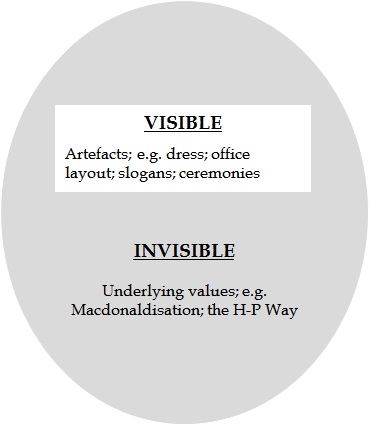
“...the
underlying assumptions about the way work is performed”.
“...what is acceptable and not
acceptable”.
“...what behaviour and actions are
encouraged and discouraged”.
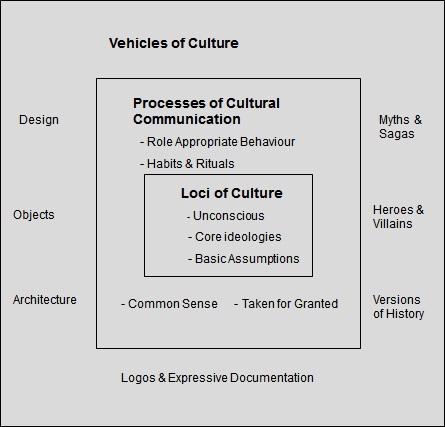
“…managers who embrace value-based change
initiatives often have little awareness of the causal impact of cultural forces
- values, assumptions, patterns of thought and action - on the success or
failure of their plans.”
The
Role Culture (Apollo)
Based on definition of role or job to be
done
Task of organisation sub-divided into
organisational flow-chart of work - system of prescribed roles
Communications, systems and procedures
are formalised - rules & procedures
abound - culture is organised & managed, not led.
Role culture is excellent when stability
and predictability are assumed and encouraged - stable and unchanging tasks
Efficiency is meeting standard targets -
psychologically secure
Examples: Life
assurance companies; civil service, state industries; companies with long
history of success with one product or service
The
Task Culture (Athena)
Task culture evolved so organisation
could respond to change speedily and in non-individualistic way - talks of
teams and committees.
Culture thrives in situations where
problem solving is job of the organisation - group talents and resources
applied to project or task.
These cultures are expensive - use
professional people.
Culture good to work in if you know your
job - group has a common purpose, sense of enthusiasm & joint commitment.
Relies on team leaders and co-ordinators
(rather than managers), mutual respect & desire to help not exploit - full
of budgets, short on job descriptions.
Examples: consultancy,
advertising agencies, product development groups, surgical teams, project work.
The
Person Culture (Dionysus)
Puts individual first - organisation is
resource for individual’s talents (in other cultures individual is there to
help organisation achieve its purpose).
Individual talent is all important - the
culture preferred by professionals.
Commune culture existing for its
participants - cluster of individual stars loosely gathered in a circle.
Professional tenure - culture serviced by
minimal organisation - management lower status than the professional stars
& has few formal controls over them.
Difficult to run - only expert or
personal power is relevant - ‘stars’ are protected against actions of holders
of resources - culture works where talent of individual is what counts.
Common examples: GP practice, architect partnership,
Barristers in chambers, Professors & Scientists
The
Club Culture
(Zeus)
Radial Lines: Lines of responsibility &
function/product
Encircling Lines: Intimacy Lines are crucial - Lines of Power & Influence
reducing in importance with distance from centre
Excellent for Speed of Decision
Selection
& Succession
critical variables in club organisations
Clubs of like minded people - working on
personal contact rather than formal liaison - empathy,
affinity & trust key
issues
Convenient way of running things, cheap
cultures to run - depend on networks of friendships, Old Boys & comradeship
Key to success is having right people who
blend with core team and can act on their own
Examples: Small
entrepreneurial organisations; Investment banks & broking firms; political
groups
Overview
Role
Task
Person
Club
Informationen
- Beschreibung
- Bsc Hons Applied Computing (PaaSl) Notiz am Change Culture, erstellt von Steve Hiscock am 04/05/2013.
- Erstellt von
- Steve Hiscock · Mai 2013
- Aktualisiert
- 19 Feb 2016
- Aufrufe
- 948
- Tags
- Bewertung