
Human Heredity
Folien in diesem Satz (13)
-
- Miller Levine Textbook:
- Section 14.1 Human Chromosomes
- Section 14.2 Genetic Disorders
- Section 14.3 Studying the Human Genome
-
- Genome: Complete set of genetic information carried in the DNA of an organism
- - Chromosomes involved in studying them
- - DNA and protein bundles inside nucleus of cells of eukaryotes
- Karyotype: Picture that allows for chromosomes to be seen clearly coming out from photographs of cells in mitosis (chromosomes easy to see), chromosomes cut out and arranged
- - Full diploid set of chromosomes in pairs are shown, chromosomes from largest to smallest in size
- - 46 total chromosomes in human cell, arranged into 23 pairs
- - Pairs from egg and sperm
- Image credit: https://upload.wikimedia.org/wikipedia/commons/e/e0/Human_karyotype.svg
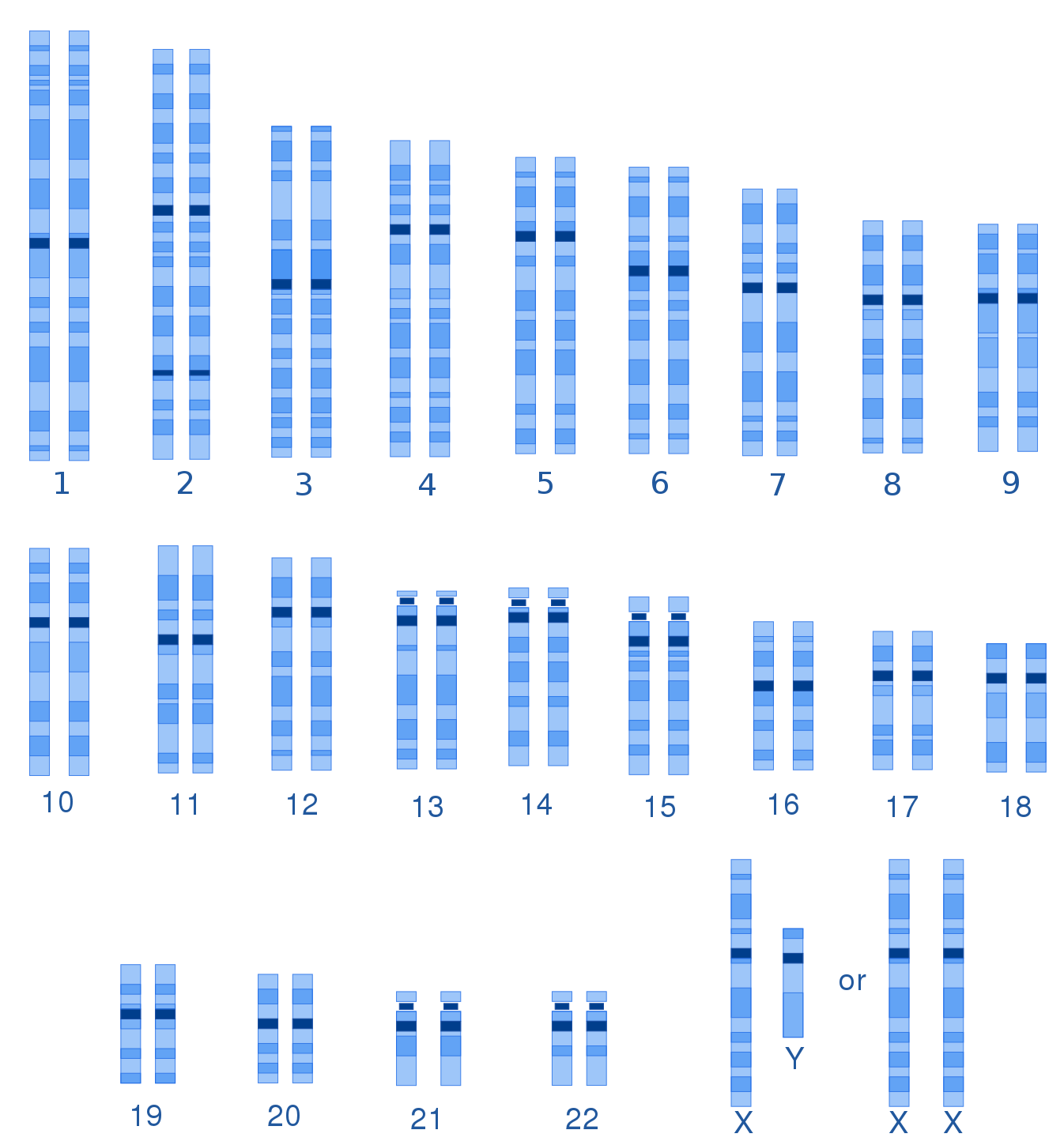
- Bildunterschrift: Karyotype Illustration
-
Sex Chromosomes and Autosomes (14.1)
- Sex Chromosomes: Two chromosomes that determine the sex of an individual
- Females --> XX (two copies of X chromosome)
- - 46, XX (summarization of total chromosomes in cell)
- Males --> XY (one X chromosome, one Y chromosome)
- - 46, XY
- - If you put XX and XY in a Punnett Square, you will see why boys and girls are born at a ratio of about 50:50
- - Human egg cells carry a single X chromosome while half of sperm cells carry an X and half carry a Y
- - 1200+ genes on X chromosome
- - Y chromosomes much smaller; 140 genes mostly related to male development and determination of sex
- Autosomes (or Autosomal Chromosomes): The 44 chromosomes that are not sex chromosomes
- - 46 chromosomes in human genome
- - 44 autosomal and 2 sex
-
Transmission of Human Traits (14.1)
- Dominant and Recessive Alleles
- - A bunch of human genes follow simple dominance pattern
- - Rh blood group --> Rh+ dominant and Rh- recessive
- Regular dominant/recessive rules: HH, Hh, hh
- Multiple Alleles and Codominance
- - Quite a few human genes show they are inherited by codominance
- Codominance: Phenotypes of both alleles are expressed
- - ABO blood group
- - Three alleles (I^A, I^B, and i)
- - I^A and I^B display codominance
- - Make blood type AB (producing both antigens)
- - i is recessive (two of these alleles produce type O blood)
-
- Sex-Linked Gene: A gene located on a sex chromosome
- - These chromosomes (X and Y) determine the sex of an individual, so sex-linkage is the pattern displayed by the genes located on them
- - Males have only one X chromosome, while females have two
- - Some genes are found on the X chromosome
- - Colorblindness
- - Hemophilia
- - Muscular dystrophy
- As a result of these being recessive conditions, they are far more common in males, since females can mask up the gene with a dominant one of their other X chromosome.
-
X-Chromosome Inactivation (14.1)
- Mary Lyon, British geneticist
- - Found that most of the genes in one random X chromosome are switched off in female cells
- - Creates dense nucleus region called Barr body
- - This is how the cell adjusts to the extra X chromosome in females
- - Calico cats with three fur colors
- - Most likely female
- - Coat color spot gene located on X chromosome
- - Maybe one has an allele for orange and the other for black
- - Different X chromosomes switched off in different parts of the body
- - Produces the color pattern
-
- Pedigree: Chart used to analyze inheritance of a specific trait by showing relationships within a family
- - Presence or absence of trait using relationships between family members
- - Applies for any species
- - Lets us assume genotypes of family members
- - Dominant/recessive
- - Lets us determine nature of genes and alleles connected to traits
- - Dominant, recessive, sex-linked, autosomal, etc
- Image Credit: https://upload.wikimedia.org/wikipedia/commons/6/63/Autosomal_Dominant_Pedigree_Chart.svg
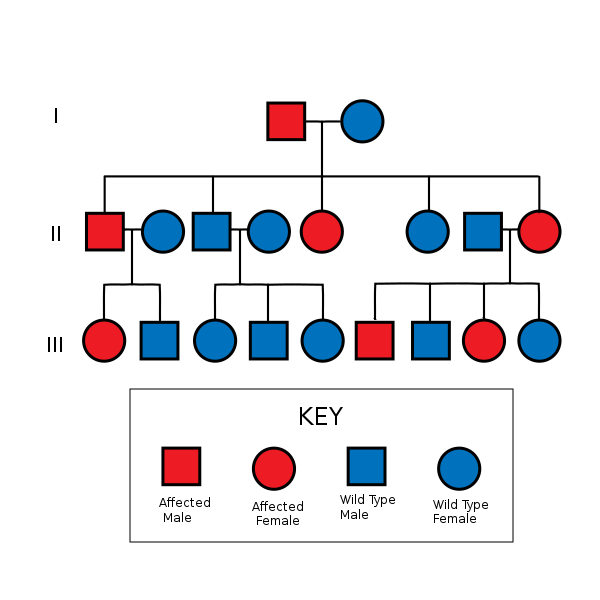
- Bildunterschrift: Pedigree Chart (red has trait, blue does not)
-
From Molecule to Phenotype (14.2)
- - If a gene doesn't work properly, which it can, there can be consequences
- - Genotype --> Phenotype
- - Clear link
- - For example, the difference between wet and dry earwax is caused by just one base change
- - The connection between molecule and phenotype is similar
- - If a DNA sequence changes, it can affect amino acids, and therefore change proteins
- - Affects traits of individual
- - Genetic disorders have a molecular basis
-
Disorders, From Individual Genes (14.2)
- Sickle Cell Disease:
- - Caused by a defective allele in a hemoglobin polypeptide
- - Defect causes hemoglobin less soluble, making the molecules stick together when oxygen levels plunge
- - Long fibers created, eventually forcing into the sickle cell shape
- - These blood cells are more rigid than normal, meaning they can get stuck in capillaries, causing damage
- - More common in people of African ancestry
- Cystic Fibrosis (CF):
- - Deletion of three bases from CFTR gene
- - Deletes amino acid, causing protein to fold improperly
- - Protein is destroyed
- - Chloride ions unable to transport through cell membranes
- - Digestive and breathing issues
- - More common in people of European ancestry
-
- - Sickle Cell disease
- - Allele carried by 1/12 people of African ancestry in US
- - Cystic Fibrosis
- - Allele carried by 1/25 people of European ancestry in US
- - Why?
- - In west central Africa, malaria is common. Malaria is caused by a parasite living in red blood cells.
- - Individuals with only one copy of the allele are healthy and resistant to parasite
- - Protects against malaria
- - Typhoid fever in medieval Europe
- - Caused by digestive system bacterium
- - CF allele gives advantage, blocking its entry
- - Individuals with just one CF allele are protected and do not suffer from CF
-
- Nondisjunction: The failure of homologous chromosomes to separate during meiosis
- - May result in abnormal amount of chromsomes, causing a numerical chromosome disorder
- - Nondisjunction of autosome
- - Three copies of chromosome
- - Trisomy
- - Most common form is Down Syndrome, trisomy 21
- - Nondisjunction of X chromosome
- - Turner's syndrome or Klinefelter's syndrome
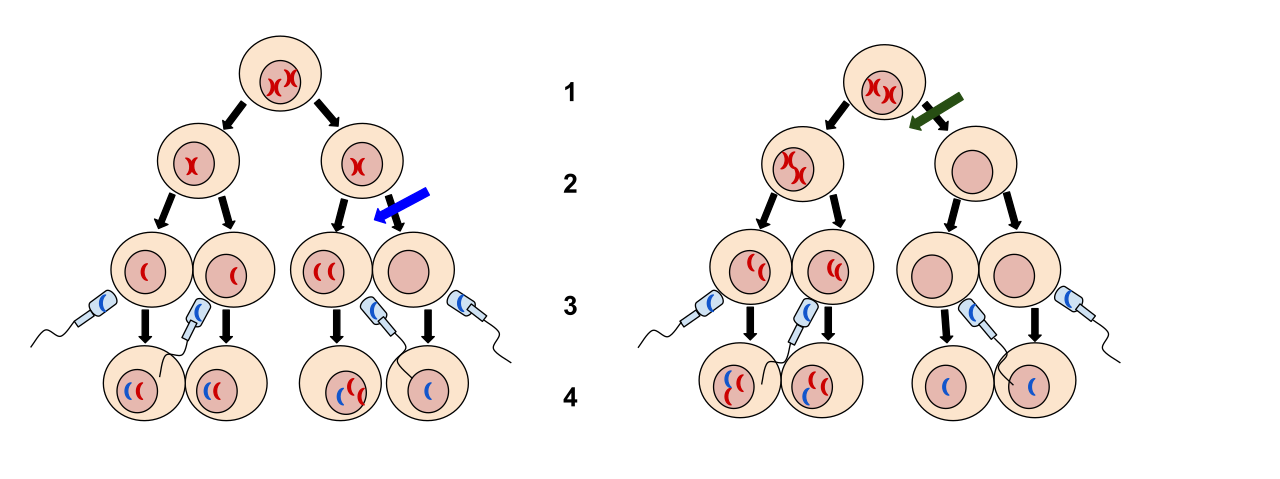
- Bildunterschrift: Nondisjunction
-
- - Scientists can use tools that cut, separate, then replicate DNA base by base to read DNA sequences from any cell
- Cutting DNA:
- - Difference of nucleic acids to other macro-molecules
- - Molecules of DNA too large for analyzing
- - Need to be cut into smaller pieces
- Restriction Enzymes: Enzymes produced by bacteria that cut DNA into precise pieces (restriction fragments)
- - Many, with each one cutting at a different nucleotide sequence
- - EcoRI restriction enzyme recognizes only the base sequence GAATTC
- - Cuts between G and A bases leaving AATT
- Sticky ends - Overhangs left by restriction enzymes that can "stick" or bond to complementary sequences (AATT is sticky end)
- Blunt ends - Straight ends left by a restriction enzyme that cannot bond onto a complementary sequence
-
Separating and Reading DNA (14.3)
- Separating DNA
- - Gel Electrophoresis: Technique to separate and analyze differently sized fragments of DNA
- - A mix of DNA fragments is put on one end of a gel, and an electric voltage is applied. The negatively charged fragments move across the gel and create a size-based pattern (smaller fragments move faster and therefore move farther on the gel)
- Reading DNA
- - Fragments put into test tube with DNA polymerase
- - The four bases are also put into the tube
- - Enzyme uses unknown strand to make new strands of DNA
- - Bases dyed with chemicals are added, so that when added to a strand the strand stops synthesis
- - Results in color-coded fragments of DNA
Informationen
- Beschreibung
- Preparation for exam, covering all sections of Chapters 14 in the Miller Levine Biology Textbook (Still in progress)
- Erstellt von
- Shelby Conroy · Jun 2019
- Aktualisiert
- 11 Jun 2019
- Aufrufe
- 30
- Tags
- Bewertung