
ECOSYSTEM
Folien in diesem Satz (10)
-
- > In ecology, productivity refers to the rate of formation of biomass in ecosystem
- >Two types of productivity :
- PRIMARY PRODUCTIVITY. The amount of biomass or organic matter produced per unit area by plants for photosynthesis. Expressed in terms of weight or energy
- Primary productivity depends ono Topography- Altitude, latitude etc. o Environmental factors (temp., sunlight intensity, rainfall, wind, humidity, nature of soil etc.) o Availability of nutrients (water, minerals, O2 etc.) o Photosynthetic capacity of plants
- It can be divided into gross primary productivity and net primary productivity.
- (i) Gross Primary Productivity (GPP): It is the rate of total production of organic matter during photosynthesis.
- (ii) Net Primary Productivity (NPP): It is the balance biomass remaining after meeting the cost of respiration (R) of the producers. i.e., NPP = GPP – R
- >>it is the net energy stored in plants. This energy serves as food for the animals that feed on plants
- 2.SECONDARY PRODUCTIVITY: Rate of formation of new organic matter by consumers
-
- Decomposition: It is the breakdown of complex organic matter by decomposers into inorganic substances like CO2, water and nutrients
- Steps of decomposition
- (Step-1) Fragmentation: It is the breakdown of detritus (dead remnants of plants and animals) into smaller particles by detritivores (e.g. earthworm)
- . (Step-2) Leaching: Water soluble inorganic nutrients go down into the soil horizon and get precipitated as unavailable salts.
- (Step-3) Catabolism: Degradation of detritus into simple inorganic substances by bacterial and fungal enzymes.
- (Step-4) Humification: Conversion of detritus to dark amorphous substance called humus
- Properties of Humus:-
- - It is resistant to microbial action and so decomposes slowly.
- - Being colloidal in nature it serves as a reservoir of nutrients.
- Mineralization: The degradation of humus to release inorganic substances by the action of some microbes.
-
Factors affecting rate of decomposition
- 1)Chemical composition:decomposition rate will be slow when detritus is rich in lignin and chitin.Rate of decomposition increases when detritus is rich in nitrogen and water soluble substances like sugars
- 2)Climatic conditions: warm and moist environment favour decomposition and low temperature and anaerobiosis inhibit decomposition
-
- > All living organisms are directly or indirectly dependent on producers, for their food.
- >There is a unidirectional flow of energy from the sun to producers and then to consumers
- > Photo synthetically active radiation(PAR) is responsible for the synthesis of food by plants
- >Animal obtain their food fro, plants so they are called consumers
- >Animals feed on green plants are called primary consumers or herbivorous
- >The animals eat herbivores are called secondary consumers or primary carnivores. Example,goat
- >The animals which feed on primary carnivores are called teritary consumers or secondary ucarnivores example- man
-
- Food chain: The transfer of food from the producers through a series of organisms with repeated eating and being eaten. 2 types of food chains can be recognised in an ecosystem
- I. Grazing Food Chain (GFC): It begins with a producer which is eaten by grazing herbivores which are then eaten by carnivores. Producers Herbivores Carnivores (e.g. Green plants) (e.g. Deer) (e.g. Tiger)
- II. Detritus food chain (DFC): It begins with detritus (dead organic matter) which is taken by decomposers (saprotrophs).
- Detritus ---------Decomposers
- (E.g. fungi, bacteria)
- DFC may be connected with the GFC at some levels: some of the organisms of DFC are prey to the GFC animals
- Food Web: Interconnections of food chains
- Food Web: Interconnections of food chains
- TROPHIC LEVEL
- Trophic level: The place of organisms in the food chain.
- Standing crop: The total amount of living material present in different trophic at a particular time. - It is measured as the fresh or dry weight of living organisms (biomass) or the number in a unit area.
- Law of 10%: It states that ‘Only 10% of the energy is transferred to each trophic level from the lower trophic level’. Proposed by Lindeman (1942)
-
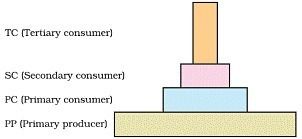
- An ecological pyramid is a graphical represenation of the relatioonships of living organisms in different trophic level
- The base of pyramid represents the producers (first trophic level) while the apex represents top level consumer.
- The base of pyramid is broad and narrow along its apex
- Ecological pyramids are 3 types:
- (a) Pyramid of number
- (b) Pyramid of biomass
- (c) Pyramid of energy
-
LIMITATIONS OF ECOLOGICAL PYRAMIDS
- It does not take into account the same species belonging to two or more trophic levels.
- It assumes a simple food chain that never exists in nature; it does not accommodate a food web.
- Saprophytes are not included in ecological pyramids.
-
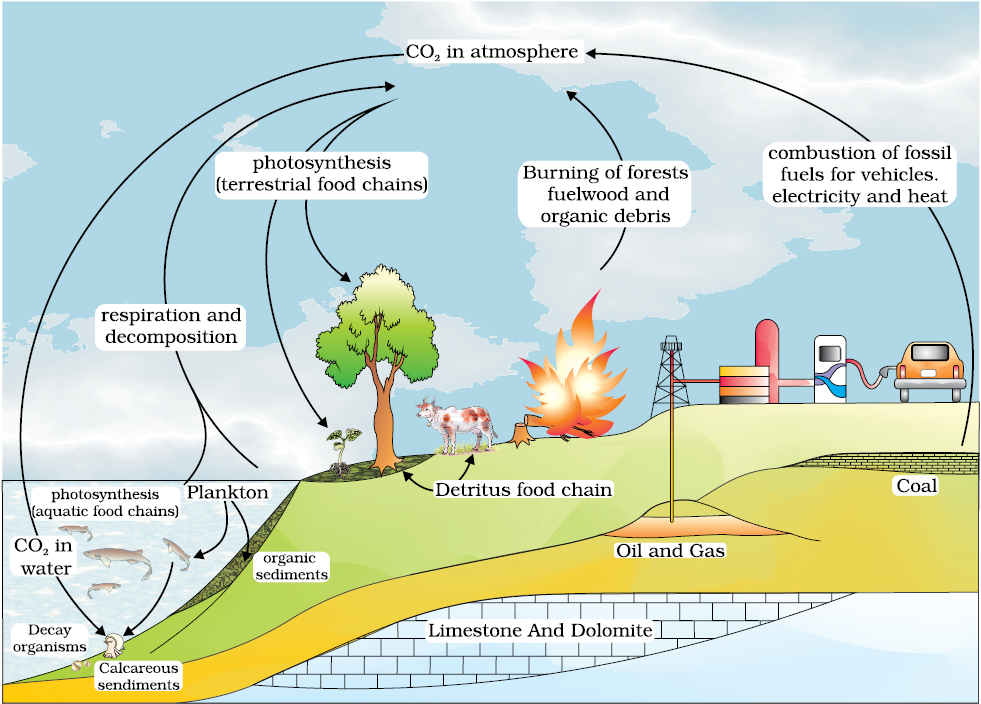
- Nutrient cycling (biogeochemical cycles): The movement of nutrients through components of an ecosystem. \
- The amount of nutrients present in the soil at a given time is referred to as the standing state. It varies with kinds of ecosystems and season.
- Nutrient cycles are 2 types:
- (i) Gaseous cycle: The reservoir exists in the atmosphere E.g. Nitrogen, carbon cycle etc.
- (ii)Sedimentary cycle: The reservoir is located in Earth’s crust. E.g. Sulphur and phosphorus cycle
-
Informationen
- Beschreibung
- 12th grade Biology Folienset am ECOSYSTEM, erstellt von Megha M Mohan am 19/02/2021.
- Erstellt von
- Megha M Mohan · Feb 2021
- Aktualisiert
- 21 Feb 2021
- Aufrufe
- 0
- Bewertung