
Notizen
1.1 Cell Biology
Inhalt der Notizen (1)
Seite 1
Principles of the cell theory
The cell theory states that:
1. All living things are composed of cells (or cell products)2. The cell is the smallest unit of life
3. Cells only arise from pre-existing cells
Questioning the cell theory
What is a cell?
Is a functional unit of a cytoplasm surrounded by a methane and containing genetic material
What happens in multicellular organism?
Mos multicelular organisms do contain many cells that conform to the cell structure for examples such as liver, pancreas, nerve, leucocytes, palisade, epidermal and cortex
Why do many cells not confirm this?
Striated muscle fibres:
Muscle cells fuse to form fibres that may be very long (>300mm)
Consequently, they have multiple nuclei despite being surrounded by a single, continuous plasma membrane
Challenges the idea that cells always function as autonomous units
Aseptate fungal hyphae:
Fungi may have filamentous structures called hyphae, which are separated into cells by internal walls called septa
Some fungi are not partitioned by septa and hence have a continuous cytoplasm along the length of the hyphae
Challenges the idea that living structures are composed of discrete cells
Giant Algae
Certain species of unicellular algae may grow to very large sizes (e.g. Acetabularia may exceed 7 cm in length)
Challenges the idea that larger organisms are always made of many microscopic cells
Function of life
Unicellular organisms (e.g. Euglena, amoeba) are the smallest organisms capable of independent lifeAll living things carry out 7 basic functions integral to survival:
Metabolism – Living things undertake essential chemical reactions
Reproduction – Living things produce offspring, either sexually or asexually
Sensitivity – Living things are responsive to internal and external stimuli
Homeostasis – Living things maintain a stable internal environment
Excretion – Living things exhibit the removal of waste products
Nutrition – Living things exchange materials and gases with the environment
Growth – Living things can move and change shape or size
As unicellular organisms are composed of a single cell, this cell must be able to carry out all the life functionsHow unicellular organisms fulfil these basic functions may differ according to structure and habitat
1. Paramecium (heterotroph)
Paramecia are surrounded by small hairs called cilia which allow it to move (responsiveness)
Paramecia engulf food via a specialised membranous feeding groove called a cytostome (nutrition)
Food particles are enclosed within small vacuoles that contain enzymes for digestion (metabolism)
Solid wastes are removed via an anal pore, while liquid wastes are pumped out via contractile vacoules (excretion)
Essential gases enter (e.g. O2) and exit (e.g. CO2) the cell via diffusion (homeostasis)
Paramecia divide asexually (fission) although horizontal gene transfer can occur via conjugation (reproduction)
2. Scenedesmus (autotroph)
Scenedesmus exchange gases and other essential materials via diffusion (nutrition / excretion)
Chlorophyll pigments allow organic molecules to be produced via photosynthesis (metabolism)
Daughter cells form as non-motile autospores via the internal asexual division of the parent cell (reproduction)
Scenedesmus may exist as unicells or form colonies for protection (responsiveness)
Paramecium Feeding Heterotrophically
(http://www.youtube.com/watch?v=a4aZE5FQ284)
Surface are to volume ratio
Cells need to produce chemical energy (via metabolism) to survive and this requires the exchange of materials with the environment
The rate of metabolism of a cell is a function of its mass / volume (larger cells need more energy to sustain essential functions)
The rate of material exchange is a function of its surface area (large membrane surface equates to more material movement)
As a cell grows, volume (units3) increases faster than surface area (units2), leading to a decreased SA:Vol ratio
If metabolic rate exceeds the rate of exchange of vital materials and wastes (low SA:Vol ratio), the cell will eventually die
Hence growing cells tend to divide and remain small in order to maintain a high SA:Vol ratio suitable for survival
Overview of Surface Area to Volume Ratio
Increasing SA:Vol Ratio
Cells and tissues that are specialised for gas or material exchanges will increase their surface area to optimise material transfer
Intestinal tissue of the digestive tract may form a ruffled structure (villi) to increase the surface area of the inner lining
Aveoli within the lungs have membranous extensions called microvilli, which function to increase the total membrane surface
Magnification
Calculation of Magnification:To calculate the linear magnification of a drawing or image, the following equation should be used:
Magnification = Image size (with ruler) ÷ Actual size (according to scale bar)
Calculation of Actual Size:
To calculate the actual size of a magnified specimen, the equation is simply rearranged:
Actual Size = Image size (with ruler) ÷ Magnification
Light microscopes use visible light and a combination of lenses to magnify images of mounted specimensLiving specimens can be viewed in their natural colour, although stains may be applied to resolve specific structures
When attempting to draw microscopic structures, the following conventions should be followed:
A title should be included to identify the specimen (e.g. name of organism, tissue or cell)
A magnification or scale should be included to indicate relative size
Identifiable structures should be clearly labelled (drawings should only reflect what is seen, not idealised versions)
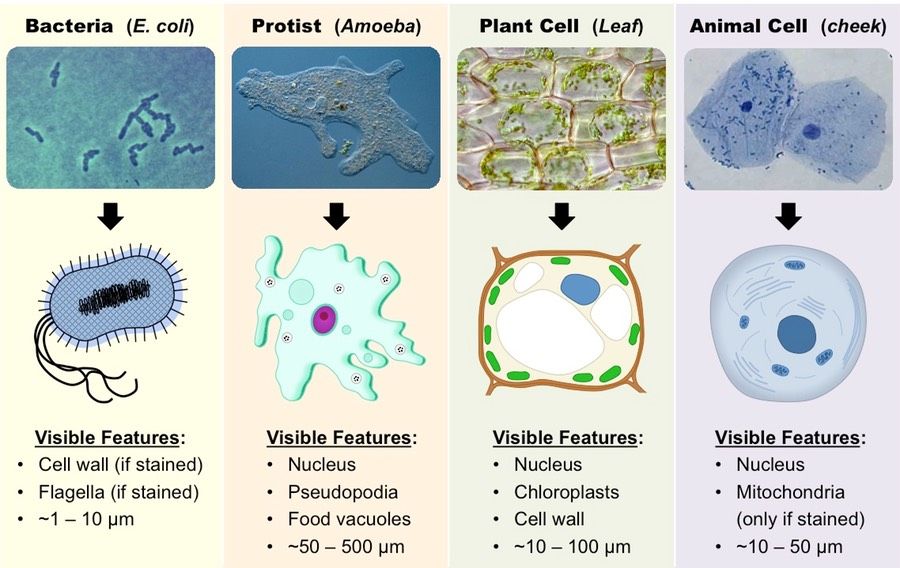
Summary of Visible Cell Features under Light Microscopy
Emergent propterties
Emergent properties arise when the interaction of individual component produce new functions
"The whole is greater than the sum of its parts” – Aristotle
Multicellullar organisms are capable of completing functions that unicellular organisms could not undertake – this is due to the collective actions of individual cells combining to create new synergistic effects
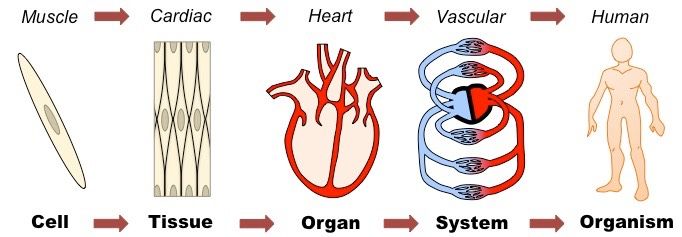
In multicellular organisms:
Cells may be grouped together to form tissues
Organs are then formed from the functional grouping of multiple tissues
Organs that interact may form organ systems capable of carrying out specific body functions
Organ systems collectively carry out the life functions of the complete organism
Cell differentiation
Differentiation
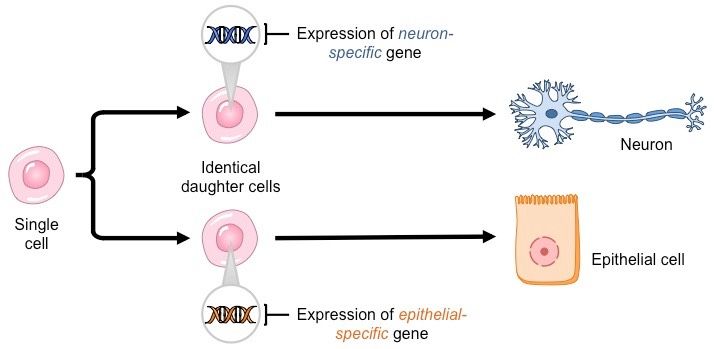
Differentiation is the process during development whereby newly formed cells become more specialised and distinct from one another as they mature
All cells of an organism share an identical genome – each cell contains the entire set of genetic instructions for that organism
The activation of different instructions (genes) within a given cell by chemical signals will cause it to differentiate
Gene Packaging
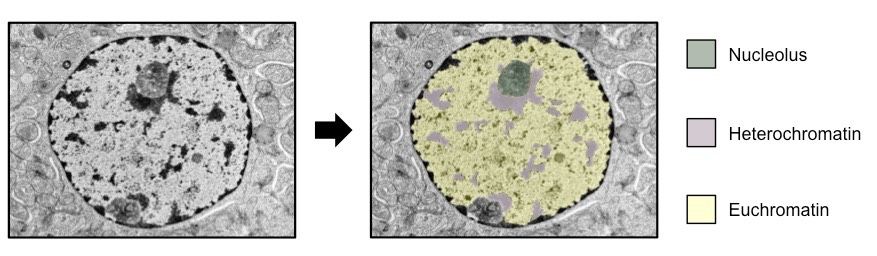
Within the nucleus of a eukaryotic cell, DNA is packaged with proteins to form chromatin
Active genes are usually packaged in an expanded form called euchromatin that is accessible to transcriptional machinery
Inactive genes are typically packaged in a more condensed form called heterochromatin (saves space, not transcribed)
Differentiated cells will have different regions of DNA packaged as euchromatin and heterochromatin according to their specific function
Stem cells
When a cell differentiates and becomes specialised, it loses its capacity to form alternative cell typesStem cells are unspecialised cells that have two key qualities:
1. Self Renewal – They can continuously divide and replicate
2. Potency – They have the capacity to differentiate into specialised cell types
Types of Stem Cells
There are four main types of stem cells present at various stages of human development:
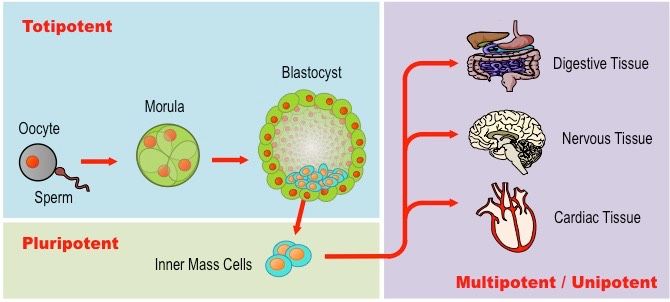
Totipotent – Can form any cell type, as well as extra-embryonic (placental) tissue (e.g. zygote)
Pluripotent – Can form any cell type (e.g. embryonic stem cells)
Multipotent – Can differentiate into a number of closely related cell types (e.g. haematopoeitic adult stem cells)
Unipotent – Can not differentiate, but are capable of self renewal (e.g. progenitor cells, muscle stem cells)
Uses of Stem Cells
Stem cells are necessary for embryonic development as they are an undifferentiated cell source from which all other cell types may be derived
Cell types that are not capable of self-renewal (e.g. amitotic nerve tissues) are considered to be non-stem cells
As these tissues cannot be regenerated or replaced, stem cells have become a viable therapeutic option when these tissues become damaged
Stem cell theory
Stem cells can be used to replace damaged or diseased cells with healthy, functioning ones
This process requires:
The use of biochemical solutions to trigger the differentiation of stem cells into the desired cell type
Surgical implantation of cells into the patient’s own tissue
Suppression of host immune system to prevent rejection of cells (if stem cells are from foreign source)
Careful monitoring of new cells to ensure they do not become cancerous
Examples of Stem Cell Therapy
1. Stargardt’s Disease
An inherited form of juvenile macular degeneration that causes progressive vision loss to the point of blindness
Caused by a gene mutation that impairs energy transport in retinal photoreceptor cells, causing them to degenerate
Treated by replacing dead cells in the retina with functioning ones derived from stem cells
2. Parkinson’s Disease
A degenerative disorder of the central nervous system caused by the death of dopamine-secreting cells in the midbrain
Dopamine is a neurotransmitter responsible for transmitting signals involved in the production of smooth, purposeful movements
Consequently, individuals with Parkinson’s disease typically exhibit tremors, rigidity, slowness of movement and postural instability
Treated by replacing dead nerve cells with living, dopamine-producing ones
3. Other Therapeutic Examples
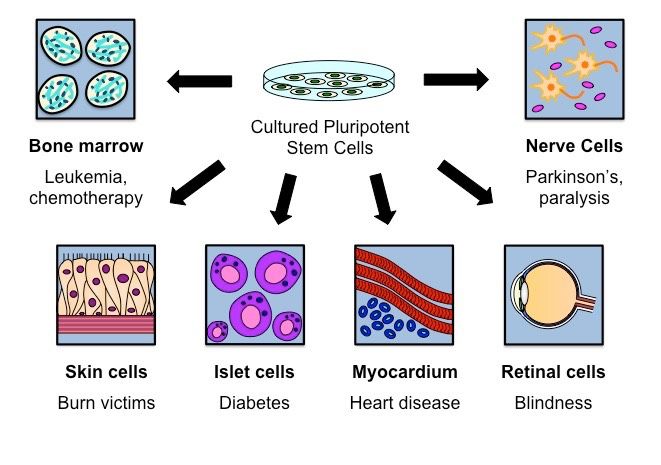
Leukemia: Bone marrow transplants for cancer patients who are immunocompromised as a result of chemotherapy
Paraplegia: Repair damage caused by spinal injuries to enable paralysed victims to regain movement
Diabetes: Replace non-functioning islet cells with those capable of producing insulin in type I diabetics
Burn victims: Graft new skin cells to replace damaged tissue
Stem cells can be derived from one of three sources:
Embryos (may be specially created by therapeutic cloning)
Umbilical cord blood or placenta of a new-born baby
Certain adult tissues like the bone marrow (cells are not pluripotent)
The ethical considerations associated with the therapeutic use of stem cells will depend on the source
Using multipotent adult tissue may be effective for certain conditions, but is limited in its scope of application
Stem cells derived from umbilical cord blood need to be stored and preserved at cost, raising issues of availability and access
The greatest yield of pluripotent stem cells comes from embryos, but requires the destruction of a potential living organism
Artificial Stem Cell Techniques
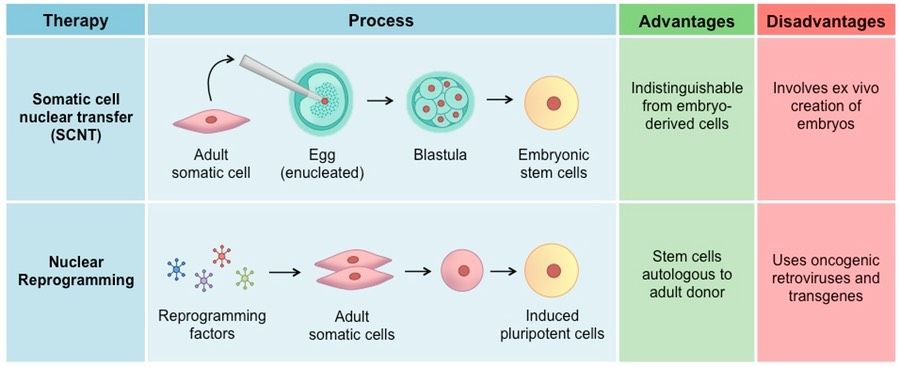
Stem cells can be artificially generated via nuclear transfer or nuclear reprogramming, with distinct benefits and disadvantages
Somatic cell nuclear transfer (SCNT):
Involves the creation of embryonic clones by fusing a diploid nucleus with an enucleated egg cell (therapeutic cloning)
More embryos are created by this process than needed, raising ethical concerns about the exigency of excess embryos
Nuclear reprogramming:
Induce a change in the gene expression profile of a cell in order to transform it into a different cell type (transdifferentiation)
Involves the use of oncogenic retroviruses and transgenes, increasing the risk of health consequences (i.e. cancer)
Informationen
- Beschreibung
- International Baccalaureate Biology (1.1 Cell Biology ) Notiz am 1.1 Cell Biology , erstellt von Carolina Guimaraes am 06/05/2016.
- Erstellt von
- Carolina Guimaraes · Mai 2016
- Aktualisiert
- 6 Apr 2018
- Aufrufe
- 11
- Bewertung