
Karteikarten
AS AQA Biology (New Spec) Flashcards
Karten in diesem Stapel (25)
- 1High blood pressure can lead to an accumulation of tissue fluid. Explain howHigh blood pressure=high hydrostatic pressure
Increased outward pressure from arteriole end of capillary
Decreased inward pressure from venule end
more tissue fluid formed/less reabsorbed - 2Describe how bacteria are destroyed by pathogensPhagocyte engulfs bacteria to form phagosome
Lysosomes in phagocyte release lysozymes
Lysozymes hydrolyse the bacterium in the phagosome - 3Describe and explain the mechanism that causes forced expirationContraction of internal intercostal muscles
Relaxation of diaphragm/external intercostal muscles
Decrease in volume of thorax
External pressure lower than internal pressure
Air pushed down pressure gradient - 4Describe the appearance and behaviour of chromosomes during mitosisProphase - Shortening and thickening
- Attach to spindle fibres
Metaphase - Line up along the equator of the cell
Anaphase - Spindle fibres contract
- Splitting of the centromere
- Chromosomes split in half
- Half go to each pole - 5Compare and contrast the processes by which water and inorganic ions enter cellsBoth move down concentration gradients
Both move through (protein) channels in the membrane
Ions can move against a concentration gradient by active transport - 6Give two properties of water that are important in the cytoplasm of cellsPolar - Solvent
Solvent - Speeds up metabolic reactions
Reactive - Hydrolysis/condensation reactions - 7Cells lining the ileum of mammals absorb the monosaccharide glucose by co-transport with sodium ions. Explain howSodium is actively transported out the epithelial cells
Sodium-potassium pump
Lower concentration of sodium ions inside epithelial cells
Sodium enters from lumen
Enters via sodium-glucose co-transport channel
Must be in association with glucose to enter
Glucose enters blood capillaries via facilitated diffusion - 8Homologous chromosomes carry the same genes but are not genetically identical. Explain why(Homologous chromosomes) carry different alleles
- 9Explain why meiosis is important in sexual reproductionProduces gametes that are genetically different
Chromosome number halved (haploid)
When fertilisation occurs the embryo has the correct number of chromosomes (diploid) - 10Explain the advantage of peptidases being secreted in an inactive formCell membranes contain protein
Active peptidases may digest these proteins - 11Amylase is not secreted in an inactive form. Explain why this is not a disadvantageAmylase digests starch
Starch is not present in animal cells - 12Describe the reaction catalysed by a peptidase enzymeHydrolysis reaction
Water is added (to a large soluble molecule)
Breaking the peptide bond - 13Explain how water enters a bacterial cellWater potential lower/more negative in cell
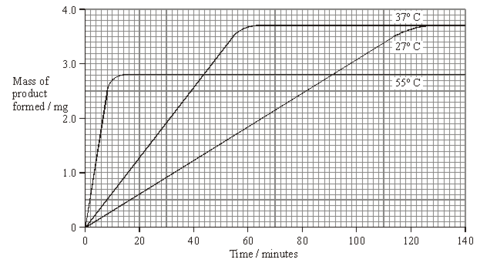
Water enters by osmosis - 14Explain -(i) The shape of the curve at 55C after 20 minutes -(ii) Why the curves for 27C and 37C level off that the same value(i) Causes detnaturation
H+/ionic bonds break
Shape of active site changed
Substrate can no longer bind
(ii) All substrates changed into product
Same amount of product formed
Same initial substrate concentration - 15Describe how the Golgi apparatus is involved in the secretion of enzymesModifies protein
Put into Golgi vesicles
Transport to cell surface/vacuole - 16Describe how two amino acids differ from one anotherDifferent R groups
- 17Give structural differences between mRNA and tRNAtRNA - Folded shape
mRNA - No hydrogen bonds - 18Describe how phospholipids are arranged in a plasma membraneBilayer
Hydrophobic (lipid) (tails) to inside
Hydrophillic (polar) (phosphate) (heads) to outside - 19Describe and explain the processes that occur during meiosis that increase genetic variationCrossing over - Bivalents overlap
- Break off at chiasmata
- Recombination - Different alleles
Independent assortment/segregation - Homologous chromosomes are independent of each other - 20When a vaccine is given to a person it leads to the production of antibodies against a disease causing organism. Describe howVaccine contains antigen from pathogen
Macrophage presents antigen on its surface
T cell with complementary receptor protein binds to antigen
T cell stimulates B cell with complementary antibody
B cell secretes large amount of the antibody
B cell divides by mitosis
Memory cell formed producing the same antobody - 21How do mutations lead to non-functional proteins?Base deletion/substitution
Frame shift - changes codons after that point
- Base deletion
Different amino acids coded for
Change in hydrogen/ionic/disulfide bonds
Change in tertiary structure
Can no longer bind to substrate as it is no longer complementary - 22Describe the difference between passive and active immunityActive - Memory cells
- Production of antibody by plasma/memory cells
- Long term - antibody production
- Takes time to develop
Passive - Antibody introduced into body from outside source
- Short term - Antibody given is eventually broken down - 23Explain how the structures of the walls of arteries and arterioles are related to their functionElastic fibres - Stretch under pressure/during systole
- Recoil during diastole
- Maintain constant blood pressure
Muscle - Contracts
-Reduces diameter of lumen/vasoconstriction
- changes pressure to maintain a constant
Epithelium - smooth
- Reduces friction/blood clots/resistance - 24Compare and contrast the structure of starch and celluloseBoth - Polysaccarides
- Contain glucose
- Contain hydrogen bonds within the structure
Starch - Contains alpha glucose
- Helical structure
- No hydrogen bonds between molecules
Cellulose - Contains beta glucose
- Straight molecule - 25When comparing variation it is often considered more useful to compare standard deviations rather than ranges. Explain whyRange influenced by a single outlier (anomaly)
Standard deviation shows dispersion around the mean
Range only shows extremes
Standard deviation allows statistical use
Informationen
- Beschreibung
- Flashcards containing exam style questions based off the new AS biology specification, specifically AQA, but with overlap with the other courses
- Erstellt von
- Lucy Frances · Apr 2017
- Aktualisiert
- 9 Apr 2017
- Aufrufe
- 2.228
- Tags
- Bewertung