
Notizen
Primates Workbook
Inhalt der Notizen (8)
Seite 1
P r i m a t e s
Use Chapter 29 (Primate Legacy), page 369 of your ESA textbook, the supplied Biozone books and the Primate Evolution PPT on the student drive, to help you complete the following work.
Complete the following statements using the following keywords:
anthropoids, hominids, hominins, hominoids, pongids, primates, prosimians,
Primates are a group of mammals that have adaptations to arboreal life.
Primate evolution branched into Prosimians and Anthropoids (Humans, Apes and Monkeys)
The group Hominoids includes humans and all apes (Pongids)
The group Hominids refers to humans and the great apes (gorilla, chimps & orangutans)
The group Hominins refers to humans (and their ancestors) only – habitually bipedal.
Primates are thought to have risen from an ancestor that may have looked similar to a tree shrew. Describe the features that this primate ancestor would have had:
Arboreal (tree dwelling) habitat
Grasping hands and feet
Long, mobile limbs
Quadrupedal locomotion
Binocular vision
Upright sitting position
Nails instead of claws on most digits
Primates are divided into SIX major groups”
Tarsiers
Prosimians
New World Monkeys
Old World Monkeys
Apes (pongids)
Hominins
Seite 2
Complete the following tables on the group of Primates:
Tarsiers
Examples:
Tarsiers
Anatomical Features:
Enormous eyes (151 x larger in proportion to body size than humans)
Dry hairy nose
Whiskers reduced
No grooming claw
Entire upper lip (not fastened to the gum underneath)
Complex placenta
Distribution and Habitat:
SE Asian Islands
Prosimians
Examples:
Loris
Lemur
Anatomical Features:
Tooth comb & grooming claw
Wet naked nose with whiskers
Arboreal (tree dwelling)
Grasping hands and feet
Long, mobile limbs
Quadrupedal
Binocular vision
Upright sitting position
Nails instead of claws on most digits
Simpler placenta
Distribution and Habitat:
Madagascar
SE Asia
Southern Africa
New World Monkeys
Examples:
Spider Monkey
Squirrel Monkey
Tamarin (Cotton Top & Golden Lion)
Anatomical Features:
Prehensile tails that can be used as a fifth limb
Quadrupedal (use all four limbs to move about)
Strictly arboreal (tree dwelling)
Widely separated nostrils that face outwards
Distribution and Habitat:
Central & South America
Seite 3
Old World Monkeys
Examples:
Baboon
Macaque
Mandrill
Anatomical Features:
Tail NOT prehensile
Quadrupedal (use all four limbs to move about)
Some are ground dwelling
Nostrils and close together and face downwards
Distribution and Habitat:
Africa, Asia & Europe
Apes
Examples:
Orangutan
Gibbon
Gorilla
Chimpanzee
Anatomical Features:
No tail
Brachiating (swing from branch to branch)
Some mainly ground dwelling and quadrupedal
Arms longer than legs
Flattened nose
Bony eye ridges
Distribution and Habitat:
Asia & Africa
Hominins
Examples:
Homo sapiens (US!)
Homo neanderthalensis
Homo erectus
Paranthropus robustus
Australopithecus afarensis
Anatomical Features:
Bipedal
Larger brain
Reduced size in teeth
Prominent chin
Reduced eye ridges
Reduced body hair
Highly sensitive skin
Complex social behaviour
Distribution and Habitat:
Worldwide
Seite 4
General Primate Characteristics
Complete the following, showing general characteristics of the primate groups.
Vision: Large, forward facing eyes giving binocular vision with the ability to see colour
Face shape & snout: Face or snout projection is reduced as there is a move away from relying on smell in favour of vision. Eyes protected by a ring of bone.
Posture: Generally quadrupedal with an ability to sit in an upright position.
Brain size & specialisation: Areas associated with vision more highly developed while those for smell reduced.
Teeth shape & dental arrangement: Simple cusp pattern with 3, sometimes 4, kinds of teeth.
Collarbone: Retained, allowing for brachiation.
Limb joints: Extremely mobile, able to articulate in a wide arc.
Hands & Feet: 5 fingers on hands & feet for grasping. Possess nails, not claws and have become important sensory areas. Opposable thumb & big toe; Fingerprints to improve grip.
Reproduction: Increased infancy dependency for acquiring learned behaviour. Long period of parental care.
Social Organisation: Often complex social grouping with hierarchies and extended family groups
Seite 5
Ape Skull Features
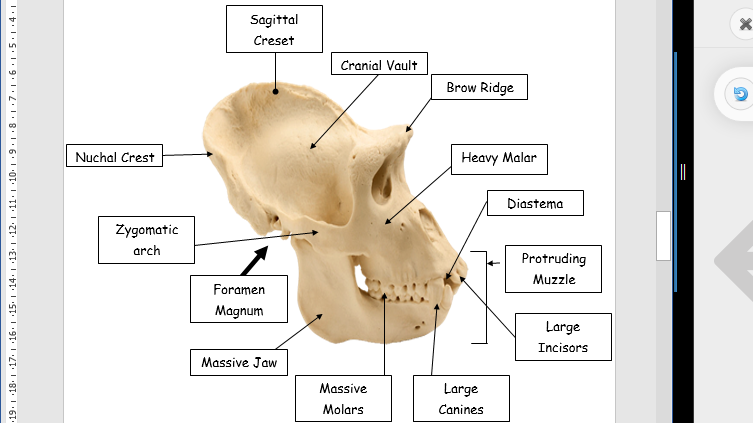
Label the gorilla skull below using the following list of terms:
Brow Ridge, Heavy malar, Nuchal crest, Protruding muzzle, Diastema, Massive molars,
Sagittal crest, Foramen magnum, Zygomatic arch, Massive jaw, Large canines, Cranial vault
Explain the significance of the following features:
Large sagittal crest: Attachment site for jaw muscles
Nuchal crest: Attachment site for neck muscles
Massive zygomatic arch: Arch through which jaw muscles pass
Massive molars: For grinding vegetation / tough, low-grade food.
Foramen magnum at rear: Attachment site for spine
Large canines: Used as defensive weapons (but usually only for display)
Heavy brow ridge: Provides protection for the eyes and brain case. Provides extra strength for other bones in the skull.
Seite 6
Male and female gorilla skulls show sexual dimorphism. What does this mean?
There is a difference between males and female i.e. you can tell males and females apart.
Describe 4 ways in which the female skull is different to the male skull:
Smaller overall size of skull compared to males
Less pronounced canines compared to males
Reduced sagittal crest compared to males
Jaw is smaller (less robust ) than males
Seite 7
Seite 8
Informationen
- Beschreibung
- NCEA Level 3 Biology (Trends in Human Evolution) Notiz am Primates Workbook, erstellt von lauren calvert am 22/08/2017.
- Erstellt von
- lauren calvert · Aug 2017
- Aktualisiert
- 22 Aug 2017
- Aufrufe
- 19
- Bewertung