
Quiz
Enzymes
Erstelle ein kostenloses Konto, um dieses Quiz zu beenden
Speichere deinen Fortschritt und sieh dir dein Endergebnis an.
oder mit deiner E-Mail registrieren
Schon ein Konto? Anmelden
Fragen in diesem Quiz (40)
1Ensymes are?
- AEsters
- BLipids
- CProteins
- DPeptides
2All enzymes have an active site
- ARichtig
- BFalsch
3Enzymes are ___________________ _______________this means that they catalyse metabolic reactions both at cellular level and as a whole for the organism.
- Aprotein synthesisers
- BMetabolic catalysts
- Cwhite blood cells
- DBiological catalysts
4Respiration is an example of a ''whole organism'' metabolic reaction.
- ARichtig
- BFalsch
5Digestion is an example of a ''whole organism'' metabolic reaction.
- ARichtig
- BFalsch
6Enzyme action can be intracellular (outside individual cells) and extracellular (inside individual cells).
- ARichtig
- BFalsch
7In a chemical reaction a specific amount of energy has to be supplied first to the chemical before the reaction will start - this is called_________________________________.
- AEssential energy
- BActive energy
- CActivation energy
- DReaction energy
8pt 1: Enzymes __________________ the amount of activation energy needed.
- AIncrease
- BDecrease
9pt 2: This means that the temperature needed for the reaction is __________________.
- AHigher
- BLower
10pt 3 : This ___________________ the reaction rate.
- Aspeeds up
- Bslows down
11Enzyme-substrate complex - this is what the molecule inside the active site is called.
- ARichtig
- BFalsch
12The enzyme-substrate complex is what lowers the activation energy.
- ARichtig
- BFalsch
13There are TWO ways in which that happens
- AMulti-tasking =less time wasted
- BIt reduces repulsion between molecules
- CIt increases repulsion between molecules
- DPuts a strain on the bonds in the enzyme
- EPuts a strain on bonds in the substrate
14Which is the more accepted/accurate model?
- AInduced fit model
- Block and key model
15L.A.K M = Shape of the enzyme has to be specific to fit the substrate and also has to change shape in the right way.
- ARichtig
- BFalsch
16When enzymes combine two substrates into one this is called?
- ASynthesis
- BSymphony
- CPhotosynthesis
- Dsynthesia
17Enzyme properties are related to their _________________ structure.
- APrimary
- BSecondary
- CTertiary
- DQuaternary
18Enzymes can catalyse more than one type of reaction
- ARichtig
- BFalsch
19If the active site is said to be complementary...what does that mean?
- AAn enzyme-substrate complex can be formed
- BIts pretty and deserves a compliment
- CIt's not damaged
- DI will pass this class
20Which will not change the shape of the active site?
- ATemperature
- BMutation in the primary structure
- CpH changes
- DA pathogen
- EAnother substrate
- FAn inhibitor
21Measuring enzyme activity can be done in two ways...
!) How quickly the reactants are used up
2) How fast the substrate is broken down (or synthesised)- ARichtig
- BFalsch
22Which affecting enzyme factor is this?
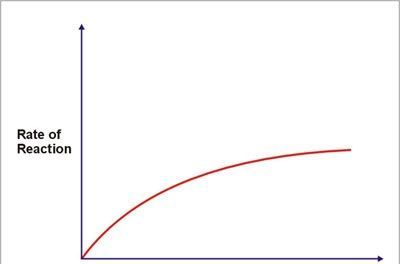
- ATemperature
- BpH
- Csubstrate conc.
- Denzyme conc.
23Which one is it?
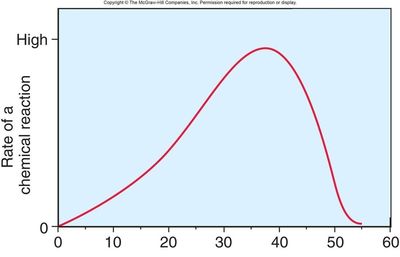
- Asubstrate conc.
- BTemperature
- CpH
- Denzyme conc.
24Which one is it?
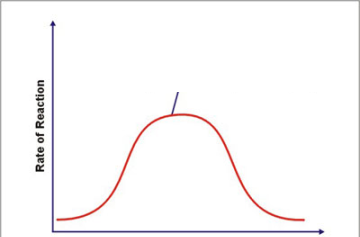
- Asubstrate conc.
- BpH
- CTemperature
- DEnzyme conc.
25Which one is it?
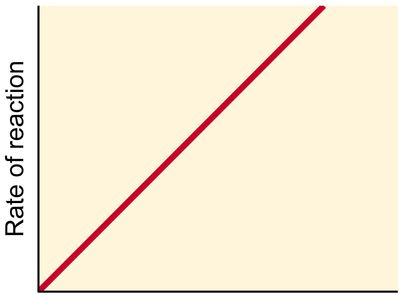
- ATemperature
- BSubstrate conc.
- CpH
- DEnzyme conc.
26All enzymes denature above 37*C
- ARichtig
- BFalsch
27what does denatured mean?
- Aactive site is misbehaving misbehaving
- Bactive site changed shape temporarily
- Cactive site changed shape permanently
- Dactive site broke down
28Above and below the optimum pH, the H+ and OH- ions found in acids and alkalis can disrupt the covalent bonds that hold the tertiary structure in place. The enzyme becomes denatured.
- ARichtig
- BFalsch
29The saturation point in substrate concentration means that all enzyme active sites are full and adding more will make no difference.
- ARichtig
- BFalsch
30Adding more enzymes to increase enzyme concentration means that collisions will be more likely and the formation of enzyme-substrate complexes less frequent.
- ARichtig
- BFalsch
31On the enzyme conc. there is a limitation...if there's little substrate adding more enzymes there will be no difference in rate of reaction.
- ARichtig
- BFalsch
32When a graph flattens out...we call it ?
- Aflattened out
- Bplateaued
- Cplate-toad
- Devening out
33Competetive or non-C inhibitor?
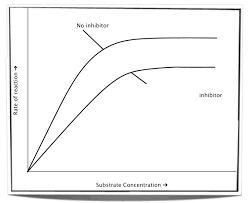
- AC
- BNC
34Competetive or non-C?
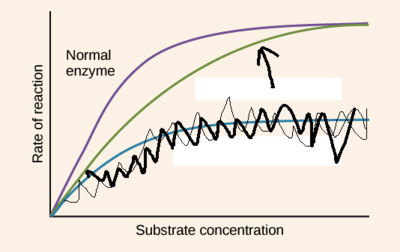
- AC
- BNC
35Competitive inhibitors are non-complementary to the enzyme... they attach themselves to the enzyme (away from the active site) causing a change in the tertiary structure and therefore active site rendering the enzyme obsolete.
- ARichtig
- BFalsch
36Non-competitive inhibitors are complementary and so can bind at the active site of the enzyme...however no reaction takes place...they block the active site so no substrate can fit in.
Its effectiveness depends on the conc. ratio --> the enzyme/substrate/inhibitor- ARichtig
- BFalsch
37This is one of the experiments to measure the reaction rate : how fast the product is made.
This apparatus is investigating the break down of what with catalase?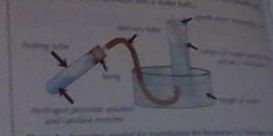
- ASodium chloride
- Bhydrogen peroxide
- CSodium hydroxide
- Diodine
38Set up boiling tubes of chemical - same vol + conc. - to keep pH constant add equal amounts of buffer - put tubes in different temp water baths along with correspondent catalase tubes - wait 5 mins - use pipette to add same amount of catalyse to chemical each time - quickly attach bung to delivery tube - recird 60seconds of how much gas is produced - repeat each temp 3 times. This is the correct procedure?
- ARichtig
- BFalsch
39Another experiment : how quickly the substrate is broken down
The enzyme amylase catalyses the breakdown of starch into maltose. You test for the presence of starch using ?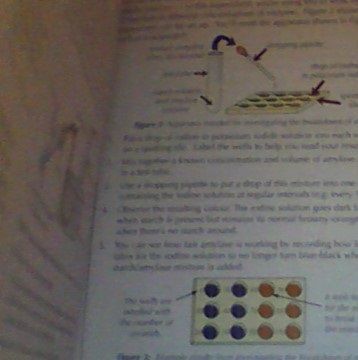
- AEthanol
- BIodine in K.I
- Camylase
- Dbenedict's reagent
40put a drop of iodine in K.I into each well on the spotting tile - mix together a known vol. and conc. of amylase and starch in a test tube - place in different temp water baths - use pipette to add drop of solution into one well at regular intervals (e.g. 10 s) -
blue - starch present / orange - no starch - positive result
see how long it takes for amylase to work - repeat each temp 3 times- ARichtig
- BFalsch
Informationen
- Beschreibung
- A Levels AS Bio Quiz am Enzymes, erstellt von Julia Romanów am 20/12/2015.
- Autor
- Julia Romanów
- Sprache
- English
- Aufrufe
- 6
- Schlagwörter
- Bewertung
- Noch keine Bewertungen Bewerte dieses Quiz