
Karteikarten
L3 Principles of drug action 1
Karten in diesem Stapel (11)
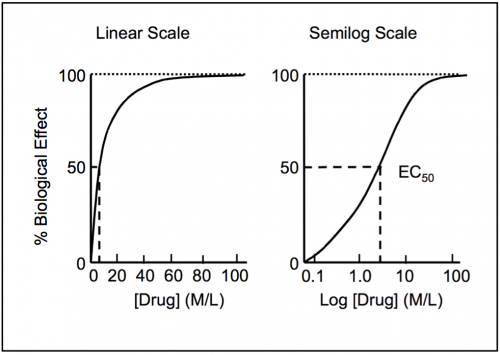
- 1Conc vs response graphsConc vs response: rectangula hyperbola
Log conc vs response: symmetrical sigmoid - 2Distinguish between in vitro, in vivo and ex vivo measurements: In VitroIn vitro- most common. Effects on a drug are studied on a tissue kept alive outside of the body.
- 3In vivo- Tightly regulated by the Home Office
- Effects of a drug are studies on living animals/humans
- Responses measured include blood pressure, reduction in pain threshold.
- Molar concs can't be used because volume of solvent (blood) cannot be known
- Instead conc is expressed by weight of drug per weight of animal eg 1mg/kg. This allows extrapolation of dose from human to animal - 4Ex vivo- Tissue/organ is removed from an animal that had been treated by the drug
- Can be used to see the long-term effects of treatment - 5Constructing a concentration-response curve: Guinea pig ileum practical- Ileum in an organ bath attached to a force transducer, which measures the effects of the drug on the ileum (contraction of the longitudinal muscle)
- The organ bath contains a physiological salt solution to keep ileum alive. It is kept at 37c by an organ jacket.
1. Drug gradually added, cumulative conc is used, or washed off between administrations. Force increases until it reaches max. - 6The maximal 'effect': EmaxThe maximum effect (response) a drug can produce- ie: at the 'top' of the conc-response curve.
- After this has been reached, increasing the concentration of drug has no further effect - 7The EC50The molar conc of a drug that produces 50% of the maximum response for the drug
- 8Potency- The conc at which a drug is effective: often quantified using EC50
- The lower the EC50, the more potent the drug
- Potency ratio- compares EC50s to find the relative potencies of 2 drugs
- Calculating potency ratio 'M':
M= EC50 (test)/EC50(standard)
or
logM= LogEC50 (test) - LogEC50 (standard) - 9Bioassay- Used to measure the potency of a drug by measuring the biological response it produced
- Ranges from cells in culture to clinical trials in humans
- Underpins the development of drugs in the pharmaceutical industry - 102+2 bioassay- Simplest bioassay for determining the relative potency of 2 drugs
- It makes use of the fact that if 2 drugs are acting by the same mechanism, their conc-response lines should be parallel - 11Therapeutic index- The ratio between the toxic dose of the drug and the dose that produces the desired therapeutic effect
- The higher ther therapeutic index, the less chance the drug will produce toxic side effects in therapeutic use.
- Difficult to quantify
- Sometimes defined as LD50/ED50
LD50= lethal dose in 50% of the population
ED50= effective dose in 50% of the population
- No longer used for a number of reasons:
Variation so great between toxic/beneficial effects of drugs
Unethical to test lethal dose on animals
ED50 may vary depending on what is being treated
Informationen
- Beschreibung
- Lecture 3: principles of drug action 1
- Erstellt von
- Rose P
- Aufrufe
- 26
- Tags
- Bewertung