
Notes
PFP Mathematics
Content of the notes (2)
Page 1
PFP Mathematics 2
1. TRIGONOMETRY
1.1 Angles, Arcs and Sectors
Angles
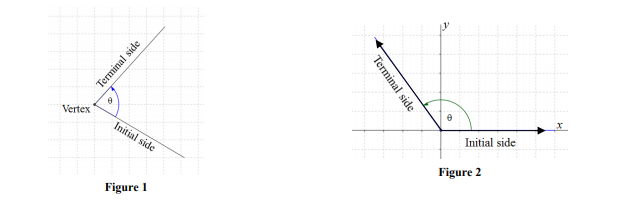
An angle is determined by rotating a ray (half-line) about its endpoint. The initial side of an angle is the starting position of the ray. The terminal side of an angle is the position of the ray after rotation. The vertex of an angle is the endpoint of the ray (see Figure1) An angle is in standard position when the origin is the vertex and the initial side coincides with the x -axis (Figure2)
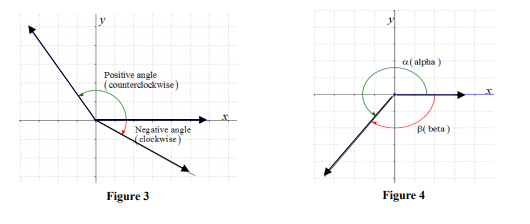
A positive angle is generated by a counter-clockwise rotation; whereas a negative angle is generated by a clockwise rotation (Figure 3) Angles that have the same initial and terminal sides (Figure 4) are referred to as co-terminal.
Units for Angle Measurements
Angles can be measured in units called the degree or the radian.
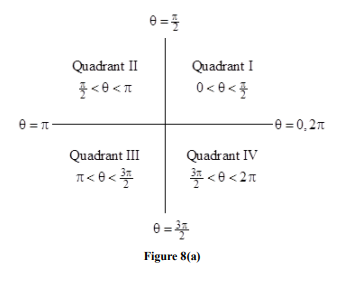
Angles with measures between 0 and π/2 radians are acute angles
Angles with measures between π/2 and π radians are obtuse angles
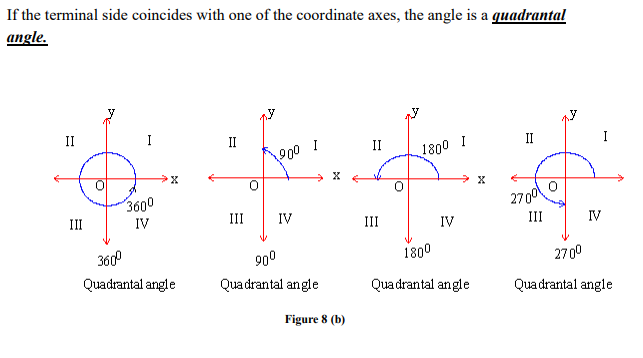
Angles with measures between π and 2π radians are reflex angles [Figure 8(a)]
Page 2
Information
- Description
- Note on PFP Mathematics , created by Nigel Ong on 04/11/2018.
- Created by
- Nigel Ong
- Views
- 1
- Rating
More on Radians and Circular Measure