
Notes
Waves
Content of the notes (1)
Page 1
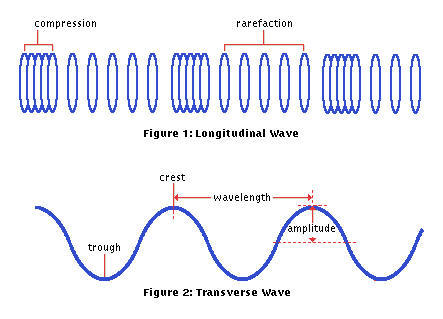
Transverse Wave: A wave where the medium oscillated perpendicular to the direction - or propagation - of the wave.
Longitudinal Wave: A wave which vibrates parallel to the direction of propagation.
Mechanical Wave: Requires the vibration of a matter to move.
Electromagnetic Wave: Requires the oscillation of electric and magnetic fields. (see electromagnetic waves notes)
Above we can see a diagram of a transverse wave (fig 2):
Wavelength / Period (m) : Distance between peaks, distance from the start to the end of a single oscillation. Given the symbol lambda.
Time Period (s): Time taken for one wavelength to pass a point.
Frequency (Hz): Wavelengths passing a point per second.
Amplitude (m): Maximum displacement from the point of zero disturbance.
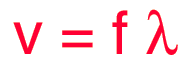
Wave speed = Frequency x Wavelength
Information
- Description
- GCSE Physics Note on Waves, created by Jack Harrison on 04/10/2016.
- Created by
- Jack Harrison
- Views
- 0
- Rating