
Quiz
The Paris Peace Conference and the Terms of the Treaty of Versailles Quiz
This quiz has question types that open in the usual player.
Questions in this quiz (17)
1The war against [blank_start]Germany[blank_end] ended with the armistice on [blank_start]11[blank_end] Nov [blank_start]1918[blank_end]. The [blank_start]Entente Cordiale[blank_end] powers had defeated Germany, but at a price. In the West the war had been fought mostly in [blank_start]France and Belgium[blank_end] and much of their land had been devastated: Military losses for Britain and the empire totalled around 1 million, for France they were around 1.4 million and for the USA just over 100,000. Added to this were the wounded, which came to around 20 million, and civilian losses which totalled over 6 million if the [blank_start]influenza epidemic[blank_end] of 1818-19 is included.
- AGermany
- B11
- C1918
- DEntente Cordiale
- EFrance and Belgium
- Finfluenza epidemic
2The 'Big Three' of the Paris Peace Conference were....
- ARoosevelt, Stalin, Churchill
- BLloyd George, Truman, Clemenceau
- CLloyd George, Wilson, Clemenceau
3Clemenceau was 79 in 1919. He had seen [blank_start]Germany[blank_end] invade France twice in his lifetime, in [blank_start]1870[blank_end] and in [blank_start]1914[blank_end], and was under great pressure from the French public who wanted [blank_start]revenge[blank_end] on Germany. Most of the war had been fought on French soil and the industry and [blank_start]agriculture[blank_end] of north-western France had been virtually ruined. The desire of the French people for revenge and [blank_start]compensation[blank_end] was understandable but unlikely to lead to a [blank_start]fair[blank_end] peace agreement.
- AGermany
- B1870
- C1914
- Drevenge
- Eagriculture
- Fcompensation
- Gfair
4Clemenceau’s main aim was to gain security for France by preventing another attack on its frontiers.
- ATrue
- BFalse
5What slogans did Lloyd George's party use in their successful general election campaign at the end of 1918?
- A'Hang the Kaiser'
- B'Make Germany Pay'
- C'Peace, Bread, Land'
- D'Down with the German woman'
6Did Lloyd George share these views?
- AYes
- BNo
7Woodrow Wilson published his Fourteen-point plan in January 1918. Which of these were part of this plan?
- AThe end of secret treaties
- BReduction in armies and weapons
- CRussian troops to leave Germany
- DAn independent Poland to be set up with a port
- EThe formation of an association of nations to guarantee peace
- FAlsace and Lorraine to be set up and independant states
8Wilson was an [blank_start]idealist[blank_end] who believed that lasting peace was not possible without the introduction of new [blank_start]standards[blank_end] into public life. He believed that countries should be open and truthful with each other and that the boundaries of Europe should be recognised according to the principle of [blank_start]self-determination[blank_end]. The USA had only been in the war since [blank_start]1917[blank_end] and Wilson did not [blank_start]appreciate[blank_end] the strong feelings against Germany that existed in France and Britain, so he simplified the problems. Moreover, it soon became obvious that his party was [blank_start]losing[blank_end] support in the USA and there was a growing feeling in America that the USA should have nothing to do with [blank_start]Europe[blank_end]. There was no [blank_start]certainty[blank_end] that the USA would sign the treaty. As the conference went on, Wilson began to give in more to the views of [blank_start]Clemenceau[blank_end], putting all his faith in the success of the [blank_start]League of Nations[blank_end]
- Aidealist
- Bstandards
- Cself-determination
- D1917
- Eappreciate
- Flosing
- GEurope
- Hcertainty
- IClemenceau
- JLeague of Nations
9When was Germany forced to sign the Treaty at the Palace of Versailles?
- A7 March 1936
- B11 November 1918
- C28 June 1919
10Label the below image with the names of the areas lost by Germany.
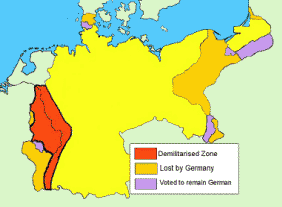
- ARhineland, demilitarized.
- BAlsace-Lorraine, returned to France
- CSaarland, under control of LoN for 15 yr
- DEupen and Malmedy to Belgium
- EPolish Corridor formed.
- FDanzig made a free city, used by Poland
11Anschluss, the union of Germany and Austria, was permitted according to the Treaty of Versailles.
- ATrue
- BFalse
12The Army was limited to [blank_start]100,000[blank_end] men. [blank_start]Conscription[blank_end] was not allowed and tanks and military aircraft were [blank_start]forbidden[blank_end]. The Navy was limited to [blank_start]15,000[blank_end] men, [blank_start]6[blank_end] battleships and [blank_start]no[blank_end] submarines. The [blank_start]Rhineland[blank_end] was declared to be a demilitarized zone. This meant that although it still belonged to Germany, no German [blank_start]troops[blank_end] or weapons were to be allowed within [blank_start]50[blank_end]km of the river [blank_start]Rhine[blank_end]. Allied troops were to occupy parts of this area for [blank_start]15[blank_end] years, although they had all left by 1930.
- A100,000
- BConscription
- Cforbidden
- D15,000
- E6
- Fno
- GRhineland
- H50
- IRhine
- J15
- Ktroops
13Why was Germany forced to admit that it was guilty of causing the war?
- ABecause it really was responsible.
- BTo give the allies a legal reason for demanding reparations from Germany.
- CAs moral condemnation of the actions of the country
14Reparations were compensation to be paid by the defeated powers to the victorious powers for the cost of the war.
- ATrue
- BFalse
15The war had been [blank_start]costly[blank_end] for everyone: all the countries involved had lost large numbers of [blank_start]men[blank_end] and spent a vast amount of money on [blank_start]munitions[blank_end], transport and supplies for the fighting men. In the case of France and [blank_start]Belgium[blank_end], in addition to their losses of men and weapons, much of their land and industry had been [blank_start]destroyed[blank_end] by the war. The problem of [blank_start]reparations[blank_end] was so complex that it was too difficult to solve in [blank_start]1919[blank_end]. Feelings of hatred and revenge in the victorious countries against the defeated ones were too great. A Reparations [blank_start]Commission[blank_end] was set up, which reported in 1921; reparations were set at £[blank_start]6,600[blank_end] million. Germany was originally given [blank_start]42[blank_end] years to pay, but the amount was reduced in [blank_start]1929[blank_end] and it stopped paying in the 1930s.
- Acostly
- Bmen
- Cmunitions
- DBelgium
- Edestroyed
- Freparations
- G1919
- H6,600
- I42
- J1929
- KCommission
16Which of these were German objections to the Treaty of Versailles?
- ADiktat
- BLoss of Land
- CMilitary Restrictions
- DWar Guilt
- EReparations
- FRejection from the League of Nations
- GDissolved Government
17The Treaty of Versailles brought [blank_start]peace[blank_end] to Europe and set up an international organisation, the League of [blank_start]Nations[blank_end], to preserve the peace. However, it left Germany with many [blank_start]grievances[blank_end], some of which seemed justified because some of the terms of the Treaty contradicted the [blank_start]Fourteen[blank_end] Points.
If Germany ever recovered from the war, it would be determined to get rid of what it saw as the [blank_start]unfair[blank_end] parts of the treaty, this could lead to future [blank_start]problems[blank_end]. Wilson had put too much [blank_start]faith[blank_end] in the power of the League of Nations to solve these problems. When the US government [blank_start]refused[blank_end] to sign the treaty and did not join the League, the whole [blank_start]settlement[blank_end] became less secure.- Apeace
- Bgrievances
- CNations
- DFourteen
- Eproblems
- Ffaith
- Grefused
- Hsettlement
- Iunfair
Information
- Description
- GCSE History (Peacemaking 1918-19 and the League of Nations) Quiz on The Paris Peace Conference and the Terms of the Treaty of Versailles Quiz, created by Leah Firmstone on 18/10/2015.
- Author
- Leah Firmstone
- Language
- English
- Views
- 233
- Tags
- Rating
- 2.7 out of 5 · 3 ratings Rate this quiz