
Quiz
Beginner's Guitar Quiz- theory
This quiz has question types that open in the usual player.
Questions in this quiz (9)
1Label the parts of the guitar.
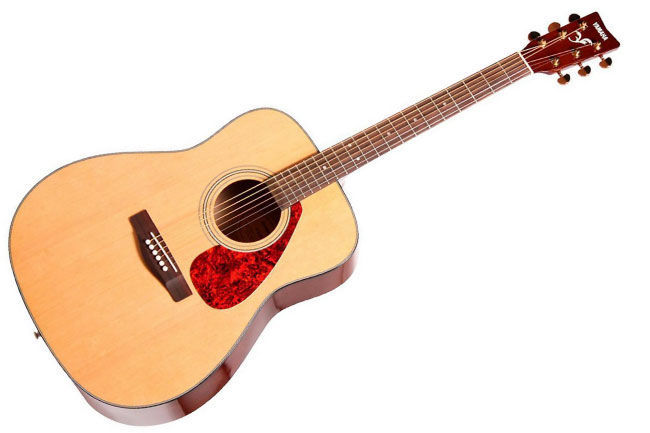
- Afretboard
- Bsound hole
- Cbody
- Dbridge
- Eheadstock
- Fnut
- Gtuning pegs
2The notes in the musical alphabet are: [blank_start]A[blank_end], [blank_start]A#[blank_end], [blank_start]B[blank_end], [blank_start]C[blank_end], [blank_start]C#[blank_end], [blank_start]D[blank_end], [blank_start]D#[blank_end], [blank_start]E[blank_end], [blank_start]F[blank_end], [blank_start]F#[blank_end], [blank_start]G[blank_end], [blank_start]G#[blank_end]. Sharps and flats are also called [blank_start]accidentals[blank_end]. They raise or lower a note. Sharps [blank_start]raise[blank_end] the note and flats [blank_start]lower[blank_end] the note.
- AA
- BA#
- CB
- DC
- EC#
- FD
- GD#
- HE
- IF
- JF#
- KG
- LG#
- Maccidentals
- Nraise
- Olower
3What is the root, or tonic?
- AThe first note around which a chord or scale is built- the basis.
- BThe first note you play in a song.
- CThe first chord you play in a song.
4What does 4/4 mean?
- A4 quarter notes per measure.
- B4 notes per measure.
5What does 3/4 mean?
- A3 quarter notes per measure.
- B3 out of 4 notes are the same note.
6How do you read a time signature?
- AThe first number is how many beats, the second number is the type of note.
- BThe first number is the type of note, the second number is how many beats.
7Types of Musical Intervals:
[blank_start]Major[blank_end]: only ever used to describe 2nds, 3rds, 6ths and 7ths.
[blank_start]Minor[blank_end]: a major interval minus one step- achieved by raising the bottom note or lowering the top note.
[blank_start]Augmented[blank_end]: when a major or perfect interval is made one step larger, but the interval number doesn't change.
[blank_start]Diminished[blank_end]: when a minor or perfect interval is made one step smaller, but the interval number doesn't change.
[blank_start]Perfect[blank_end]: an '8th', a full octave's difference.
[blank_start]Unison[blank_end]: The same note played again!- AMinor
- BMajor
- CAugmented
- DDiminished
- EPerfect
- FUnison
8What is the symbol on the left and what does it mean?
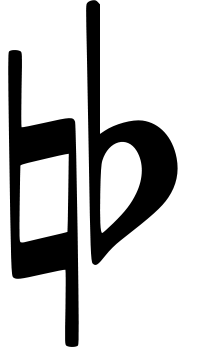
- AAn accidental; Play the note flat.
- BA flat; play the note flat.
- CAn accidental; play the natural note instead of a sharp or flat.
- DA flat; play the natural note instead of a sharp or flat.
9A [blank_start]major[blank_end] chord is made up of the root and the [blank_start]major[blank_end] third and perfect [blank_start]fifth[blank_end] above this root. These chords are often said to sound 'happy'.
A minor chord is comprised of a root, [blank_start]minor[blank_end] third and [blank_start]perfect[blank_end] fifth. When a chord has these three notes alone, it’s called a minor [blank_start]triad[blank_end]. These are said to sound sad.
A [blank_start]dominant[blank_end] or [blank_start]dominant[blank_end] [blank_start]seventh[blank_end] chord is composed of a root, [blank_start]major[blank_end] third, perfect fifth and [blank_start]minor[blank_end] [blank_start]seventh[blank_end]. It can also be viewed as a [blank_start]major triad[blank_end] with an additional minor seventh. These tend to sound bluesy.
[blank_start]Augmented[blank_end] chord: a chord consisting of two major [blank_start]thirds[blank_end] (also called an [blank_start]augmented[blank_end] [blank_start]fifth[blank_end]).
[blank_start]Diminished[blank_end] chord- three [blank_start]minor[blank_end] thirds above the root. Unstable sound quality.
[blank_start]Suspended[blank_end] chord: The major or minor [blank_start]third[blank_end] is omitted, replaced by a perfect fourth or major second.- Amajor
- Bfifth
- Cmajor
- Dminor
- Eperfect
- Ftriad
- Gdominant
- Hdominant
- Iseventh
- Jmajor
- Kminor
- Lseventh
- Mmajor triad
- NAugmented
- ODiminished
- PSuspended
- Qthird
- Rminor
- Sthirds
- Taugmented
- Ufifth
Information
- Description
- Based on Jim Bowley's checklist for beginner guitarists.
- Author
- Sarah A
- Language
- English
- Views
- 685
- Tags
- Rating
- 5.0 out of 5 · 1 rating Rate this quiz