
Flashcards
D&L - TB8 - Tutorial
Cards in this deck (13)
- 1Infantile Amnesia.The inability of adults to retrieve episodic memories before the age of 2-4 years old, as well as the period before age 10 of which adults retain fewer memories than might otherwise be expected given the passage of time.
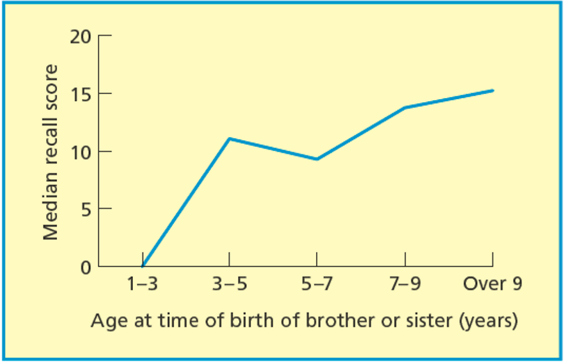
- 2Sheingold and Tenney (1982). Asked college students to recall the birth of their sibling.- They remembered virtually nothing if the event had occurred before they were 3 years old.
- An example of infantile amnesia. - 3Sheingold and Tenney (1982). Why do you think the researchers chose to investigate the birth of a sibling?1. Highly memorable event - Less likely to underestimate early memory.
2. Better control over study design - Probe for specific details (e.g. who looked after you?)
3. Means of verifying memory - Compare with details provided by parents. - 4Reasons for Infantile Amnesia: Memory format change hypothesis.Format of memories may change with increasing age, making early memories inaccessible.
- 5Reasons for Infantile Amnesia: Neural Change Hypothesis.Immature brain areas are unable to store memories.
- 6Reasons for Infantile Amnesia: Cueing Hypothesis.Early memories may be accessed only with special cues.
- 7Reasons for Infantile Amnesia: General.- Brain is undergoing lots of development and so all these changes may be the reason why the child doesn't remember.
- Children are learning so much and absorbing so much information on how to do things they may forget other memories.
- Memory format change hypothesis. - 8Age-related changes in verbal and nonverbal memory during early childhood.Simcock and Hayne (2003).
- 9Simcock and Hayne (2003). Study Rationale:- Wanted to create a task that was age-appropriate across the crucial developmental period they wanted to study (2-4-year-olds), tie up different studies that had used different tasks, assessed different aspects. Comprehensive approach. Look at age of verbal recall, relations with non-verbal measures, connections with language ability.
- Age-appropriate task.
- Look at age of verbal recall, relations with non-verbal measures and connections with language ability.
- Also, using different measures of studying memory.
- Why was previous research not addressing this? – finding a task that both 2 and 5-year-olds could complete. - 10Simcock and Hayne (2003). Methods:• ‘Magic shrinking thing’ – shown to child multiple times.
• Assess memory after 24hr gap.
• Medal given as a cue – let child explain in their own words – assess verbal memory.
• Controlled for language ability at time of the event.
• Predominantly European decent and came from a wide range of socioeconomic backgrounds.
• Controls:
o Asked the parents to recall.
o What would be the level you expect from a really good memory – maximum you can expect the child to do.
o See what children would do with no experience of the ‘magic shrinking box’ – can check if the task was getting at memory and not just what the child would normally do.
o Check it is to do non-verbal memories *** check controls - 11Simcock and Hayne (2003). Results:• Recall improves with age, but all groups recalled something (= some memory), nonverbal recall superior. Verbal ability correlated with both verbal memory interview and other aspects of test, maintained when controlling for age (language a constraint).
• Recall ability improved with age.
• All tests got better with age.
• Non-verbal was better than verbal memory.
• Better language predicated better performance on all the tasks. - 12Simcock and Hayne (2003). Implications/Findings:• Idea children represent their memories non-verbally first
• Start to be more verbal recall in line with losing infantile amnesia
• Could have done an immediate test of memory – see what they are taking in/remembering to begin with
• 24hrs may be a while for younger children in the study
• 4 year old have better language skills than the 2 year old – keep how they carry out the experiment the same across all the age groups, don’t provide more help to younger children - 13Simcock and Hayne (2003). Discussion/Conclusions:• Age-related differences in how memories are represented – early memories are encoded non-verbally, mismatch with testing; dependent on language skills (not aging).
• Still seems to be conscious/declarative aspect of memory, as complex sequence of actions.