
Flashcards
Lab Midterm Practical
Cards in this deck (53)
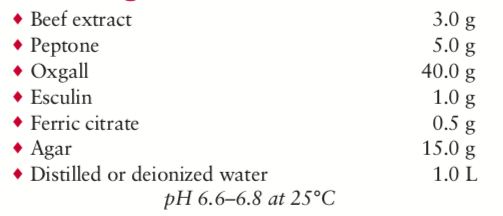
- 1—Bile Esculin Agar
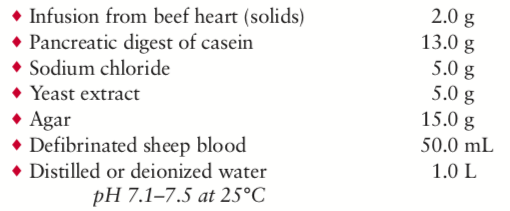
- 2—Blood Agar
- 3—Citrate Agar
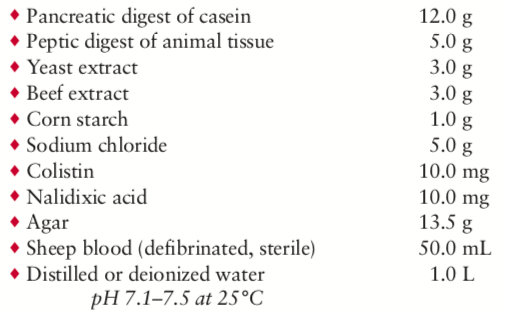
- 4—Columbia CNA w/ 5% sheep blood agar
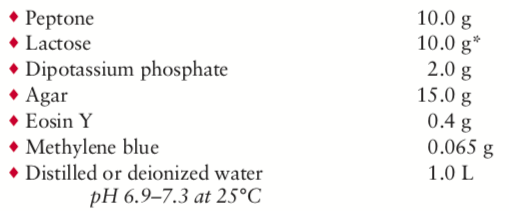
- 5—Eosin Methylene Blue Agar
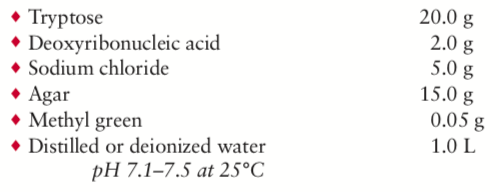
- 6—DNase
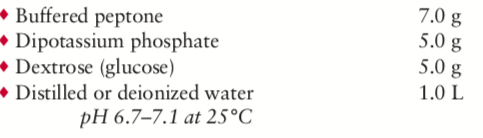
- 7—Methyl Red and Voges-Proskauer
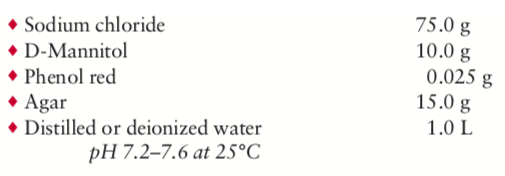
- 8—Mannitol Salts Agar
- 9—MacConkey Agar
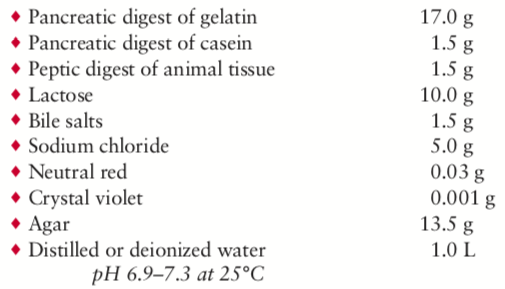
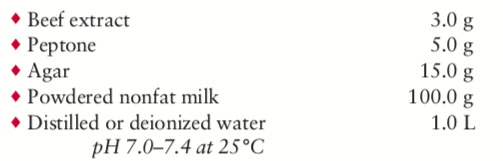
- 10—Casein hydrolysis
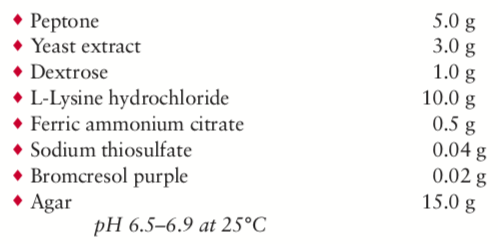
- 11—Lysine Iron Agar
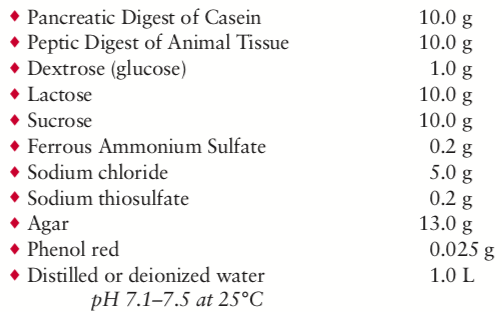
- 12—Triple Sugar Iron Agar
- 13—SIM (Sulfur Indole Motility)
- 14—Urea Hydrolysis
- 15—Starch Hydrolysis
- 16—Xylose Lysine Desoxycholate
- 17Columbia CNA w/ 5% sheep bloodSelective for gram positives
presence of blood allows for differentiation based on hemolysis of RBCs - 18CNA: 1. P/NG 2. G/beta hemolysis 3. G/alpha hemolysis 4. G/gamma hemolysis1. probable gram negative
2. probable beta-hemolytic staph, strep, or enterococcus
3. probable alpha-hemolytic staph, strep, or enterococcus
4. probable gamma-hemolytic staph, strep, or enterococcus - 19Bile Esculin TestSelects for intestinal organisms
differential: presence of esculinase enzyme - 20BEA: 1. medium darkened 2. no darkening1. presumptive ID of intestinal organism. Esculin+acid=esculetin which reacts with iron to create dark brown colour
2. presumptive determination as not an intestinal organism - 21Mannitol Salt AgarSelective for staphylococci
differential: phenol red indicator - 22MSA: 1. P/NG 2. G/Y 3. G/R1. not staphylococcus (inhibited by NaCl)
2. possible s. aureus (mannitol fermentation)
3. staph other than s. aureus (no fermentation) - 23MacConkeySelective for gram negative
differential: neutral red dye - 24MAC: 1. P/NG 2. G/R or P 3. G/C1. gram positive
2. probable coliform (lactose fermenter)
3. noncoliform (no fermentation) - 25Eosin Methylene BlueSelective for gram negative
differential: dyes + lactose fermenters - 26EMB: 1. P or NG 2. G/Pi 3. G/D 4. G/C1. gram positive
2. possible coliform (ferments lactose w/ little acid production)
3. probable coliform (ferments lactose and/or sucrose w/ acid production)
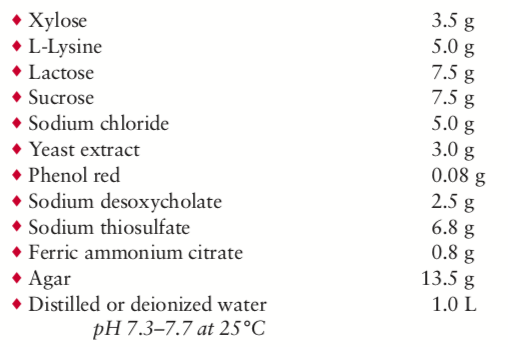
4. noncoliform (no fermentation) - 27Xylose Lysine Desoxycholateselective for gram negative
differential: H2S production; phenol red pH indicator - 28XLD: 1. P or NG 2. G/Y 3. G/RB 4. G/R1. Gram positive
2. xylose fermentation
3. reduces sulfur; no xylose fermentation or xylose fermentation with lysine decarboxylation
4. no xylose fermentation or xylose fermentation with lysine decarboxylation; no sulfur reduction; - 29—Oxidation-Fermentation Test
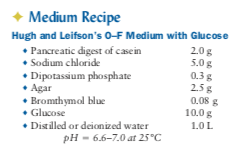
- 30Oxidation-Fermentationused to differentiate bacteria based on their ability to oxidize or ferment specific sugars. (oil creates anaerobic environment)
- 31OF test: 1.Sealed: G/B; unsealed: any Y 2. Sealed: Y; unsealed: Y 3. sealed: Y at top; unsealed: Y at top 4. sealed: G/B; unsealed: G/B1. Oxidation
2. Oxidation and fermentation or fermentation only
3. Oxidation and slow fermentation or slow fermentation only
4. no sugar metabolism; nonsaccharolytic organism - 32Methyl-Red and Voges-Proskauer Testsused to distinguish between members of the family Enterobacteriaceae and to differentiate between other gram negative rods
- 33Methyl Red Results: 1. media turns red immediately 2. no colour change1. Mixed acid fermentation occurs
2. no mixed acid fermentation - 34Voges-Prokskaeur results: 1. Red colour 2. No colour change1. 2,3-butanediol fermentation (acetoin produced)
2. no 2,3-butanediol fermentation - 35Oxidase test: 1. blue colour w/in 20s 2. no colour change w/in 20s1. presence of cytochrome c oxidase
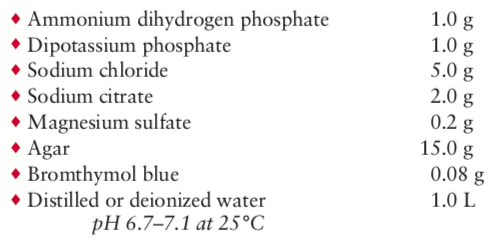
2. no cytochrome c oxidase - 36citrate testused to determine the ability of an organism to use citrate as its sole source of carbon. Distinguishes between Enterobacteriaceae and differentiate from other gram negative rods
- 37Citrate test: 1. any blue colour 2. no colour change1. citrate is utilized (citrate-permease present)
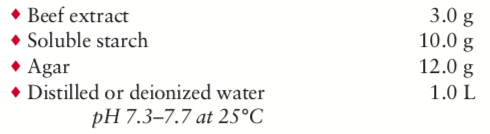
2. no citrate utilized - 38Starch Hydrolysisaids in differentiating members of the genera corynebacterium, clostridium, bacillus, bacteroides, fusobacterium, and enterococcus
- 39Starch hydrolysis: 1. clearing of media after iodine added 2. no clearing of media after iodine added1. organism can produce alpha-amylase and hydrolyze starch
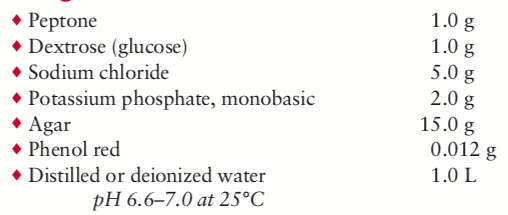
2. organism cannot hydrolyze starch (no alpha-amylase) - 40Urea Hydrolysisused to differentiate organisms based on their ability to hydrolyze urea via urease. Helps identify Proteus genera
- 41Urea hydrolysis: 1. all pink (24h and 24+h) 2. partially pink (24h); all pink or partially pink (24+h) 3. orange or yellow (24h); all or partially pink (24+h) 4. orange or yellow (24h and 24+ h)1. rapid urea hydrolysis
2. slow/weak urea hydrolysis
3. slow/weak urea hydrolysis
4. no urea hydrolysis - 42Casein Hydrolysis 1. Clearing 2. No clearingDifferential: Presence or absence of Casease
1. Casease present
2. Casease absent - 43DNA Hydrolysis 1. Clearing 2. No clearingDifferential: Presence or absence of DNase. Differentiate Serratia from Enterobacter, S. aureus from other Staphylococcus species
1. DNase present
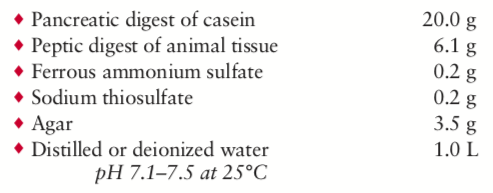
2. DNase absent - 44SIM MediumCombo differential
Sulfur, Indole, Motility
Cysteine desulfurase and thiosulfate reductase (H2S byproduct)..differentiate members of enterobacteriaceae
Indole from tryptophanase (check with Kovac's reagent) - 45TSI AgarTriple Sugar Iron
Differentiate members of Enterobacteriaceae and distinguish them from other gram negative rods
H2S production and gas production also tested - 46TSI Agar: 1. A/A 2. K/A 3. K/K 4. K/NC 5. NC/NC1. Glucose and lactose and/or sucrose fermentation with acid accumulation in slant and butt
2. Glucose fermentation with acidic by products; aerobic peptide catabolization with alkaline products in slant (reversion)
3. No fermentation of sugars; aerobic and anaerobic peptide catabolism producing alkaline byproducts
4. no fermentation; peptide catabolism only aerobically with alkaline products
5. organism not growing or growing slowly - 47LIA agarLysine Iron Agar
differentiate enteric based their ability to decarboxylate or dominate lysine and product H2S. - 48LIA: 1. K/K 2. K/A 3. R/A1. lysine carboxylase positive (alkaline products)
2. glucose fermentation; no carboxylation or deamination; aerobic peptone degradation resulting in alkaline products in slant
3. deaminase positive; glucose fermentation. deamination (only aerobic) reacts with ferric ammonium citrate to product red colour - 49MPN testmost probable number of fecal coliforms in a water sample by lactose fermentation of organisms in a sample
also called "multiple tube fermentation method" - 50LTB tubesLaurel Tryptose Broth
selective for: coliform groups (but does not screen out non-coliforms); simply used to test for presence or absence of coliforms
part of MPN/multiple fermentation tube test - 51BGLB tubesBrilliant Green Lactose Bile
Selects against: non-coliforms; confirms presence of coliforms
part of MPN/multiple fermentation tube test - 52EC tubesselective for: E. coli (when incubated at 45.5ºC)
part of MPN/multiple fermentation tube test - 53MPN/100 mL=100P/[sqrt(VaVn)]
P=total # of + results (BGLB or EC)
Va=combined volume of sample in all LTB tubes
Vn=combined volume of sample in LTB tubes that produced - results in BGLC or EC
Information
- Description
- Flashcards on Lab Midterm Practical, created by Diamond Sapphire on 28/02/2019.
- Created by
- Diamond Sapphire
- Views
- 0
- Rating