
Flashcards
CE202
Cards in this deck (34)
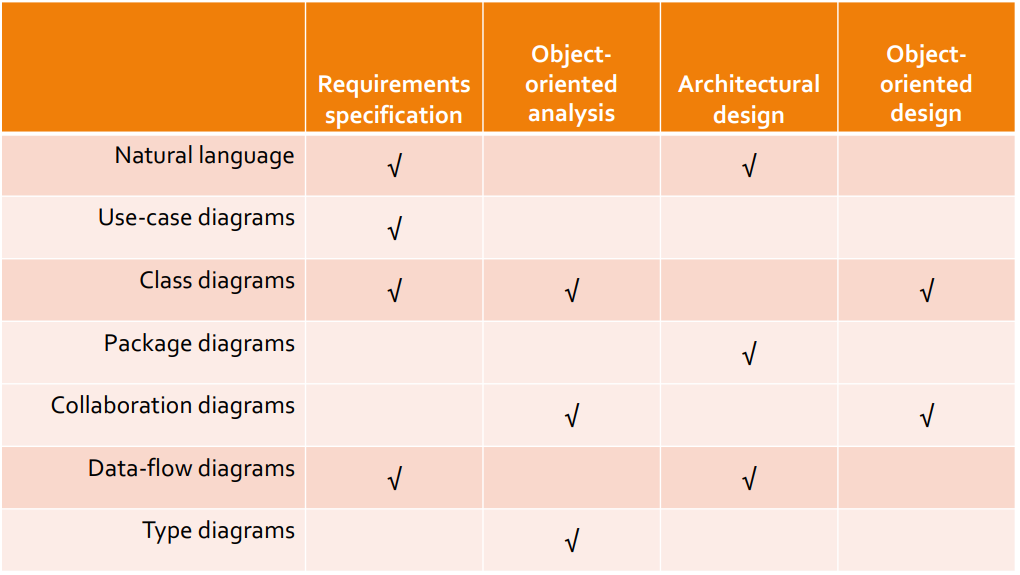
- 1Types of Diagram and where they're used
- 2Static ModelsDescribe Structural Aspects
• Class Diagrams
• Package Diagrams
•Type Diagrams - 3Dynamic ModelsDescribe behavioural Aspects
• Use Case Diagrams
• Sequence Diagrams
• Collaboration Diagrams
• Activity diagrams - 4UML Use-case diagrams• Specify only user views of essential system behaviour
• Do not specify the flow of processes in the implementation
• Box is the system boundary
• Users are actors
• Ovals inside are use cases
• Lines to connect actors and use cases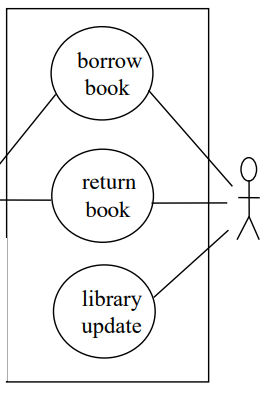
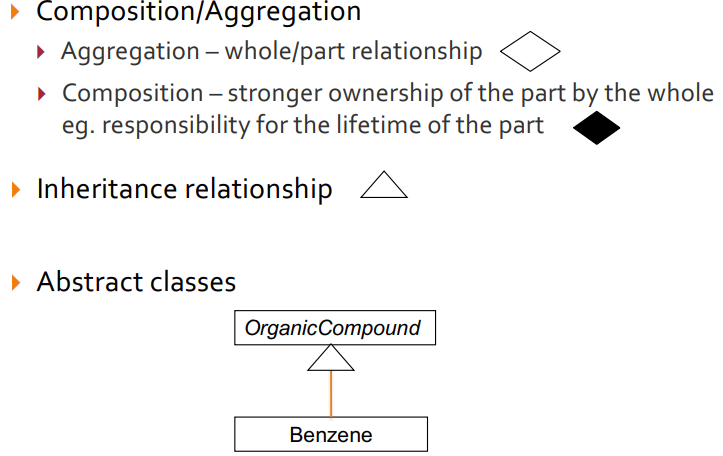
- 5UML Class Diagram Notation
- 6UML Package Diagram• Views system as small collection of packages
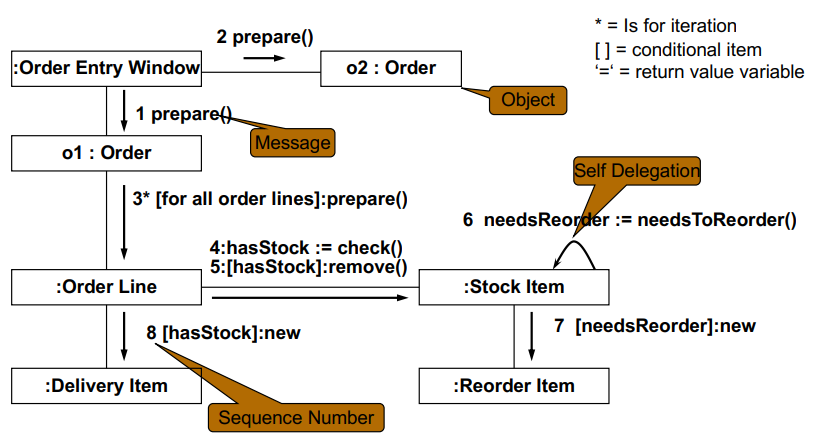
• Each can be expanded to larger set of classes - 7UML Collaboration Diagram
- 8UML Pros• Industry standard
• A standard of communication - 9UML Cons• No well-defined semantics
• Low level of abstraction
• Little integration between sub-notations - 10Waterfall• Requirements
• Analysis
• Design
• Implementation
• Testing
• Deployment - 11Things in Analysis Phase• Use Case
• Type diagrams
• Prototypes
• Class diagrams
• Interaction Diagrams - 12Things in Design Phase• Prototypes
• Class diagrams
• Interation diagrams
• Package Diagrams - 13Things in Implementation• Coding
• Unit Testing
• Version Control - 14Testing in Implementation• Integration testing
• Unit testing - 15Activity Diagram Notation 1
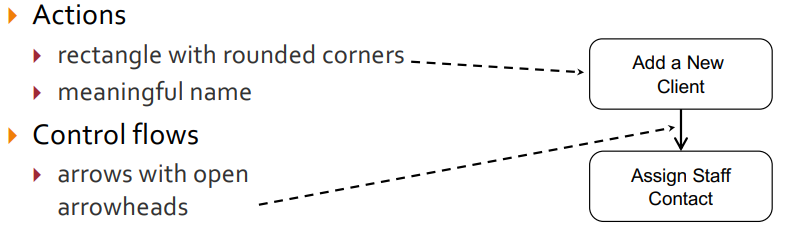
- 16Activity Diagram Notation 2
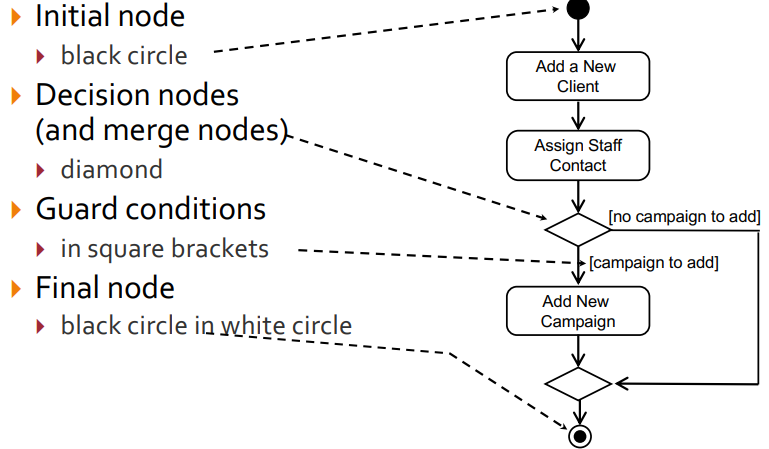
- 17Aggregation• Something is a part of something else
• Empty diamond - 18Composition• Something is completely a part of something else
• If the larger thing is deleted so is the thing
• Filled diamond - 19Logical Design• Independent of the implementation
- 20Physical Design• Based on implementation and language to be used
- 21Qualities of Design• Secure
• Flexible
• General
• Buildable
• Manageable
• Maintainable
• Usable
• Reusable - 22Static Validation• Carried out without executing the program
- 23Dynamic Validation• Carried out by executing the program
- 24validatino Testing• Ensure the system meets client expectation
- 25Defect Testing• Detect defects
- 26White Box• Testing form inside the system
• Concerned with internal structures - 27Black Box• Testing from outside the system
• Concerned with input/outputs - 28Alpha Testing• Verification
• Inputs and outputs - 29Beta Testing• Validation
• User environment - 30performance Testing• Test the system performance
- 31Functinoal Testing• Conducted against functional specification
• Test function - 32Top-down testing• Start with high-level system
• Go to individual components - 33Bottom-up testing• Integrate individual components in levels until the complete system is created
- 34Concrete Class• Implements an abstract class or interface
Information
- Description
- Flashcards on CE202, created by B O U Y B O Y on 12/05/2019.
- Created by
- B O U Y B O Y
- Views
- 3
- Rating