
Flashcards
Atomic structure
Cards in this deck (48)
- 1What are the positions of protons, neutrons and electrons in the atom?Protons and neutrons found in nucleus.
Electrons on electron orbit. - 2What is the relative mass and charge of proton, neutron and electron?Proton - 1 relative mass, +1
Neutron - 1 relative mass, 0
Electron - 0.0005 relative mass, -1 - 3What is mass number?Number of protons plus the number of neutrons in an atom
- 4What is an atomic number?Number of protons in the nucleus
- 5What is an isotope?Same element, with different mass number
- 6In the periodic table which number is by the top of the element and which is at the bottom?Top - atomic number
Bottom - mass number - 7How can you tell the number of protons or electrons?no. of protons = no. of electrons = atomic number
- 8How can you tell the number of neutrons?no. of neutrons = mass no. - number of protons
- 9What is cation?a positive ion
- 10What is an anion?A negative ion
- 11Compare the properties of the isotopes of an elementIsotopes show same chemical properties as change in no. of neutrons have no effect. Physical properties such as boiling and melting points change. Heavier isotopes move more slowly at a given temp, and therefore these differences can be used to separate isotopes.
- 12What can radioisotopes treat?Cancer
- 13Describe isotopesRadioisotopes have the same chemical properties as any other atom of that element, so they play the same role in the body. They can be monitored by detecting radiation levels making them tracers.
- 14Give an example of a radioisotope tracerIodine -131 emits beta and gamma rays, investigating the thyroid gland
- 15What are the dangers of radioisotopes?Living organisms can be seriously affected if they are exposed to uncontrolled radiation may result in excessive use and their release into the environment
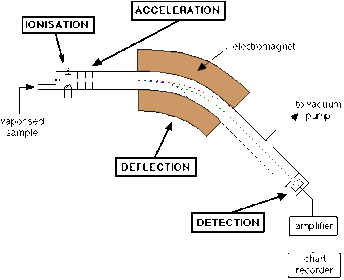
- 16Draw a mass spectrometer
- 17What does a mass spectrometer measure?the mass of different isotopes and their relative abundance
- 18What are the 5 basic operations?Vaporisation
Ionisation
Acceleration
Deflection
Detection - 19What is vaporisation?Vaporised sample is injected into instrument. Allows individual atoms of an element to be analysed
- 20What is ionisation?Atoms are hit with high energy electrons which knocks off an electron creating a positive ion
X+e->X+2e - 21What is Acceleration?Positive ions are attracted to negatively charged plates. They are accelerated by an electron field and pass through a hole in the plate.
- 22What is deflection?Accelerated positive ions are deflected by a magnetic field. Amount of deflection is proportional to charge/mass ratio.
- 23What is the ratio of deflection?Smaller mass = more deflection
Higher charge = more deflection - 24What is detection?Positive ions of a particular charge/mass ratio are detected and a signal is sent to a recorder. Strength of the signal reflects the number of ions with that particular charge/mass ratio detected
- 25How can a mass spectrometer be used to determine the relative atomic mass using the carbon-12 scale?Mass spectrometer measures mass of individual atoms. As it is in the range of x10^-24 and x10^-22 a relative standard is needed. 12C is the chosen standard. It is the most abundant isotope of carbon. The results of mass spectrometers are presented in a mass spectrum
- 26Go over the page of notesone with 2.2.3
- 27Describe the electromagnetic spectrumAll electromagnetic waves travel at the same speeds (c) but can be distinguished by their different wavelengths. Different colours of visible light have different wavelengths.
Red light has a longer wavelength than blue light. When sunlight passes through a prism, it produces a continuous spectrum - 28What is frequency?number of waves that pass through a particular point
c=f*wavelength - 29What is white light?A mixture of light waves of differing wavelengths and colour
- 30Distinguish between continuous spectrum and line spectrumqWhen sunlight passes through a prism, it produces a continuous spectrum.
When white light is passed through hydrogen gas, an absorption spectrum is produced. - 31Explain how the lines in the emission spectrum of hydrogen are related to electron energy levelsHydrogen atoms give out energy when an electron falls from a higher energy level to a lower one. Hydrogen produces visible light when the electron falls to the second energy level (n=2). Transitions to first energy levels correspond to a higher energy change and are in the ultraviolet region of the spectrum. Patterns of the lines give a picture of energy levels in the atom. Lines converge at higher energies because the energy levels inside the atoms are closer together. When an electron is at the highest energy level (n=infinity) it is no longer in the atom, and the atom has ionised. Ionisation energy is the energy needed to remove an electron from the ground state of each atom in a mole of gaseous atoms.
- 32What are the different types of spectra?continuous emission
continuous absorption
line emission
line absorption - 33What is Planck's equation?E=hn
E = energy of the emission
h = Plancks constant (6.02 x 10⁻³⁴)
n = frequency of the radiation
(the frequency is related to the wavelength by c = ln, c is the speed of light and l is the wavelength) - 34How is evidence for electron configuration formed?Energy is given to particles and response is detected. Hypotheses are tested by all means available. Accurate hypothesis becomes theory and eventually 'truth'
- 35What and how is used to determine the structure of an atom?Spectra: An electron absorbs heat or electrical energy and is promoted to a higher level
The electron returns to the original level and emits the difference as a specific electromagnetic radiation.
The wavelength seen is related to the energy of the emission by Plancks equation - 36What is the first ionisation energy?Minimum energy required to remove an electron from a gaseous atom
- 37Explain how evidence from first ionization energies across periods accounts for the existence of main energy levels and sub-levels in atomsAs nuclear charge increase, electrons require more energy to remove (in the same period).
- 38Why does sulphur not fit the pattern?because removing the 3p electron leaves a stable configuration so this requires less energy than predicted OR you can say that the electron pair in the 3p repel , making the energy required to remove it lower than the pattern would suggest.
- 39Explain how successive ionisation energy data is related to the electron configuration of an atomSuccessive ionization energies show the energy levels (rings) in an atom.
Low IE (easy to remove electron) = electrons are far from the pull of the nuclei, neutral atom, lots of shielding (between the electron in question and the nuclei are many electrons "in the way)
High IE (hard to remove electron) = electron close to nucleus, positive ion, no shielding. - 40State the relative energies of s,p,d, f orbitals in an energy levelS is lowest energy level
F is highest
Example:4s is the lowest energy (closest to the nucleus), then 4p, then 4d and finally the 4f orbitals have the highest energy levels (furthest from the nucleus). - 41State the maximum number of orbitals in a given energy leveln = energy level
Number of orbitals = n squared
look at energy level, then number of electrons, divide number of elecrons by two because you can only fit two electrons in an orbital - 42Draw the 1 s orbital
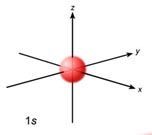
- 43Draw the 2 s orbital
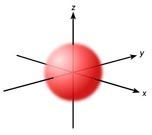
- 44Draw the 3 s orbital
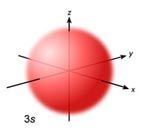
- 45draw the px orbital
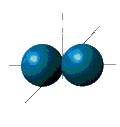
- 46draw the py orbital
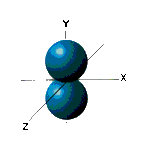
- 47Draw the pz orbital
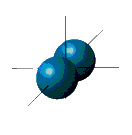
- 48why is a very low pressure is maintained inside the mass spectrometer?To prevent collisions or unintentional deflection
Information
- Description
- Flashcards on Atomic structure, created by milicevic.marija on 21/03/2015.
- Created by
- milicevic.marija
- Views
- 36
- Tags
- Rating